Sunday, September 1, 2024

Loading Zones Are the Key

To Unlocking our Parking Lanes

New loading zone, Pine near 18th.


People who live in what is sometimes called CCRAville live in a very nice place. Geographically, it is the southwest quadrant of William Penn's 1682 plan for Philadelphia. The present-day City Hall sits in the square that was at the center of Penn's plan; a bit to the southwest lies Rittenhouse Square, and a bit further to the southwest lies Fitler Square. Rittenhouse and Fitler squares are the lungs of CCRAville. 

This part of the city was largely developed in the nineteenth century, and today many of the tree-lined streets in the area are flanked by rows of red brick and brownstone houses from that time. It is, generally speaking, a prosperous, well-tended area. But it is not without its problems - this is, after all, the real world. And one of those problems is parking.

Finding a curbside parking space in CCRAville is a challenging process in the best of times. And sometimes, frankly, it's impossible. I speak from personal experience.

The shortage of open space at the curb makes it very difficult for people to gain access to the area. And so the plumber who arrives to fix the leak in your basement may very well wind up parking illegally, possibly in a crosswalk or possibly blocking a traffic lane. All these maneuvers contribute to congestion on our streets, and sometimes they are quite dangerous.

Recently the City government and the Philadelphia Parking Authority (a state agency) agreed to do something about this problem. They worked together to install loading zones at or near the end of each block of Pine and Spruce streets, running between Broad and 22nd - basically running east-west through the middle of CCRAville. (For the City's flyer explaining this project, click here.) 

The Center City Residents' Association, the local community group that looks after CCRAville, encouraged this project from its conception and through a lengthy gestation.

The final result, in place since June, is a great success. Illegal parking on these streets has declined dramatically, improving traffic flow and increasing safety.
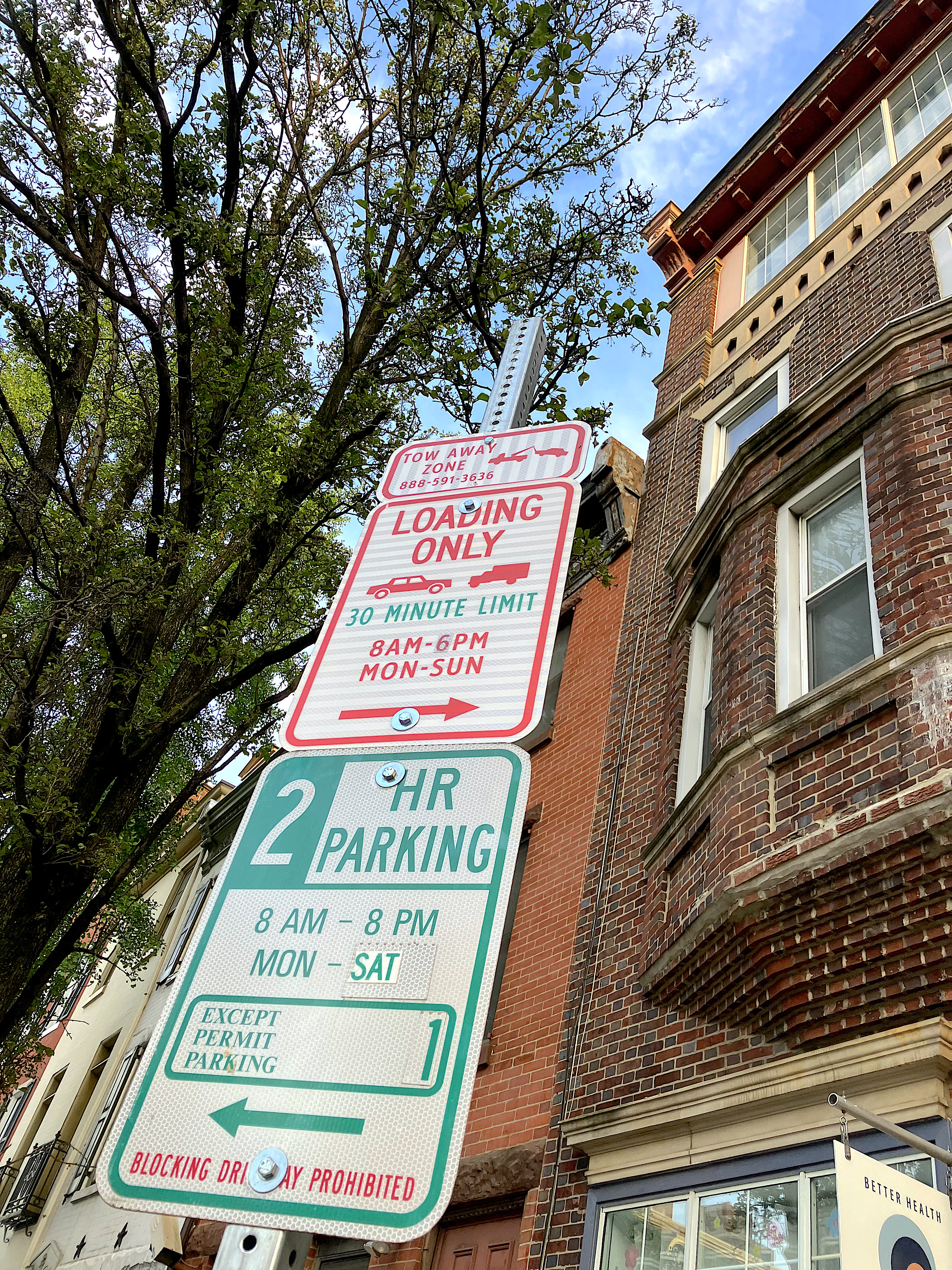
The rules of the game.


A Long Backstory

You might think that putting up a few posts and some small signs is a quick and easy process. You would be wrong. I can trace the roots of this project back for a decade, and I think others could probably add a few years to that.

What I'm going to do here is tell you the story as I saw it. Like an infantry soldier in a trench, my view of this project was quite limited. I know what I did; I know some of what the people around me did. I can't tell you what was going on with other people further down the trench line, and I have no idea what the colonels and the generals were thinking and doing.

When I retired in 2009, my daughter got me a gmail account, and my wife set me up with a blog called westwordsphilly. The blog started as a friends and family affair, with me processing my departure from corporate life for a small audience. I soon found myself writing about health insurance - I had worked for an insurance company and developed a strong interest in reforming the industry. This led me to work on the campaign to get Obamacare passed. And then, after the bill became law, I found myself looking at other topics. I had worked for the New York City Planning Commission in the 1970s, and as I walked around CCRAville it struck me that we weren't managing our streets any better than we had been handling health insurance.

I had been an avid runner and bicyclist, but I was particularly annoyed by the parking in my neighborhood, and in due course I found Donald Shoup, a professor at UCLA who had been analyzing parking for decades and was in the process of revolutionizing the entire field.

That's a story for another day. Today, all we need to know is that, if curbside parking is free or very inexpensive, and off-street parking is more expensive, the street will always fill first. 

Many of our City leaders do not understand this mechanism even today. When confronted with streets where curbside occupancy is 100 percent or more, City Council tends to respond by trying to create more off-street parking. The main problem with this approach is that it doesn't work.

Bug truck, 1600 block of Pine.


Implementing Shoup in Philly - or Not

At this time, ten years ago, I did not have the idea of reimagining our streets lane by lane, and I certainly had not thought about how changes in one lane could affect the other lanes. And, frankly, I didn't yet know much about parking. In all this, I don't think I was alone. 

I saw three things. First, what we were doing wasn't working. Second, we needed to reimagine the whole street and not just nibble around the edges of various problems. And, third, the arrival of bicycles in large numbers could drive reform.

I had been talking with various friends about these ideas, and on May 4, 2014, I wrote an email emphasizing the importance of bicycling to the reform of our streets: "I can't help thinking that bicycles, starting as a disruptive force, may well be the catalyst for a long-needed solution.  Bicycle lanes, reduced speed, improved intersections, better separation of traffic overall, and more attentive drivers, pedestrians and bicyclists." 

Be careful what you ask for. CCRA president Jeff Braff was one of the recipients of this email. He was an enthusiastic bicyclist, but in his CCRA job he naturally heard a lot of complaints about parking in the area, and he was interested in getting a better understanding of the issue. So, I suppose we could say that talking about bicycling brought me to working on parking. Jeff asked me to work with Mike Axler, CCRA's assistant treasurer, to count the parking spaces in CCRAville, something which had never been done. (To this day, nobody knows how many parking spots actually exist in large swaths of Philadelphia.) 

Mike and I agreed; we received our commission from Jeff on September 15, 2014, and promptly started counting parking spots. Jeff had hoped we could finish in three weeks, but the work carried us well into 2015. The summary report of our study was published in the Center City Quarterly in summer 2015, p. 19. 

I'm not going to go through all the details here. If you're interested, have a look at the stories on my blog that are listed at the end of this article. 

For me, the most surprising number was that no more than 13 percent of the households in CCRAville were parking a car on the street. Roughly half the households didn't own a car, and the rest were parking off the street. 

So a small minority of residents were monopolizing the curb space in CCRAville, and virtually everyone in the area was suffering from a lack of access, whether it be visits from friends and family, a house call by the friendly local plumber, or the ability to drop off groceries that you've brought back in your carshare car. (See, in particular, Parking: Storage v. Access.)

I'll just add one more number. The parking authority had issued more than twice as many Zone 1 parking permits to CCRAville residents as there were Zone 1 parking spots in CCRAville. (See Parking Permits and Musical Chairs.) 

All this struck me as an easy act to follow. And Professor Shoup had provided the tools to make the system function effectively. My thought was that we should use them.

Needless to say, things did not go well.

Cash machine, Starbucks. Spruce near 18th.


Not

It took a couple of years, but I eventually came to understand that Philly was simply never going to use fancy tools like variable pricing or uniform price auctions to manage its public parking. But we did manage to head off a bad move by City Council that involved something called parking minimums. 

Parking minimums are legal requirements that new construction contain a certain minimum number of parking spaces. In 2012, Philadelphia adopted a new zoning code that substantially reduced parking minimums. (Professor Shoup's recommendation is to abolish them.) 

In 2017, when City Council introduced a bill to raise parking minimums, CCRA president Wade Albert wrote a letter to Council President Darrell Clarke and Council Member William Greenlee. Here is one paragraph of a fairly long letter: 

"CCRA further opposes the bill because it is not at all clear that mandating more parking space for multi-family housing will in any way reduce the shortage of on-street parking. A relatively recent study of car owners in CCRA's neighborhood conducted in [2014-2015] by CCRA members Bill West and Michael Axler concluded that there are many vacant parking spaces in local garages and lots. And this is not surprising, given that many individuals with cars often choose not to pay for garage parking (with a monthly average cost likely between $175 and $275) when they have the option of parking on the street with permits that only costs [sic] $35 on an annual basis." 

The curb will always fill first. And CCRAville dodged a bullet.

When the loading zone fills,
there will be spillover.


Loading Zones in Residential Areas

And Professor Shoup had given me another tool - loading zones in residential areas. I first wrote about a version of this idea in 2015, and in 2016 I applied the idea to Pine and Spruce streets, where the concept was particularly appealing because the bike lanes there were being severely impacted by cars and trucks blocking the lane.  The 2016 story contains one of my favorite lines: "I don't think the bike lane is the problem. I think the parking lane is the problem." 

Later, I joked to a friend about this article: "Needless to say, it didn't exactly move and shake the movers and shakers."

And things were quiet for a while. 

A Pivot Point on Chestnut Street 

In the summer of 2019, the City greatly increased the number of loading zones on Chestnut Street. (For an article in the Inquirer, click here.) On September 26, 2019, CCRA president Maggie Mund wrote to Jeannette Brugger of the City's Office of Transportation, Infrastructure and Sustainability. Here is part of what she wrote. 

"The Chestnut Street loading pilot is still in its early stages, but it already seems clear that increased provision of legal loading zones has dramatically decreased the incidence of illegal parking or stopping in the traffic lanes, thereby substantially reducing congestion and smoothing traffic flow.

"Chestnut Street is a commercial corridor, but we believe that these lessons are also applicable to residential zones, which have seen a dramatic increase in package delivery, as well as pick-ups and drop-offs by companies such as Uber and Lyft.

"CCRA would be very interested in exploring with you the possibility that the CCRA area could become a pilot zone for testing the utility of increased numbers of loading zones in residential areas." 

This proposal was received positively, but in the end nothing came of it. I recall that one of the problems was picking an appropriate area in which to conduct the pilot. Virtually every block in CCRAville would have benefited from loading zones, so how do you pick.

And then of course, early in 2020, the Covid epidemic arrived, and this project went into long-term storage. 

If only the vehicles looked half as interesting as the buildings.


Same spot: Spruce near 21st, July 4.


Another Pivot Point

It turns out, though, that the idea of installing substantial numbers of loading zones in residential areas was not dead. Randy LoBasso of the Bicycle Coalition had been talking with the parking authority, engaging in what the Quakers call friendly persuasion, and asking them to increase the effectiveness of their enforcement activities on the Pine-Spruce bike lanes, which were being crippled by cars and trucks blocking the lanes. In September 2021, those talks bore fruit. 

"In September, the Philadelphia Parking Authority announced that it was creating a dedicated unit of bicycle-mounted enforcement officers, who would be ticketing cars illegally parked in bike lanes and bus lanes. CCRA ran a survey in its weekly email newsletter, asking residents if they would be willing to see more loading zones added to the parking lane on blocks of Pine and Spruce where the crosstown bike lanes run. The response was overwhelmingly positive. In October, CCRA wrote to the Office of Transportation, Infrastructure and Sustainability (OTIS) asking the City to work with us on installing loading zones in this area. OTIS responded affirmatively, and planning is expected to begin in January 2022." - CCRA Streets Committee Report for the Year 2021, submitted December 9, 2021. 

Here's the text of the letter from CCRA president Rick Gross to Chris Puchalsky of oTIS on October 4, 2021. 

"Dear Chris,

"We read with interest the Philadelphia Parking Authority's announcement that it was forming a special, bicycle-mounted unit of enforcement officers. Their mission: Write tickets for motor vehicles parked illegally in bike lanes and bus lanes in Center City and University City.

"It's worth noting that people parking in this way often don't see any option, because there are no spaces available in the parking lane.

"CCRA has been looking at the issue of parking congestion in our area for some time. We have been discussing the idea of creating one or two loading zone spaces per block in areas such as Pine and Spruce from Broad Street to 22nd, where there are bike lanes and where the parking lane is almost always at 100 percent occupancy or higher. The loading spaces would operate during the day and then revert to regular spaces in the evening.

"After the PPA announcement, CCRA surveyed its members regarding this notion, and 83% of respondents replied affirmatively to the idea.

"We would like to see a loading zone pilot for Pine and Spruce between Broad and 22nd. We think this should be done in conjunction with the PPA's enforcement pilot.

"We would be happy to collaborate with you on this project, and we look forward to hearing from you in the near future." 

Planning progressed, and in October 2022 I joined representatives from the City and the Philadelphia Parking Authority for a walk-through of Pine and Spruce, between Broad and 22nd streets. It turned out that quite a few of the blocks had idiosyncrasies that needed to be dealt with. This is what walk-throughs are for. 

We met at Spruce and Broad and walked to Spruce and 22nd, where something interesting happened. It was outside our study area, but we noticed that the block of Spruce between 22nd and 23rd had signage on the north side of the street barring parking during the day. The blocks east of 22nd had only one lane for motor vehicle traffic, so why two lanes here? We discussed. People went back to the office and researched and discussed. In the end, nobody could understand why the north side of the street was no parking during the day. And in 2023, the signs were changed to allow parking both day and night, adding thirteen spots - a baker's dozen - of daytime parking in an area where parking is famously tight. 

In August of 2023, CCRA received notice that the City planned to skip the pilot phase and install the loading zones on a permanent basis. 

Finally, in June of this year, while I was at the beach, I received an email from Anna Kelly, one of the people I had been working with at the City, informing me that the loading zones had been installed. That was a very happy day. 

What a street corner can look like.


Streets Are for People

Early on, I saw the need to look at the whole street. Call me slow, but I only gradually came to the unifying principle that streets should be designed for people. I did not come to this idea by myself. Just as Professor Shoup educated me on parking - and particularly loading zones - Jan Gehl, with his book Cities for People, educated me on the many ways, large and small, that design of our public spaces can make them interesting and welcoming.

I think the pope's visit to Philadelphia in 2015 was an eye opener for many people. Streets can be very versatile, if only you let them. And then in the pandemic we had the streeteries. We also fiddled with Open Streets, but in the end didn't do nearly as much as we had hoped. 

Many people, including many in positions of power, are definitely not on board with this new approach. After all, for many years our streets have been for transportation and sanitation, and basically everything else was unimportant.

But I feel that seeds have been planted and taken root and cannot be easily extirpated. And I'm hopeful for the future.

See also Parking: Storage v. Access; Measuring the Health of a Parking System; Parking Permits and Musical Chairs; The Supreme Court and Parking; Reimagining Our Streets: Bikes Will Lead, But They Will Not Be Alone; Barnacles at the Curb.


Monday, August 26, 2024

Pine-Spruce: Will We Replay Washington Avenue?

No.

Farm worker waiting for dinner bell, Ohio, 1938.
Ben Shahn/FSA.


I'm not willing to play charades with Kenyatta Johnson any more. The travesty of Washington Avenue should be enough to convince anyone with eyes, ears, and a pulse that the man does not bargain in good faith. 

He sets us tasks. We perform them. He sets us more tasks.

This is a very old playbook. It's called The Labors of Hercules. My favorite is The Cleansing of the Augean Stables. (Augeas made the mistake of stiffing Hercules after he'd done the job; things did not go well for Augeas.)

I won't rehearse The Labors of Washington Avenue here. They involved meetings and petitions, and more meetings and more petitions, and finally a decision to reject competent advice and insist on a plan that very quickly proved deadly. (For more, click here.) 

The facade of consulting the citizenry is just that, but it does allow Mr. Johnson to play his little games of divide and conquer - make sure the citizenry are split and angry with one another, and perhaps they will forget to be angry at Mr. Johnson. 

And it gives Mr. Johnson what he wants, which is No Change. All while he can pretend to be open to change.

And meanwhile, he does nothing to make life in Philadelphia better. In fact, by making people very angry, he makes the quality of life for residents worse. It's a sick, twisted game. I'm not playing any more.

A Better Model

There are better models of government available. One of my favorites is the podesta. The city-states in medieval Italy were often places of significant internal conflict. Back then the political factions were built around wealthy and powerful families suffused with arrogance, and all trying to dominate the whole city. (If you're fond of Shakespeare, think about the Montagues and Capulets in Romeo and Juliet.) Sometimes one family would succeed, but often the factions found themselves mired in irreconcilable conflict. At loggerheads, as people used to say. 

Then one fine day, there comes a wake-up call. Perhaps one of the cities that has gotten its act together has taken it in mind to conquer Loggerhead City, and is hiring mercenaries from all over Italy to put together an army.

Oh my, what are we going to do? say the rich and powerful of Loggerhead City. Maybe we need to work together to defend ourselves, but every time we meet it just turns into a shouting match.

Enter the podesta. He's almost always an outsider because his main job is to settle disputes between powerful people who don't trust anyone who's from another faction of the city. He also runs the city government and the army. Something like a mayor, but also something like a judge.

A Podesta for Philadelphia

Philadelphia is a very Italian city, in many ways. We have many factions; we are frequently quarrelsome; and often our government seems paralyzed. Maybe we need a podesta. Wait, you say. We already have a mayor.

Yes, but the mayor these days is quite weak, because Darrell Clarke, the previous president of City Council, set out on a personal mission to destroy Michael Nutter, who was the mayor at the time. One of his chosen instruments was bike lanes. Nutter was fond of bike lanes and was installing quite a few of them. Clarke (with help from his mini-me Bill Greenlee), wrested control of bike lane installation from the mayor and gave that control to City Council.

This was bad for bicycling in Philadelphia, and it was also bad for Philadelphia. In time Clarke essentially became a shadow mayor, with greatly expanded authority over many things. 

So we had two mayors, one of whom had authority without responsibility, because, when things went wrong, as they often did, the shadow mayor could step further back into the shadows and send his whisperers out to blame the mayor for the travesty du jour.

So, yes, Philadelphia could use a podesta. Or at least a single strong mayor. It's a very Italian town, in many ways.

Two Final Thoughts

First: A basic function of government is resolving disputes that the parties themselves cannot resolve. Judges do this all the time. But for many issues, responsibility ultimately falls on our mayor and City Council, who have become quite adept at dodging this part of their jobs. 

Second: Our leaders need to lead. We didn't hire them just to change street names. They have the police power, which covers health, safety, morals, and the general welfare. This is their power, and their responsibility, and they can't duck it. That dead body on Spruce street belongs to City Hall. 

See also Quo Vadis, Philadephia?

Friday, August 16, 2024

Mussolini's Personal Sex Factory

Mass Production Comes to the Land of Casanova 

Clara Petacci in the 1930s.


I knew that Benito Mussolini had a retinue of mistresses. And I had known for quite a while that the mistress he died with, Clara Petacci, was 33 years old and came from a good family. It turns out that her father was the pope's doctor. Later I became familiar with the formidable Margherita Sarfatti, a journalist from a wealthy Venetian family who authored a biography of Mussolini in the mid-1920s.

What I didn't know was that the mistresses were only the tip of the iceberg. Underneath that tip, obscure to the world but not to its participants, lay an army of virtually anonymous, disposable receptacles for the dictator's apparently endless lust.

There are, of course, precedents for Mussolini's sexual career. In Italy alone, we can point to Giacomo Casanova in the eighteenth century. And, in modern times, there is Gabriele D'Annunzio. In 2013, Lucy Hughes-Hallett published a whole book about him. I read the book a little while ago. D'Annunzio is, I think, central to an understanding of Italy in the first third of the last century. He was also a despicable human being.

More broadly, I think it's fair to say that promiscuity and serial adultery are not rare phenomena in the world of humans, and that in this world rich and powerful men have long been accustomed to receiving what has been called the tribute that beauty owes to power.

But Benito put the power of a totalitarian government behind his enterprise.

A 2012 story in the Guardian tells us that "Mussolini's sexuality has been 'ignored' by historians as being unworthy of study." In the last few years that has changed. NYU professor Ruth Ben-Ghiat, in her 2020 book, Strongmen, describes Mussolini's sex machine in detail on pages 126-128:

"Mussolini had always had a busy sex life. Before World War I, for example, he was living (as of 1910) with his future second wife, Rachele Guidi, and seeing his future first wife, Ida Dalser. He was also spending time with ... Margherita Sarfatti and courting the anarchist Leda Rafanelli while having quickies with countless others. ... 

"During his early years in power, with his wife Rachele still living in the Romagna region, Mussolini made his apartment on Via Rasella in Rome his bachelor pad. His housekeeper Cesira Carocci prepared his partners for intercourse and sometimes serviced him too. His brother Arnaldo disbursed funds for abortions, maintenance of illegitimate children, and silence. In 1929, when Mussolini made peace with the Vatican and Rachele and their children moved into Rome's Villa Torlonia, the dictator debuted a new personality cult theme of 'family man' and transferred his sex life to his Palazzo Venezia office. Police chief and OVRA secret police head Arturo Bocchini became his chief enabler after Arnaldo died in 1931. Bocchini's operatives worked with Il Duce's personal secretariat staff to vet and track prospects and arrange for postcoital punishments or payments.

"Police files, diaries, and testimonies from Mussolini's inner circle and his last major lover, Clara Petacci, suggest that he had extramarital sex with up to four different women daily during his twenty-three years in power. His sex life is best visualized as a pyramid. Rachele, his wife, was on top, then his major lovers Sarfatti and Petacci, and then a dozen or so regular partners whom he saw once or twice a month. If he had children with the women, the relationships could go on for decades. ... The pyramid continued with a dozen semi-regular partners and ended with the thousands of women he summoned, screwed, and had surveilled. ..." 

A Different View

Antonio Gramsci was the head of the Italian communist party when he was arrested in 1926. Prison life exacerbated his already poor health. He remained in prison until 1933, when he was transferred to a series of clinics. In one clinic the authorities actually removed the bars from his window. He died at a clinic in Rome in 1937, at the age of 46. He was married and had two children.

While he was in jail Gramsci wrote his Prison Notebooks, where I found the following: "The formation of a new feminine personality is the most important question of an ethical and civil order connected with the sexual question. Until women can attain not only a genuine independence in relation to men but also a new way of conceiving themselves and their role in sexual relations, the sexual question will remain full of unhealthy characteristics ...." (Quintin Hoare and Geoffrey Nowell Smith, ed. and trans., Selections from the Prison Notebooks of Antonio Gramsci, 1971, p. 296. For details of his imprisonment, see pp. xciii-xciv. See also this 2023 article in the Stanford Encyclopedia of Philosophy.) 

I guess Rush Limbaugh would call him a feminazi. 

Gramsci was a communist. Mussolini was a fascist. These two men saw women in very different ways. Which view do you prefer?

The photograph of Clara Petacci is from Wikimedia Commons. 

See also As the Tide Goes Out; The Correct Strategy: Fight; The Face of Fascism; What Happened in Ferrara?

Tuesday, August 13, 2024

No Parking v. No Stopping

Don't Follow Leaders, Watch the Parking Meters


One of the demands being made by reformers, after the death of Dr. Friedes, is to make the curbs behind the bike lanes on Pine and Spruce No Stopping instead of No Parking. It occurred to me that, back when I was researching these streets in the mid-teens, I noticed that quite a few of the blocks of these lanes, west of Broad, were already marked No Stopping. As I recall, most of the blocks were No Parking, but a non-trivial number were No Stopping. (To see the 2016 story, click here.)

Then I said to myself, Wait a minute. After Emily Fredricks was murdered in 2017, the bike lanes were switched from the right side of the street to the left side. So I wondered if the No Stopping signs had jumped over with the bike lanes. 

I didn't know. But people have been talking, at least it seems to me, as if all the bike lanes are currently marked No Parking. 


So I decided to go and have a look, and I found three blocks near my house where the bike lanes are marked No Stopping and Tow-Away Zone.

Back in the mid-teens, I did a full survey of the Pine-Spruce lanes west of Broad. You may rest assured that I will leave this task to someone else this time out.

Nobody has ever given me a rationale as to why some of these blocks are No Parking and some are No Stopping. And, frankly, I don't think there is a rationale. 

I think the demand to make all of the blocks No Stopping gains strength from the fact that a bunch of them already are No Stopping. And the people who have No Parking signs in front of their houses should perhaps engage in some introspection about their unique, and inexplicable, privilege.


See also The Vigil for Dr. Friedes, Once More Unto the Breach, Dear Friends.

Sunday, August 11, 2024

Once More Unto the Breach, Dear Friends

This Day Is Called the Feast of Crispian

Roy Lichtenstein, 1963.

I've been watching Philadelphia's city government in action for quite a few years. I regularly find myself shaking my head in puzzled wonderment: Is this latest travesty caused by stupidity, incompetence, or malice? In situations like the present, I often have the feeling that it's a swirling mixture of all three.

I've been working on reimagining our streets for longer than I care to remember, and I suppose I should be desensitized to the transparent same-old, same-old. It's true that the forces of reaction are wearing new, and perhaps more fashionable, cloaks. No longer do I hear in meetings that bikes do not belong on the street and should simply go away. (Although I'm told you can still hear this on the street quite a lot.) No longer do I hear that bikes should be confined to our small streets - although recently I did hear of a proposal to remove the bike lanes from Pine and Spruce and redirect all bike traffic onto Market.

This last idea strikes me as coming from an expiring brain. But what actually worries me is the charm offensive - we agree with you; let's study it some more. You get this particularly from elected officials; some are actually sincere, and many are not. This meditational limbo appears to be where we are with the plans to upgrade the bike lanes on Pine and Spruce.

While we're waiting, I've decided to pass on a few ideas about street design that I hope others may find useful.

Street Design: Six Principles

Streets account for a huge percentage of the public land in Philadelphia. They belong to us, and not to a real estate oligarch; and we should be able to choose what goes on in those streets, and also change our minds about what should go on in those streets. Today, of course, this is a fantasy. But I would like to see it become a reality. 

My small contribution here is a list of six principles for street design that I have cobbled together, largely from the work of others who are smarter than I am. I hope this may prove to be a useful guide for those who are looking at our streets and trying to reimagine them. (By the way, we all have the right to play this game, but it's useful to approach the process with some humility, and an open ear for reasoned criticism.)

1. NO DEATH. This is, of course, the basic principle of the Vision Zero movement. It's pretty well worked out, but an astonishing number of people are utterly innocent of the concept. However, it has been several years since someone told me that he thought 40,000 dead on our roads and streets every year seemed like a reasonable cost of doing business.

Let me put it simply: Your convenience should not compromise the safety of other people.

2. We need to LOOK AT THE WHOLE STREET. People often have tunnel vision when it comes to streets. Why are people parking in a bike lane? Is it because there are no loading zones in the parking lane? Why do people insist on unloading their groceries at the front door, when they have a perfectly good back door on the little street behind the house?

3. Safety measures should be UNOBTRUSIVE AND EFFECTIVE. Often they are obtrusive and ineffective. Take, for instance, speed limit signs. Who, in the City of Brotherly Love, even looks at speed limit signs? (Well, I do.) Perhaps there is a better way. 

4. FLEXIBILITY. We are accustomed to sclerotic streets. The current arrangements on our streets often don't work well, but people assume that the present was inevitable and is certainly unalterable. Then the pope came for a visit, and we got a glimpse - for a few days - of a completely different city. Streets can be very flexible if you let them, changing to meet the many needs of the people for public space. And I must insist: flexibility is a strength and not a weakness.

5. CONFRONT THE BASIC PROBLEM, which is human error. We are all human and make mistakes, and we need to plan for those mistakes. Bad drivers make good posters, and they kill a lot of people. But the problem is broader than that. We need to look in the mirror, and highway engineers need to stop designing interstates that encourage people to drive 100 mph. The Complete Streets and Vision Zero programs are good on this. It would help if people listened.

6. This is personal, and pro-bicycle. I would like to see a MODE SHARE OF 50 PERCENT for bicycles and scooters in Center City. This goal has been my lodestar for quite a few years. Why? Because it would utterly transform our streets, for the better, and it would help us save the planet. Did I tell you about the lady who told me bicyclists are evil? I've thought a lot about her comment, and I think I know where it came from - a fear that we would actually succeed.

Thanks to Mr. Shakespeare and his Henry V for the hed and dek.

I found the Lichtenstein print at the Victoria and Albert Museum.

See also Defense Doesn't Win Wars and The Vigil for Dr. Friedes, and the notes at the end of those stories.

Monday, August 5, 2024

Defense Doesn't Win Wars

Vision Zero: Switch to Offense

A street in Cincinnati, before cars.

I've been thinking lately that the forces of Vision Zero and Complete Streets are spending too much time trying to figure out how to defend against bad behavior by motorists, and not focusing on the source of the problem, which is bad behavior by motorists. Perhaps the murder of Dr. Friedes offers an opportunity for a reset.

When we accept bad behavior as inevitable, and instead focus on mitigating the damage, we are of course not alone. The U.S. Department of Transportation and the National Highway Traffic Safety Administration, from their inception, have been primarily focused on protecting the occupants of vehicles. By making crashes safer for the perpetrators, we may in fact have been encouraging more bad behavior. I think, not so many years ago, Mr. Vahey would probably have died in the crash that he caused.

How can we make drivers drive more safely? Well, here's an idea: Make them drive slower. One way to do this is by installing speed governors in cars.

This is a very old idea. I first came across it in Peter D. Norton's Fighting Traffic (2011), where he talks about the Cincinnati speed governor war in 1923 (pp. 95-99). The pro-safety forces lost that war, and they helped create the very powerful pro-car lobby that we confront to this day.

In 1923, installing and operating speed governors would have been a cumbersome mechanical task, easily defeated by friendly car mechanics. Today, however, new cars effectively come with electronic speed governors. Cruise control is, of course, under the control of the driver, but it doesn't have to be. And cars now communicate regularly with the outside world, posting, for instance, the local speed limit on the dashboard. (For some recent articles, click here and here and here.)

How about establishing a speed governor zone in Philadelphia, perhaps starting with Center City? Center City would be easy to geofence, and it would be relatively simple to make all modern cars automatically conform to the local speed limit - 25 mph or, better, 20 mph.

I've seen geofencing in action in Asbury Park, where the city has a scooter share program. If you try to go across the bridge outside my living room window and leave the city, your scooter's engine will cease to operate. Also, if you try to ride your scooter on the boardwalk, the engine stops working. Push your scooter back within the geofence, and the motor starts again. 

Asbury Park scooter share scooters also have speed governors. The maximum speed is generally 12 mph; it is lower in certain areas that have high levels of pedestrian traffic. 

Frankly, thinking of the Asbury Park boardwalk, I don't see why you couldn't geofence the Pine-Spruce bike lanes. You'd probably have to let the cars go at two or three miles per hour so they could get out of the bike lane. If you stopped them completely, they'd just sit there and block the lane.

A proposal for a speed governor zone in Philadelphia would, of course, elicit massive, enraged opposition from the usual suspects. And I suspect, in the beginning, they would prevail. Long-term, I think this may be an idea whose time has come. And, in the interim, the pro-death crowd would be playing defense quite close to their own goal line.

I found the illustration at the beginning of  this story in Cincinnati Magazine. It's from 1893 and apparently lives at the Public Library of Cincinnati and Hamilton County.

See also The Vigil for Dr. Friedes; What We Lost; We Should Not Overestimate the Driving Skills of the Typical Philadelphia Motorist; Cars and Bikes - the Back Story; What the Greeks Knew; Why Are European and American Bicycling So Different? and When Will Philly Get Scooters?

Thursday, August 1, 2024

How Surfboards Get Around

They Are Everywhere in Asbury Park

Sometimes they pretend they're zebras.


Surfing is probably not a good way to commute to work, but it is a mode of transportation. Admittedly the rides on the Asbury surf are not long, but they are rides nonetheless, and I think the riders go to happier places than an air conditioned office that quietly extinguishes any sense of the natural world.

If you're interested in how long a ride in the surf can be, have a look at the documentary movie The Endless Summer (1966). The protagonists are traveling the world in search of the best wave ever. "What every surfer dreams of finding is a small wave with perfect shape - what we call a perfect wave," says director/narrator Bruce Brown at 49:37. They find one at Cape St. Francis in South Africa. A small wave, with a perfect curl, and it just keeps going. "On some rides I timed them in the curl for 45 seconds," says Brown (50:44). 

Back to Asbury Park

Surfboards taking a shower.


Surfing in Asbury Park continues to sundown and sometimes beyond. And here we have a car wash for surfboards, just after sunset on a summer day. It also doubles as a shower for surfers (and other beachgoers). As with people, so with surfboards: It's best to leave as much sand and salt at the beach as you can.

Surfboards have travel costumes, known variously as bags or socks. I think the bags are made of heavier material, but I confess I'm out of my depth when it comes to clothes for surfboards. If you're interested, you could click here. Or you could decide that you know enough.

Surfboards Can't Walk to the Beach

Back in the sixties, surfboards arrived at California beaches strapped to the top of a Ford Woody station wagon. I've actually seen a Ford Woody (an old friend used to have one), but I haven't seen any woodies in Asbury Park lately. 

They also serve who only lie in the sand and wait.


The surfing beach in Asbury Park is located at the northern end of town, where the City has reserved a beach for surfing and fishing. There's even a parking lot called the fisherman's lot. It's popular with anglers and surfers and others. I live near the surfing beach, so I don't have to work hard to watch surfboards arrive at the beach and, at the end of the day, depart.

I think the surfboards generally arrive strapped to the roof of a car, or jammed into the back of an SUV. I've seen them dumped into the back of a Ford F-150 pickup truck. And, of course, a person who lives close to the beach can walk and carry the board under an arm. But I think the boards are happiest riding a bike. Some people just carry the board under an arm while riding the bike, but others have surfboard racks mounted on their bikes.

End of the day.


Here's a large van with a man strapping down a surfboard on the roof. On the other side of the van there is a sign that says Jeremiah's Amish Doughnuts. I hunted around online; it appears there may be a connection to the television series Breaking Amish and Return to Amish. I decided to stop there, because this is a story about surfboards and not doughnuts. 

Doughnut truck.


Waiting and Action

Like cars, surfboards spend most of their time not doing anything. Even when a surfboard is in the water, it is mostly waiting, quietly and patiently along with its rider, for a good wave.


And then, like a thoroughbred horse at the racetrack, it explodes from a standing start to catch the force of a wave and ride on for as long as it can. Which is not very long. But the surfers are happy, and so, I suppose, are the surfboards.


As an observer, I have wondered whether surfers find the waiting for a wave to be tedious. I've decided that many of them just enjoy being on the water, much as some bathers, down on the bathing beaches, enjoy standing quietly in the water or perhaps floating on their backs and gazing at the sky, amidst the hurly-burly of splashing and frolicking.

I'm particularly struck by this meditative aspect of surfing at the end of the day. Some surfers will linger, even if there are no rideable waves, just floating on the water as the sky puts on its light show. 


All the photographs in this story were taken in 2023. 

See also Umbrellaville, Precious Cargo, The Uncertain Eighties, Layers at the Beach Front.