Tuesday, December 24, 2019

What a Nice Present!

I'm a Pushover for Zebra Stripes

December 23, 2019.

I'd been aware of it, but I hadn't seen it until yesterday, when I went to the Christmas Village in Love Park. And there it was, at the northeast corner of the park, at the intersection of 15th and Arch. My wife got French soap, and I got a new crosswalk! Also a greatly expanded raised concrete island.

The crosswalk runs across 15th Street just south of Arch. For many years there was no crosswalk here. There was a little stick man on a post, with a diagonal red line running across him. People crossed here anyway; presumably they thought that it was illegal for little stick men to cross, but okay for humans.

Below is what this intersection looked like in 2015. All the cars on Arch headed toward us must turn right on to 15th Street - the 1400 block of Arch is one-way westbound. Then there's the exit from the Love Park garage. By the way, the white stripes on 15th Street where the crosswalk should be are lane markers.

2015.

There are a lot of other things that could be done to improve the general level of sanity in the streets around Love Park - and also City Hall and the Municipal Services Building. And in fact I've heard some quiet rumbling that further improvements may be in the offing.

But you know what? It's the holidays. I'm in a good mood, and I'm thrilled to stumble across a change on our streets that I think is an unalloyed good thing. My thanks go out to those who were involved in this project.

Kudos!

See also Crossing 15th Street, Love Park Garage: Close the 15th Street Exit.

Sunday, December 1, 2019

When Will Philly Get Scooters?

Driving Your Car to the Corner Store Is Not Okay

Bangs Avenue, Asbury Park.

Well, the new bike lanes are in on Pine and Spruce, and I think they're quite beautiful. The pavement is marvelously smooth, the painted lines vivid, and there are flex posts at strategic locations that will substantially reduce crash risks. And the bike lanes have been moved from the right side of the street to the left, making bicyclists more visible to drivers and again reducing crash risk.

Some pieces are missing. We don't have full-block coverage with flex posts, similar to the design of the bike lane on Chestnut Street in West Philly. And we don't have adequate numbers of loading zones in the parking lane.  This means that drivers will continue to use the bike lane as a loading zone and very reasonably claim that they don't have an option.

But here's what's wrong with using the bike lane as a loading zone. It limits the people using these lanes to two groups of bicyclists. The first group is called the strong and fearless - think bicycle messengers. The second is called the enthused and confident. Together they compose about 10 to 15 percent of the population. A much larger group - studies generally size it at half of all people - is called the interested but concerned.

The interested but concerned are interested in biking but concerned about getting into a life-altering crash with a car, or possibly a trash truck. Dodging cars and trucks parked in the bike lane is a deal-breaker.

2018 Bike PHL Facts, from the Bicycle Coalition of Greater Philadelphia, says that Center City had a 2017 bike mode share of 7.3 percent. South Philly was higher, with an 8.1 percent mode share, and a few census tracts actually score over 20 percent. (See also the Center City District's 2018 report on bicycle commuting.)

In an American context, these numbers are not at all shabby, but they also indicate that the present market for bicycling in Philadelphia is almost entirely strong and fearless or enthused and confident.

More disturbing, in 2018 the Bicycle Coalition's bike counts on the Schuylkill River bridges and in Center City were actually down. The South Street bridge, for instance, declined from 455 bikes per hour in 2017 to 380 per hour in 2018. Fortunately, preliminary data from the Bike Coalition's 2019 bike count indicate that bike counts have rebounded strongly.

Still, we haven't yet made any significant gains with the interested but concerned group. Since this group has about half the population, I've been saying for years that bike mode share in Center City could get to 50 percent. But that will require building a complete network of fully protected bike lanes. Pine and Spruce can be the east-west spine of this network in Center City, but these by themselves will not be enough.

So we have a few years of building ahead of us before we can expect the interested but concerned to come off the bench in any numbers.

What to do? Call in reinforcements - in this case, e-scooter share.

Learning About Scooters
Back on February 27 of this year, the committees on transportation and public utilities and the environment of Philadelphia's City Council held a very interesting hearing on e-scooter share. Several of the major firms were there - Lime, Bird, Spin - along with City administrators from various departments and outside experts.

I attended the meeting, and I found it a very good tutorial on a very new topic - e-scooter share was less than two years old at the time. A lot has happened in the intervening nine months, and so I found myself going back and reading the transcript on the City Council website (to see it, click here).

In February, the scooters were quite controversial, mainly for two reasons. First, they were thought to be very unsafe. Second, the industry was pushing dockless scooters, which created many, many complaints about scooters being left in inconvenient spots.

I'll get to the criticisms later, but first let's have a look at some of the positives that scooters can bring.

For starters, it turns out that lots of people who won't bike are quite willing to get on a scooter. Sarah Clark Stuart, executive director of the Bicycle Coalition of Greater Philadelphia, noted a study in Portland, Oregon, in which 74 percent of scooter riders reported that they had never used the local bike share, and 42 percent reported that they had never biked. (See transcript, p. 75. For the Portland study, click here.)

Liz Cornish is executive director of Baltimore's Bikemore, an organization that advocates for bicycling and Complete Streets. Baltimore was just wrapping up a pilot scooter share project with Bird and Lime, and she said, "Scooters have also proven appealing to a broader range of users than those who bike." (P. 89.)

In other words, we can use scooters to fill the bike lanes. Many scooter riders will be new recruits, and not bicyclists switching over to scooters.

Professor Megan Ryerson is UPS Chair of Transportation at the University of Pennsylvania. She put it this way: "Demand for separated, protected, multi-purpose bike/scooter lane infrastructure will become impossible to ignore." (P. 93.)

So where are all these new scooter riders coming from? Well, a lot of them are coming from cars. Paul Steely White used to be executive director of Transportation Alternatives in New York City. Now he works for scooter company Bird. He noted, "Thirty-four percent of e-scooter trips in Portland were trips that would have otherwise been taken by a private car, an Uber or a Lyft." (P. 62.) And in other cities Bird keeps seeing a figure around 30 percent (p. 64).

The experience at Lime is the same: "30 percent of our riders in major markets took a scooter instead of using a personal car," reported Shari Shapiro of Lime. (P. 53.)

Getting this many people out of cars is a big deal. It leads directly to reduced traffic congestion and reduced air pollution. Call it a win for scooters. Call it a win for all of us.

At the hearing, representatives from the City urged caution, arguing primarily that the safety issues were inadequately explored, and suggesting it would be best to wait awhile before letting the scooters in.

I was okay with putting scooters on hold, mainly because of the lousy condition of our streets. There was actually a speaker who spent most of his time talking about all the potholes and unfilled utility trenches.

Now I'm ready to go, for two reasons. First, we have the Pine and Spruce bike lanes, along with 11th Street and others, and rumor has it that we'll be getting a few more in the spring (I've been disappointed before). Second, e-scooter share came to my second home town, Asbury Park, last summer, and I've seen a successful program in action.

The e-scooter share in Asbury Park debuted on August 2, and it was an immediate hit, garnering 15,169 trips in the first month with 5,806 unique riders (this in a city with a permanent population of about 16,000). Each scooter had an average of 4.7 trips per day.

And they weren't all visitors headed for the beach. Local residents are using them to get to work and also just to get around during the day. In the first month of the program - August - 46 percent of users were residents. And they're still doing it, even as the weather gets colder.

And, yes, scooters are getting people out of their cars. A survey of scooter riders indicated that 33 percent would have otherwise been driving.

Parking in Corrals
One of the main objections to the scooters, back in February, was the way the dockless bikes tended to get left in inconvenient locations, blocking sidewalks and generally making a mess. Asbury Park solves this problem by requiring that scooters be parked in corrals, which are simply painted squares, either on the sidewalk or in the street next to the curb (see the photo at the beginning of this story). I am reliably informed that GPS technology requires the rider to park in a corral before the rental session can be ended.

Asbury Park did not invent the scooter corral - it appears that Seattle may have been the first, and Santa Monica may have been the first to put corrals in the street, as opposed to the sidewalk. But I can tell you the Asbury Park experience has convinced me that the clutter problem is over. (Phoenix did experience a bump in the road when it first implemented mandatory corrals. For a story, click here.)

Crashes
As to the safety issue, I need to detour back to the Portland study, which says on page 22, "Eighty-four percent of emergency room visits were the result of an individual falling off a scooter." In other words, they were solo crashes that did not involve a car, a truck, or a pedestrian.

I believe it. We're talking about newbie riders - people who may not have ridden a scooter, or a bicycle, since they were children. Riding a scooter does have a learning curve, and mistakes can lead to contact with the ground. For one thing, it's easy enough to oversteer a scooter and have it buck you off like an ornery mustang.

I'm not eager to blame the victim in any crash. There are always other factors involved, including the design of the scooter and the quality of the road. (For a few news stories click here and here and here.)

More serious crashes do occur. Recently, in Elizabeth, N.J, a scooter collided with a truck making a right turn, and the scooter rider was killed. This is unacceptable. We must find out what happened and make the necessary changes - to scooters, to the built environment, and to program management - to make sure this does not happen again.

Shortly after the debut of the Asbury Park scooter program, the maximum speed for the scooters was reduced from 15 mph to 12 mph. (For a story from the Asbury Park Press, click here.) Even before the launch it was decided to turn all the scooters off at 9 p.m.

In Asbury Park, scooter crashes do tend to be minor, as we have seen in Portland. Here's one.

A few days before Labor Day, my wife and I were walking down Ocean Avenue in Asbury Park, next to the boardwalk, and we actually watched a young woman take a pratfall more or less in front of us. I walked over and spoke with her to see if she was okay - it was a pretty dramatic dismount. She seemed alert and oriented, even cheerful. No sign of road rash on her knees. After a minute she got herself up unaided, grabbed her scooter off the pavement, and scooted away.

I wouldn't want to do this in the middle of Market Street in Philadelphia during rush hour, but I do think the safety issues are manageable and will decrease as we all get more experience with scooters on our streets, identify issues and their solutions, and make adjustments.

We just need to get started. Learning curves don't function until you climb onto them.

See also Focus on the Short Trips, Intraday Biking, Looking Three Ways at Chestnut StreetScooter Share Coming to Asbury Park, They Threw Rocks at Mayor DilworthWhy Are European and American Bicycling So Different?

Monday, November 18, 2019

Jim Crow Was a Failed State

So Why Do We Want to Go Back?

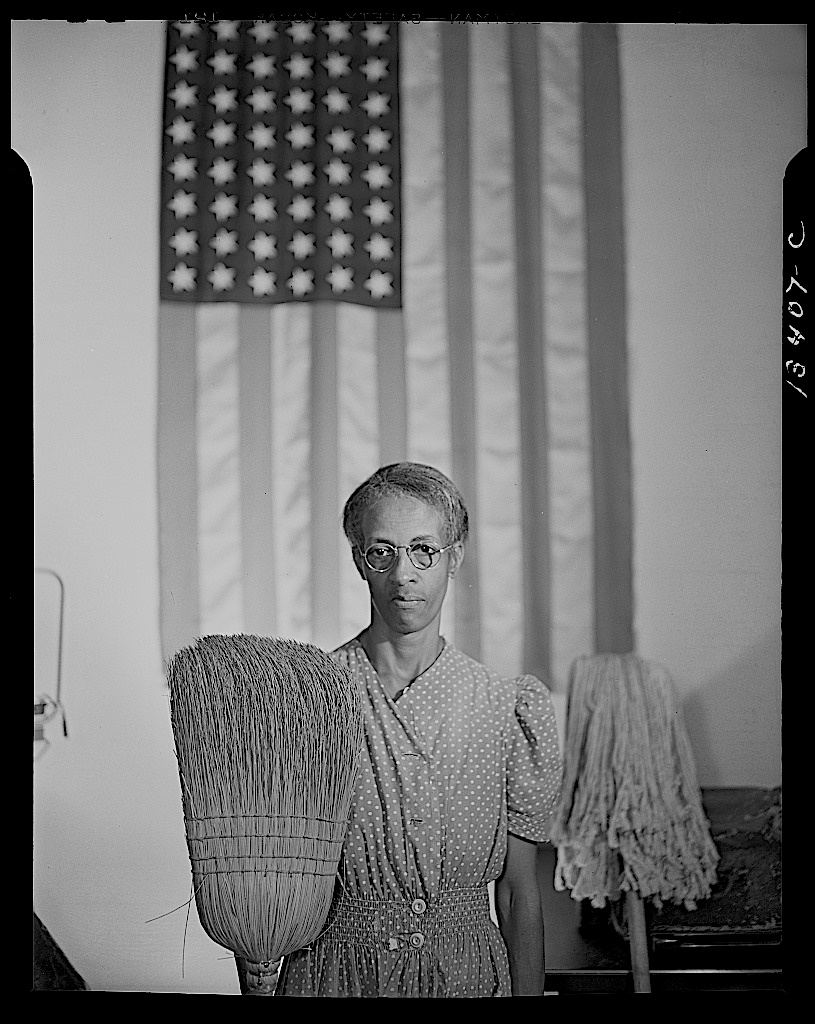
Washington, D.C, Government charwoman. Gordon Parks/FSA, 1942.

For a while now I've been thinking about Donald Trump and Benito Mussolini. There are some remarkable similarities. The bluster, the posturing, the incompetence, the success. And above all, they are both at heart clowns. Clowns who hate anybody competing for the limelight.

I now need to engage in one of my famous digressions.

Fred Trump Kills Funny Face
It's a little known fact that Donald's father Fred bought the old Steeplechase Park in Coney Island from the Tilyou family with the intention of building middle-income housing. That's what Fred did - middle-income, outer boroughs. On the facade of the park - which was basically a glass wall - there was a large image of Funny Face, the park's mascot, if you will. A clown face - I find it a bit scary.

The Coney Island History Project reports that Fred needed a zoning change from the city, which didn't come through. Then there was talk that the city was going to declare Funny Face a landmark. Trump threw a demolition party for his friends.

For what happened on September 21, 1966, I will quote from Gwenda Blair's 2000 book The Trumps: Three Generations That Built an Empire: "When the guests arrived at the Pavilion of Fun, the enclosure around the old Steeplechase entertainments, they found champagne, half a dozen bikini-clad models, TV cameras, and a wrecker's bulldozer. With all the rides sold and carted off, one of the few remnants of the past was the huge grinning clown's face painted on the pavilion's enormous glass window. Despite a steady drizzle, the bathing beauties posed with Fred Trump in the bulldozer's scoop and pulled down pieces of the pavilion that had been attached to ropes. At one point the new owner passed out bricks and encouraged guests to pitch them at the smiling face that had greeted generations of Steeplechase customers and served as the park's logo. Then the bulldozer got to work." (Pp. 219-220. Blair footnotes Michael P. Onorato, ed., Steeplechase Park: Sale and Closure, 1965-1966: Diary and Papers of James J. Onorato, 1998, pp. 57-58, which I have not seen. James Onorato was the general manager of the Steeplechase Park from 1928 to its closing in 1964.)

Let's call this Fred's own private version of Kristallnacht.

I do have a problem with this story. Funny Face was pretty high up on the facade. A brick weighs five pounds. (A baseball weighs less than half a pound.) I think you'd have to be a shot-putter to loft a brick that high. Maybe a brickbat, which is a shard of a brick, and which has been a well-known projectile since there have been bricks.

At any rate, there is a seductive charm to this tale. I imagine a young Donald there, throwing a rock at his competition and helping to kill him. And hoping to please his dad. Call it a formative experience, if it happened. At the time he was going to school at Wharton in Philadelphia, which does have academic standards, and so it's possible that he was actually in Philly, maybe even studying. It was a Wednesday, after all. However, even if he was a distance learner, Donald's later career showed him to be an apt student when it came to vandalism.

I don't think I've gotten to the bottom of this story; I'll leave that to an enterprising researcher who has time and skills that I do not possess. I did find a brief contemporaneous account in the New York Times. It doesn't mention the brick throwers.

Italy: From Travesty to Disaster
Back to Benito. Adolf Hitler dominates the story of fascism, so it's easy to forget that Mussolini was the first and lasted the longest, arriving in 1922 and departing in 1943.

One of the things I find instructive about Mussolini is the slow way in which he amassed his complete power. The famous March on Rome in 1922 simply made Mussolini the prime minister of a coalition government. He used his powers aggressively and won a parliamentary majority in 1924. Shortly thereafter Giacomo Matteotti, a principled, insightful, and very articulate member of parliament, was kidnapped and murdered. Consolidation of power proceeded and was essentially complete by the end of 1926.

Throughout this process I think it's important to watch not just the actions of the fascists but also the action and inaction of other powerful forces in the society, notably the pope, the king, the army, the large landowners, and the industrialists. I have the impression that, despite the optics, parliamentary democracy didn't actually fail because of its internal shortcomings; rather, other players were terrified that it would succeed, and they took steps to make sure that didn't happen.

Not that we should underestimate the seductive, iconoclastic power of the fascists. Mussolini had at his disposal hit squads, or squadri, composed largely of petty criminals and wannabe thugs. The squadristi would use the manganello, a kind of billy club, to beat people they didn't like. They would also make them drink castor oil. Another favorite tactic was the home invasion, where the homeowner's furniture and other belongings would be thrown into the street. The squadri also ransacked newspaper offices. (See Caroline Moorehead, A Bold and Dangerous Family, 2017, pp. 77- 78, 129-130, 140-141, 147. For a recent article in Slate, click here.)

Numerous judges and police officers simply loved the squadristi, and would go to great lengths to keep them out of jail, even before the March on Rome. (Moorehead, pp. 78, 82.)

The word "totalitarian" was coined in Italy, and by 1927 Italy was a totalitarian dictatorship. There were thought police (George Orwell's later term). The Special Tribunal for the Defence of the State, set up under a law of November 1926, was authorized to investigate and punish "any activity whatsoever capable of damaging national interests." Actions were not required; thought was enough. Suspicion was enough. And there was no need for the formality of an actual trial. (Moorehead, pp. xii, 161, 178, 188-189.)

And then there was il confino, essentially internal exile. The penal colonies were located on small islands off the Italian coast, including Ustica, Lipari, Pantellerea, and Lampedusa. There were very few escapes. (Moorehead, p. 189.)

As Mussolini put it, "Everything in the state, nothing outside the state, nothing against the state." (Moorehead, p. 178.) The only thing he lacked was a modern industrial state. The Italy he took over was in fact a very poor, largely agrarian society. Despite efforts to modernize, that is what it remained throughout the fascist time. As late as 1936, 52 percent of the labor force was working in agriculture, and as late as 1950 Italy's Gross National Product per capita was 33 percent of the GNP per capita in the United States. (Vera Zamagni, The Economic History of Italy 1860-1990, 1993, pp. 32, 40.)

Mussolini did what he could to modernize - the Italian autostrada got its start in 1924. And the famous draining of the Pontine Marshes south of Rome was only part of a much bigger land reclamation effort, which in the south largely fizzled because of opposition from the great landowners, who would have lost some of their power. (Zamagni, pp. 258-262.)

Still, the country lacked factories, and it lacked natural resources to feed those factories. For instance, there is essentially no coal in Italy, and the situation for iron ore is not much better. Italy was the number one importer of scrap iron in the world during the years 1921-1936. (Zamagni, pp. 92, 286.)

Finally, the country simply lacked the managerial infrastructure required to run a modern country. This was a serious handicap even in peacetime, but the effect during World War II was disastrous. As American scholar J.J. Sweet has put it, the Italian defeat "resulted from the failure of the army as technical expert and military advocate, the failure of the government as overseer of national needs and planner and enforcer of national policy, and the failure of Italian industry as supplier of national needs." (Quoted in Zamagni, p. 289 fn. 58.)

To project power, you first need to have it. Even so, in the 1930's, like a moth drawn to a flame, Mussolini found himself attracted to a series of ill-considered foreign adventures.

In 1935, Italy invaded Ethiopia. If you look at a map, it seems like there might be a rationale for this. Italy already had colonies bordering Haile Selassie's empire on the north and east - Eritrea and Italian Somalia - and after the war these three territories were consolidated administratively.

So, on a map, it looks like there may be some coherence to all this. But why would you want to conquer a country with no known natural resources? Maybe some coal? Maybe some iron ore?

Let's put Mussolini down for imperial glory. In a flash of high-tech modernity, he used poison gas on Ethiopian soldiers, some of whom actually were armed with spears. Hurrah. Let's have a parade.

Next up was Spain, as in the Spanish Civil War. Mussolini sent a corps of "volunteers" to help the fascist general, Franco, in his attempt to overthrow the legitimate Republican regime. And it was in Spain that Mussolini's regime started to display cracks that were visible to the non-blind.

In early 1937, Franco was trying to drive directly at Madrid, with the hope of finishing the war quickly. The Italian corps was deployed to the north of the city with orders to push south. Battle was joined around the town of Guadalajara, well north of Madrid. The Republican defenders included the Garibaldi Battalion of the International Brigades, composed of Italians who didn't like Mussolini.

Mussolini's troops were well armed for the day, with light tanks and aircraft - an early version of the mechanized armies that swept across Europe during World War II. What they lacked was a good sense of how to use these weapons in adverse conditions. When it rained, the Italian planes couldn't fly. The Republicans counterattacked, and the Italian fascists broke and ran. So much for invincibility. (On Guadalajara, see Hugh Thomas, The Spanish Civil War, 1961, chapter 46.)

Time for a word about noise. Cacophony is the sound of democracy. It can be unpleasant, although I'm quite fond of the Jimi Hendrix version of the Star Spangled Banner. Disagreement does cause dissonance.

In a totalitarian dictatorship, there is no cacophony. There is harmony (sometimes called message discipline). The problem with harmony is that too much uniformity can make it monotonous.

And monotony can lead to channel surfing. There are always alternative channels. The people themselves are constantly spawning their own narratives, often quite inventive. The dictator needs the undivided attention of his people; his message must blanket and suffocate all the natural variation that occurs in any human society possessed of language.

This is why the message masters are constantly looking for new variations to throw into the mix. Maybe just a little pogrom.

The message masters can also control the volume, and this is what happened when Italy was about to enter World War II. An eerie silence descended over Italy. Not only were the public megaphones silent about the way forward; the many, many private networks in Italy were also without new content. For an idea of what this felt like, see Iris Origo's A Chill in the Air (2018).

The war itself was a slow-moving catastrophe for Italy. In 1943, the power centers did what they should have done at the beginning and removed Mussolini from power. It was, of course, too late. The war had come to Italy, with the Allies doggedly fighting their way up the Italian boot, and the German army contesting pretty much every hill, every valley.

Iris Origo paints a vivid picture of what it was like to have your land fought over by two foreign armies, neither one in a particularly good mood: War in Val d'Orcia: An Italian War Diary, 1943-1944 (1947).

Tenant farmer family, Wagoner County, Oklahoma. Russell Lee/FSA, 1939.

Jim Crow

Attracted as I am to the Italian example, and much as Trump seems to unconsciously emulate Benito Mussolini, I suspect that many of Trump's squadristi have a different model in mind: the Jim Crow South.

Jim Crow was originally the name of a character in the old blackface minstrel shows; he lent his name to an entire period of southern history, which began with the end of Reconstruction in 1877. That was when the North, after winning the Civil War, and after spending more than a decade trying to foster a liberal, integrated democracy in the defeated South, figured out that the task was going to be extremely hard and take a very long time, and walked away, leaving the newly emancipated southern blacks to the tender ministrations of southern whites, who, like the Bourbons, had learned nothing and forgotten nothing.

Southern whites did realize that they couldn't bring back formal slavery, so they set about creating a reasonable facsimile of the antebellum South. Central to this project was the oppression of blacks.

It took a while for the full structure of Jim Crow to be erected. A landmark came in 1896, when the U.S.  Supreme Court accepted the separate but equal doctrine in Plessy v. Ferguson.

Jim Crow eventually receded during the Civil Rights Revolution. Key dates here are the integration of the armed forces in 1948, Brown v. Board of Education in 1954, the Civil Rights Act in 1964, and the Voting Rights Act in 1965. It's worth noting that the Civil Rights Revolution is not over. It continues to this day.

So what did the Jim Crow South look like? It was a desperately poor, backward agrarian society where the power structure maintained itself through a reign of terror. At the apex were the lynchings, which are finally being properly memorialized. But we should not forget the ongoing daily acts of intimidation, and also the jokes - the many, many racist jokes that whites told one another, and their children, all directed at reinforcing the racial status quo.

I think we tend to focus on the racism and the terror, the de jure segregation, and depriving black people of the right to vote; and perhaps we focus less on the poverty of this society. There were always a wealthy few; but the vast majority were in a very poor way. Call it a banana republic that grew cotton instead of bananas.

Alabama sharecroppers. Walker Evans/FSA, 1936.

Here are a few numbers. Between 1880 and 1930 the South's per capita income was generally between half and two-thirds of that of the United States as a whole. Retail sales in 1930 were about one-third of the national average. (See Gavin Wright, Sharing the Prize: The Economics of the Civil Rights Revolution in the American South, 2013, pp. 24, 58.)

Nor were southerners particularly good stewards of their land. As Wright puts it, "A common feature of economic backwardness is the destruction of natural resources." In 1933 the National Resources Board found that "nearly one-third of the land area in the southern states could be classified as 'severely impoverished,' 'soil washed off,' or 'devastated.'" This was more than 60 percent of the "impoverished or devastated soil" in the entire country. As for forests, by 1920 an estimated 156 million acres of forest land had been cut over in the South. A government observer called it "probably the most rapid and reckless destruction of forests known to history." (Wright, p. 60.)

Wright notes, "On the eve of the Great Depression, the South appeared to have settled into a lasting political-economic equilibrium, dominated by an elite planter class" (Wright, p. 56). That changed after the 1929 stock market crash, the advent of the Depression, and the election of Franklin Delano Roosevelt as president.

As Wright puts it, "the New Deal kickstarted the modern southern economy." Perhaps the most famous federal project was the Tennessee Valley Authority's electrification program. In 1933, 2 percent of households in the Tennessee Valley had electricity; by 1945, 75 percent of households were electrified. (Wright, pp. 59, 64.)

And Atlanta got a new sewer system. "The old system was disgraceful, polluting streams with human and industrial waste, generating a number-one ranking for the city in diphtheria deaths and a typhoid rate twice the average for other large urbanized areas." Of all the projects carried out in the South by the Works Progress Administration (WPA), the Atlanta sewer system was the largest. It was basically free to the locals, and it was a critical building block for Atlanta's postwar progress. (Wright, pp. 63-64.)

As a result of all this investment, the southern economy started to change, and people began to talk of the "New South." But while the economy may have been changing, the society was not. The reign of terror continued, most notably with the lynching of 14-year-old Emmett Till in 1955.

I would like to suggest that the Jim Crow South was a sinking ship. It's true that the guests at the Captain's table in the first-class dining room may not have noticed, but the people drowning in steerage were well aware. And they voted with their feet.

In what has been called the Great Migration, blacks flooded out of the South. In every decade between 1890 and 1970, what demographers call net migration of blacks was outward bound. The biggest decades were 1940 to 1970; in each of these decades (again, on a net basis) more than a million blacks uprooted themselves and left the South. Since 1970, the situation has reversed and the South has experienced continuous net immigration of blacks. (Wright, p. 143.) I wonder why that happened. Civil Right Revolution, anyone?

Interestingly, the Jim Crow South also saw substantial net emigration of whites between 1880 and 1960, with the peak decades running from 1910 to 1950 (Wright, p. 143). If you'd like to know what being a white sharecropper was like in the 1930s, read James Agee's Let Us Now Praise Famous Men (1941).

Deputy Sheriff, Gonzales, Texas. Russell Lee/FSA, 1939.

What's So Attractive About Jim Crow?
For a very long time in this world, the people at the top of societies have used fear and want to keep the people below them - the "little people" - in line. Then along came Franklin D. Roosevelt, who proclaimed his Four Freedoms at the beginning of World War II. They were freedom of speech, freedom of religion, freedom from fear, and freedom from want. They were the bedrock of the social contract that allowed the United States and its allies to come together and win World War II.

And it looked for a while as if these freedoms would stick. But the power of fear and want as tools of government is very seductive. I think this is part of what certain people are talking about when they talk about "the good old days."

Another piece of it is the shape of society. For a long time we've been taught that American society looks like a pyramid, with a few rich people at the top, a lot of middle-class people in the middle, and a bunch of poor people at the bottom.

Traditional societies didn't look like that. They looked more like a chess pawn, with a little bulb of people at the top (the aristocrats), a thin stem running down below that (the bourgeoisie, mainly assistants and enablers of the aristos), and a large flat base of poor people, whose primary concerns were food, shelter, and being as close to invisible as possible whenever their masters came around.

Trump's squadristi come in a number of different forms, of course, but I think they all share a common nostalgia for this traditional approach to society and governance.

What I do not understand, though, is where they expect to fit in this chess pawn. Some, I suppose, think they'll be in the little bulb at the top. Good luck with that. Others may see themselves in the very thin - thin to the point of fragility - stem, the piece that both holds the top and bottom together, and provides a buffer between the two. Not a lot of openings in the stem, and the places are guarded with a desperate ferocity. Nobody wants to fall out of the stem, because then you're down at the bottom.

Do any of today's revolutionaries on the right actually see themselves winding up as one of the down-trodden poor in the new-old society they hope to create?

I suspect not.

Mule, Hale County, Alabama. Walker Evans/FSA, 1936.

See also Fascism, Narcissism and Dictatorship, What Can Pierre Laval Tell Us About Donald Trump?

Thursday, November 7, 2019

Uniform Price Auctions

How to Price Parking Permits

Auctioneer, central Ohio. Ben Shahn/FSA, 1938.

A few years ago, Donald Shoup had a look at the Beacon Hill neighborhood in Boston and found that there were 983 on-street parking spaces. Only residents with city-issued parking permits could park in these spots. Shoup looked a little further and found that there were 3,933 permits in force. That's roughly four permits for every spot. (See Donald Shoup, The High Cost of Free Parking, 2011 edition, p. 516 and footnotes 31 and 32 on p. 552.)

As Shoup points out in his more recent Parking and the City, "A district with more on-street parking permits than on-street parking spaces would be like a theater that sells more tickets than it has seats."
(Donald Shoup, ed., Parking and the City, 2018, p. 484.)

I live in the Rittenhouse area of Philadelphia, which is part of the city's Residential Parking Permit Zone 1. This zone is quite large; there are a total of 3,687 zoned parking spaces in Zone 1. (It's so big there's a proposal to split it in two. I agree with the proposal, but that's another story.)

So, how many Zone 1 parking permits in force? When I looked into it in 2015, there were 6,957, or roughly two permits for every Zone 1 spot. (Click here to see the story.)

I agree with Professor Shoup that this is a bad outcome, although my analogy is to an overstuffed trash can. But how do you fix it?

The obvious answer is to charge more money for the permit. Currently the Philadelphia permit costs $35 a year, and the price is uniform across the whole city. Every zone pays the same price, regardless of the demographics or congestion of the zone. The current process for setting the price is essentially political, and it is not doing the job that I would like it to do.

Over the ensuing years I have kept coming back to this problem. Fairly early on, I decided that each zone needed to be assigned its own price. The neighborhoods of this city are simply way too varied for a single price to fit all.

But how to determine those prices? For several years, I thought the best idea would be to simply float the price up, a little bit each year, until the number of permits in the zone was in rough equilibrium with the number of spaces.

Then, last year, I was reading Shoup's new book, and on page 484 I discovered the uniform-price auction:

"Consider how a uniform-price auction would work on a block with 20 on-street parking spaces reserved for residents. Any resident can bid for a permit. The bids are ranked in descending order and the highest 20 bidders receive permits. In a uniform-price auction, all the winning bidders then pay the same price: the lowest accepted bid. All successful bidders except the lowest bidder thus pay less than what they bid."

I think this basic idea could work in Philadelphia. It would tend to increase the cost of having a car, but the current permit rate is clearly a subsidy for private car ownership, and as a matter of public policy I think we should move away from that.

Test it out in a few neighborhoods, like mine, that are both prosperous and highly congested. And see what happens. I suspect that the initial opposition - a given for any innovation in Philadelphia - might quickly give way to quiet satisfaction.

See also All the Whining Will Be the Sound of Change, Parking: Storage v. Access.

Monday, October 28, 2019

Boos Are Good

The Unvarnished Truth Has Its Place

President Trump.

The president went to the ballpark last night and got booed. Then there were chants of "Lock him up!"

And some were aghast. What about decorum? What about respect for the office if not the person?

Here's my answer. We may be a few months away from the death of democracy in the United States. We are in a war for the survival of the Republic. Not too many shots fired, if you overlook the mass shootings enabled by the National Rifle Association. But still a war.

In a war, you fight. We are fortunate to have the president under siege, but he is still dangerous. It is important to continue the classic siege tactics of isolate and diminish. Booing works for me. So does "Lock him up!" I look forward to the day when that actually happens.

In the winter of 1944, the Germans launched a massive counterattack on the western front that came to be called the Battle of the Bulge. The Germans surrounded the American 101st Airborne Division and several other units in Bastogne and demanded that the American troops surrender. General McAuliffe, commanding the 101st Airborne, replied, "Nuts!"

Wednesday, October 16, 2019

Parking Minimums in Philly

A Zombie Returns

New flex posts, Spruce at 13th.

The following is testimony I planned to deliver to the rules committee of the Philadelphia City Council on October 16. The hearing on this bill was postponed. So I decided to share my thoughts here.

Good morning. My name is Bill West. I am co-chair of the streets committee of the Center City Residents’ Association, and I am here to inform you that CCRA opposes the parking minimums bill, number 160710.

Pretty much the entire country is moving away from parking minimums, with the exception of Philadelphia's City Council. Why is the country moving away from parking minimums? Because they're a bad idea.

Parking minimums drive up the cost of housing and distort the built fabric of the city in many ways. And they increase the number of cars on streets whose size has not changed; this leads to increased traffic congestion and air pollution.

Nearly ten years ago, parking guru Donald Shoup put it this way: “Like alcohol prohibition in the 1920s, minimum parking requirements do more harm than good and should be repealed.”

If you're concerned about the shortage of on-street parking spaces in Center City, raise the meter price. There's plenty of off-street parking in Center City. People don't use it because parking at the curb is so much cheaper.

Finally, if you are in favor of affordable housing, you should not vote for this bill.

Thank you.

See also All the Whining Will Be the Sound of ChangeFinding Our Way to a Parking Policy, It's the Road Design, Stupid.

Thursday, October 3, 2019

What Are We Doing to Our Truck Drivers?

When You Can't Do Your Job Without Breaking the Law

Driver in Old City; siren in Asbury Park.

My Uncle Henry was a truck driver, among other things. He even owned his own truck.  It doesn't seem to have gone very well. Fortunately, he also had a lifetime interest in horses. He understood horses and horse people, and as he got older he found himself doing more with horses, and a lot less with trucks.

Probably the only truck driver I've known in Philadelphia was my long-time UPS driver, Donna. Lovely lady. We were all so happy when her son came home from Iraq safely.

I've spent a fair amount of time watching truck drivers like Donna try to do their jobs in Center City. Just trying to do their jobs. We don't make it easy for them. And their bosses don't make it easy for them.

Fitting Cities for Cars and Trucks
The basic problem is one of geometry. Cars and trucks are quite big, and they don't fit well on streets in the older parts of many cities - in Philadelphia, Center City and South Philly are good examples.

For most of the twentieth century, there was a huge move to alter cities so they would better fit the motor vehicles flooding their streets. I haven't bought a new suit recently, but the concept is the same: the customer's body is a given; the suit must change to fit the body. The street and its intersections should be big enough to fit a very big truck with a very large turning radius.

In the nineteenth century, of course, cities spent a lot of time altering themselves to fit the new railroads. Cities are quite malleable; change is really a constant. However, it's nice when the changes are for the better.

It turns out that the people now flocking into old downtowns around the country are often attracted by the human scale, the older buildings, the walkability.

And so people have started to look at the concept of fitting the vehicles to the city. The original micromobility vehicle was the bicycle. And now the e-scooter has entered the scene.

Recently UPS has piloted a delivery e-tricycle in Seattle (for a story, click here). I suspect we're going to see a lot more commercial uses like this. They're not entirely new of course. I remember, growing up in New York City, that the grocery stores often used delivery bicycles; they looked a lot like modern cargo bikes. And Chinese restaurants have used delivery bicycles for years. I wonder when pizza shops are going to move to delivery bicycles?

Still, it seems clear that, for longer distances and bulkier goods, large trucks will be with us for the foreseeable future. So is it possible to fit these vehicles into streets that people like to walk on?

Complete Streets and Big Trucks Can Live Together
The answer is a qualified yes. Professor Alison Conway of the City College of New York and others have produced a report entitled "Complete Streets Considerations for Freight and Emergency Vehicle Operations." (I also consulted with profit the Delaware Valley Regional Planning Commission's "Philadelphia Delivery Handbook." )

Professor Conway's report presents an array of creative engineering solutions to the admittedly gnarly problem of fitting large vehicles into small spaces. I won't go through them all, but here are my two favorites.

First, the mini-roundabout with mountable interior curb. Roundabouts are still new in this country. They're dramatically smaller than the older traffic circles that most of us are familiar with - for instance, the circle in Logan Square, which consumes a vast amount of space (admittedly elegantly) and allows motor vehicles to navigate the circle at speed. Small roundabouts consume much less space and require motorists to actually slow down. The mini-roundabout continues the shrinkage. I've seen the small roundabouts in action; I look forward to the mini.

Mini-roundabout.
Small roundabout in Interlaken, N.J.

Second is the asymmetrical median nose. This has a full curb, but admittedly does cut down on standing space for pedestrians. Still, I think it can be useful in a pinch, without compromising on safety.

Asymmetrical median nose.

George Balanchine comes to street design. I'm very happy.

The Curb
Transportation planners like to talk about the last mile, but in Philadelphia the challenge is often the last ten feet. Eventually a delivery vehicle has to stop and unload and deliver its cargo. In Philadelphia, this often means parking at the curb, and in Philadelphia there is often no space at the curb.

So what's a truck driver to do? Actually, this is when the truck driver becomes a criminal. On the Chestnut Street commercial corridor in Center City, until recently, delivery trucks would often stop in the dedicated bus lane. Why? Because they didn't have any choice.

Recently this has changed. The City has launched a "Loading Pilot," which provides 80 feet of loading zone on each block, all day.

The Chestnut Street loading pilot is still in its early stages, but it already seems clear that the new loading zones are having the desired effect. Who knew? Truck drivers, as a group, are not particularly dedicated to breaking the law.  (I consider the Julius Silvert case to be an outlier.) They're just looking for a place to park. And with the bus lane clear, traffic is much less jumbly, and the bus ride is much less of a steeplechase.

The residential parts of Center City are also experiencing an access problem. My neighborhood is a good example. I live a few blocks south of Rittenhouse Square, in the southwest quadrant of William Penn's original plan for Philadelphia, and parking has been ridiculously tight here for decades.

The recent dramatic increase in package delivery, as well as pickups and drop-offs by companies such as Uber and Lyft, has only added to the problem.

I think it's fair to say that the boom in home delivery - as opposed to commercial deliveries up on Chestnut Street - has been giving the delivery companies fits. At least, at a store, someone is home. In the modern world, it's quite possible that nobody is home during the day. So you can have a failed delivery (the driver's boss will not be happy) or you can leave the package on the stoop, where one of our local porch pirates may decide it belongs to him.

Either way, not a good outcome. So the delivery companies have been looking into alternative models. First came the delivery lockers in convenience stores, and now, at 23rd and South, we have an actual pickup and return center from Amazon. You can see it in the picture below.

Take that, porch pirates! 23rd & South, Philadelphia.

None of this is new. The pickup center in a convenience store simply replicates the nineteenth-century arrangement with general store proprietors, who often also served as the local postmaster. And the Amazon pickup and drop-off center in the picture is taking a leaf from the book of Montgomery Ward and Sears, Roebuck in the nineteenth century, when they used the nation's expanding rail system to deliver their goods. Just go down to the local train station to pick up your new mail-order buggy - horse not included.

I think these new ways of getting packages to people will be successful, but I also think that home delivery is not going away. So how do we get curb space for all these trucks? The same way we did up on Chestnut Street. We turn parking spaces into loading zones.

And things will get better. I'm sure of it.

(The National Association of City Transportation Officials has a very helpful report entitled "Curb Appeal: Curbside Management Strategies for Improving Transit Reliability.")

See also Parking: Storage v. Access, Taming Chestnut Street, Unblocking the Bus Lane of Chestnut, Flex Posts on Pine and Spruce.