Sunday, June 12, 2016

Gordon Cullen and the Outdoor Floor


Oceans of asphalt: 2400 block of Cypress.
My friend Bill Marston loaned me a book called The Concise Townscape, by Gordon Cullen. We had been looking at some of the illustrations over coffee, and I had expressed an interest in reading the text.

I was intrigued by the thought that I might have read this book, or parts of it, more than forty years ago. I wasn't sure until page 82, when I ran across this phrase: "... today the tree is more usually accepted in its own right as a living organism which is pleased to dwell among us." Some things you never forget.

The book has quite a few well-turned aphorisms. Here's another, from page 46: "The typical town is not a pattern of streets but a sequence of spaces created by buildings."

It turns out that Gordon Cullen was quite influential in his day. Many young architects interested in urban design studied his book. I called up my brother and asked him if he recalled Gordon Cullen. The answer was an immediate yes, along with the news that he still has his copy of the book on a bookshelf in his apartment.

Think of Cullen as the English Jane Jacobs - their careers were contemporary, involved magazine journalism, and centered on the harm that automobiles were doing to cities.

Asphalt Is Boring
I was particularly taken with Cullen's thoughts on treatments for the street surface - what he calls "the floor." Here's what he has to say on page 53: "Buildings, rich in texture and color, stand on the floor. If the floor is a smooth and flat expanse of greyish tarmac then the buildings will remain separate because the floor fails to intrigue the eye in the same way that the buildings do."

He comes back to this idea on page 121: "Instead of walls and floor being in harmony, the floor linking or separating architectural elements and expressing the kind of space which exists between buildings, it is as though the buildings were models plonked down on a blackboard."

And here he is on page 128: "From the visual standpoint the greatest single loss suffered is neutralization of the floor, the space between buildings, which has changed from a connecting surface to a dividing surface. ...  Buildings are gathered together but they do not form towns; one might almost as well build houses facing across a railway line."

I recently posted a story on The Pavements of Asbury Park. I wonder if my interest in the visual effect of paving treatments stems from some long-forgotten passages in a dimly remembered book.

What an Illustrator!
I'd be remiss if I didn't mention Cullen's illustrations, which manage to be both highly informative and utterly charming. They put me in mind of David Macaulay and his many books. I stumbled across this wonderful TED Talk that Macaulay did a while ago. I haven't found anything comparable for Cullen, so I thought I'd share. You can find some of Cullen's illustrations online, but I think the best way to see his work is to get your hands on the book.

I'm thinking a sidewalk would help.
See also A Tale of Three Alleys.

Tuesday, May 24, 2016

Morning on Lombard Street

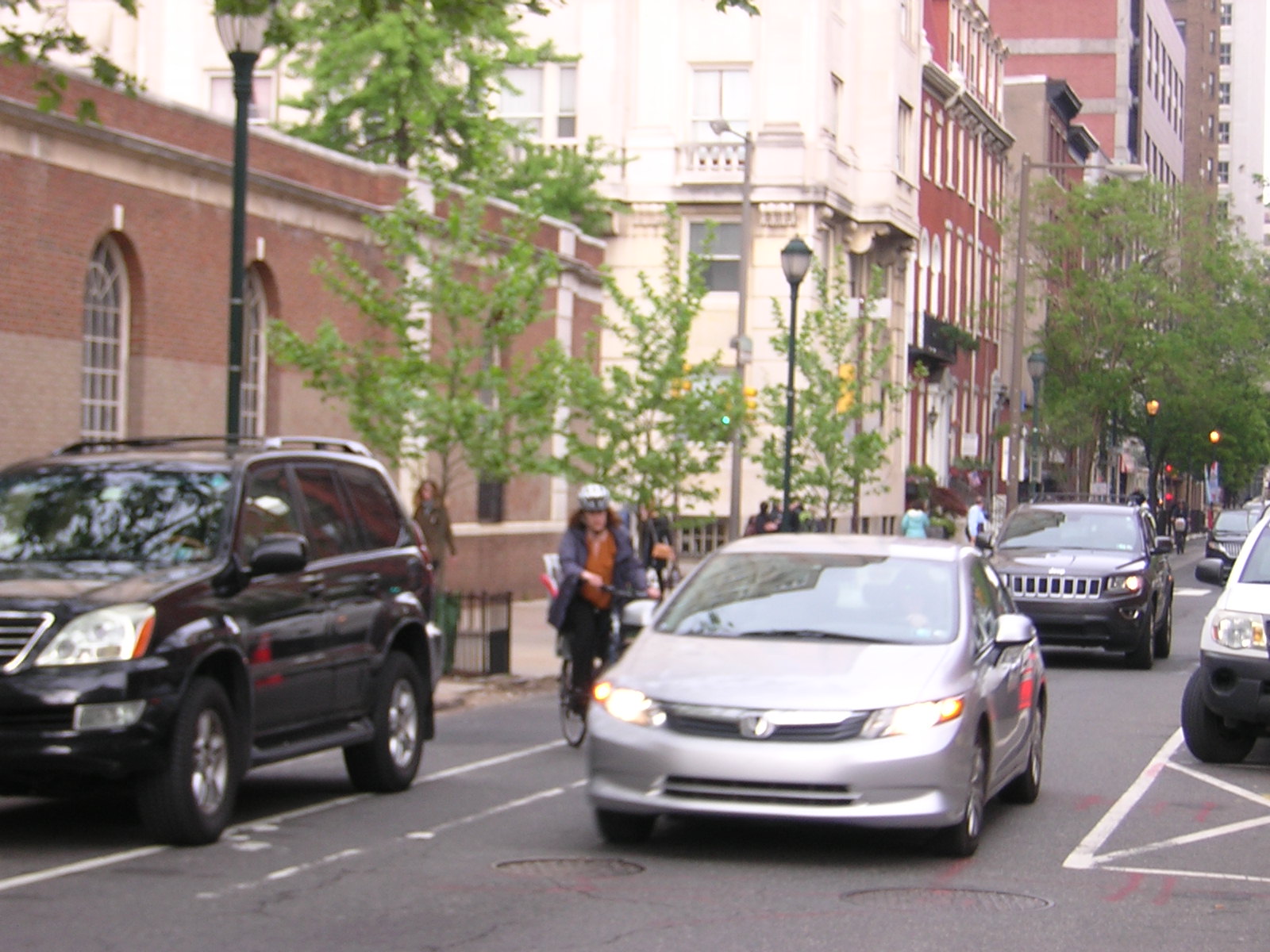
Bike lane, Lombard Street.
My friend Jim Campbell suggested that I have a look at the intersection of Lombard and 22nd, for congestion and cars blocking the bike lane that starts at 22nd and then runs down Lombard, across the South Street bridge, and out to Penn, HUP, CHOP, and other points in West Philly.

So this morning I took a walk, arriving at 22nd and Lombard before 8 a.m. I was going to do traffic counts, but the situation was patently obvious and, I thought, better explained by photographs.

The initial thought was that motorists coming up 22nd were turning and, finding the car lane full, jumping over to the bike lane. They do this, and often go in the bike lane for several blocks before they're able to squeeze into the car lane.

Lombard is very crowded in the morning. We'll get to the reason for that in a little bit. At any rate there's a solid line of cars from 22nd street down onto the bridge at 27th and South. The good news is that the traffic is moving very slowly, which reduces the crash risks.

In addition to the motorists turning from 22nd, we have motorists on Lombard coming directly across the intersection and entering the bike lane. Lombard has two car lanes up to 22nd street. The right-hand lane is marked as a right-turn only lane at 22nd. Some drivers just go straight.

Among them are the bus drivers. There is a bus stop on the east side of 22nd and Lombard, in the right-turn only lane. After receiving and discharging passengers in the bus stop, bus drivers then have a choice. They can go directly across 22nd into the bike lane, or they can move to the left and change lanes in the middle of an intersection.

Recommendation # 1. Eliminate the bus stop at 22nd. There are bus stops on almost every block along Lombard. One stop will not be missed greatly, and the change will make life a lot easier for bus drivers and the people who need to maneuver around them.

Recommendation # 2. Add some flex posts at the beginning of the bike lane to prevent cars and buses from driving down the lane.

And now to the question of why Lombard jams the way it does every weekday morning. Bridge traffic, you say. Yes, but there is a more precise answer. The vast majority of the cars on the bridge are headed for the northbound entrance to the Schuylkill Expressway.

I walked up on the bridge and had a look this morning. (Not my first visit.) The bridge conveniently sprouts three westbound lanes - the middle lane heading to West Philly, the left lane for the Schuylkill southbound, and the right lane for the Schuylkill northbound. The left and center lanes are uncrowded and flow freely. The right lane is a solid line of cars for its entire length.

Recommendation # 3. Close the northbound entrance to the Schuylkill Expressway from the South Street bridge.

First of all, the entrance is dangerous. Drivers have to merge to the right onto the Schuylkill, into the fast lane. And of course there is that blind spot that cars have on their right side, looking to the rear.

Second. it doesn't make a lot of sense to load northbound traffic onto the Schuylkill here. South Street is a southern gateway to Center City. It should be for people arriving from the south and departing to the south.

Why load more northbound traffic onto a road that is already jammed with northbound traffic? Why not wait until at least some of these people get off at Center City, and then you only have to worry about the people headed to King of Prussia.

Third, there's plenty of room on the bridges further north. I walked up there this morning, as well. Walnut, Market, JFK westbound. Little House on the Prairie.

A traffic department worth its salt would be looking for ways to balance these flows.

I'm aware that 22nd street is heavily traveled in the morning and afternoon. But the genius of a street grid is that there are options - basically any even-numbered street. And 16th at Love Park is five lanes wide. Versus one lane on Lombard.

Every once in a while my camera gives me a gift.
See also Love Park Redesign: Why Are There Still Five Lanes on 16th Street?

Thursday, May 19, 2016

More on the Pine and Spruce Bike Lanes

Welcome to Pine Street.
In Flex Posts on Pine and Spruce I defended the proposed upgrade of the bike lanes on those streets from buffered (a painted buffer zone on the pavement) to protected (flex posts added to the buffer zone).

Mindful that people do need to drop off groceries and perform similar chores, I proposed adding two loading zones to the parking lane in each block, across the street from the bike lane. Several people I have spoken to have dismissed this proposal out of hand, saying the local residents will never accept it. Presumably the only sufficiently convenient solution is to continue to allow residents to pull up in the bike lane in front of their front door.

So I went for another walk - actually several walks - and scribbled in my notebook and thought.

Let me start by concentrating on CCRAville, the area west of Broad that I am most familiar with.

People seem to think they currently have the right to stop in any bike lane in CCRAville to unload groceries, children, perhaps an aged and infirm grandmother. However, the bike lane side of the 14, 15, 16, and 1700 blocks of Pine is currently placarded as no stopping. Likewise the 1400 and 1800 blocks of Spruce. And for good measure the bike lane on 22nd street is no stopping from South to Market, except for a brief no parking zone near the Greenfield School.

No stopping means no stopping.

How can the City be so heartless? Well, there are options to parking in the bike lane. They may be a bit further from your front door, but they may also be safer - not just for bicyclists, but for you, your children, your grandmother.

Many of the buildings on the south side of Pine and the north side of Spruce (where the bike lanes are) have rear access. The poster children for this are the 15, 17, and 1800 blocks of Pine (backing on Waverly) and the 14, 17, 18, and 1900 blocks of Spruce (backing on Bach Place and Manning).

On many other blocks at least some of the buildings have rear access - for instance the 1900 and 2000 blocks of Pine.

Other blocks are more difficult to categorize. The 1400 block of Pine, for instance, contains Symphony House and Peirce College. In addition to fronting on Pine, Peirce has access from Waverly, 15th, and Carlisle. Symphony House fronts on Broad and has a loading dock on Pine.

These buildings would not be inconvenienced by a protected bicycle lane on Pine, but a protected lane would reduce the number of stories like the one that follows here.

A Story
One weekend morning, probably a year ago, my wife and I were driving down Pine to the grocery store. There was a bicyclist in the bike lane a bit ahead of us. And then, as we approached Broad, a car with Florida plates roared up behind the bicyclist and proceeded to follow him very closely and abuse him verbally.

We all stopped for a red light at Broad. I lowered my passenger window and told the motorist that he was driving in a bicycle lane. He did not take my comment well.

The light changed and we all went forward across Broad. The Florida motorist continued in the bicycle lane and turned on 12th.

Little Streets
Back to the west side of Broad. I previously mentioned Carlisle street, which runs north-south in the block between Broad and 15th. There are a lot of these little north-south streets in the neighborhood. They get very little traffic, and they strike me as good places for a motorist to pull over - safer, frankly, than the hurly-burly of Pine and Spruce.

On Pine, heading west from Broad (the bike lane ends at 22nd), you have Carlisle, Hicks, Smedley, Chadwick (which hits a stub of Cypress that runs to 17th by Tenth Presbyterian), Bouvier, Uber, Capital, and Van Pelt.

Coming back down Spruce from 22nd, you have Van Pelt again, then Smedley and Hicks.

There are also a whole bunch of mews - walkways that run behind buildings. I have one on my block. It extends, with interruptions, the full length of the block. I and others have spent a good amount of time over the years pruning the vegetation and raking and sweeping the beautiful stone pavers placed there by a long-gone generation.

Many of the mews in the neighborhood appear disused and neglected. Maybe people should have another look.

One more extraneous comment. As I walk around the neighborhood I still see a good bit of razor wire. The technology for security and surveillance has improved dramatically, and the razor wire makes a bad impression on the tourists.

East of Broad
Let's go back east of Broad for a quick look. The 1300 block of Pine is no stopping, as is about half of the 1300 block of Spruce. Then you get to the bike lane on 13th street, which is no stopping from Locust north beyond Chestnut, about halfway to Market. This commercial corridor is also well supplied with loading zones.

Here's an idea. I think the basic problem with protected bike lanes is that they're new - well, new to Philadelphia. People have trouble visualizing how they will work. So let's show them how it works. Right on 13th street. All you need to do is put in the flex posts. Literally. And let the demonstration project provide proof of concept for all to see.

Let's do it right now. Not in 2018. Right now.

Rear access on 2300 block of Spruce, from Manning.
About the manhole cover at the beginning of this story: For a very long time I thought that concrete manhole covers had only been an emergency measure during World War II. Clearly I was wrong. Thomas P. Greger received U.S. Patent No. 536,621 on April 2, 1895. If you'd like to read the patent, click here.

Thursday, May 12, 2016

Death as an Acceptable Outcome

In 1995 Pedestrians Were 36 Times 
More Likely to Die than Motorists


In 1905, at least eighteen young men died playing football in the United States. President Teddy Roosevelt, himself a football fan, invited representatives of several colleges to the White House to discuss the future of football. From this little chat flowed an important principle: Death was no longer an acceptable outcome for a football game - or by extension any other sporting contest.

Football is still a very violent sport, as the sad history of concussions regularly reminds us. But the discourse on concussions remains true to the principle established in 1905: Playing the game should not kill you, either quickly or slowly.

A few years after the White House conference - in 1908 - Henry Ford introduced his Model T, the first mass-market automobile. Soon the Model T and its imitators were everywhere, and a lot of pedestrians were getting hit, particularly in cities. People were outraged, but the cars kept coming, and gradually, over the course of the 1920s, a funny thing happened. In exchange for the convenience of cars, we as a nation came to accept a certain level of collateral damage.

More recently, we as a society seem to be coming to the conclusion that death should not be an acceptable outcome for a walk to the grocery store. Vision Zero is a movement that began in Sweden and was approved by that country's parliament in 1997. Its basic thought is that every traffic fatality is a mistake. Complete Streets is a complementary movement that also had its beginnings in the 1990s. Its basic thought is that streets are for everybody. Not just cars, but pedestrians, bicyclists, transit riders, you name it.

In 2009 Philadelphia's mayor, Michael Nutter, adopted Complete Streets. The city's current mayor, Jim Kenney, is a strong advocate for Vision Zero.

In the United States, bicyclists have been leaders in these movements, perhaps because they have nowhere to hide. In cities, at least, the pedestrian has a sidewalk. The bicyclist, on the other hand, often has no choice but to ride along with the cars and trucks and buses.

A Historical Anomaly
The situation of bicyclists in the United States is something of a historical anomaly. While the U.S. pursued a monomodal, car-focused transportation system from the 1920s until quite recently - and largely achieved its goals - in Europe there was a pronounced tendency to pursue a more balanced transportation system, including transit, bicycling, and walking. Denmark, the Netherlands, and Germany particularly favored bicycles, and created large networks of separated bike lanes, where riders could have their own space.

The United States pursued a different path on bike lanes. There is a simple reason behind this divergence. For many years a powerful - and still vocal - movement called vehicular bicycling had great influence in this country. Its leader was - and is - a man named John Forester.

The indefatigable researchers at Wikipedia inform me that John Forester is the son of C.S. Forester, author of the series of novels about Horatio Hornblower, a British naval officer in the era of the Napoleonic Wars. The elder Forester is not to be confused with Patrick O'Brian, author of a series of novels about Lucky Jack Aubrey, a British naval officer in the era of the Napoleonic Wars.

After that remarkable digression, we will now return to the subject of vehicular bicycling.

Simply put, vehicular bicycling opposes bike lanes. The reasoning starts from the premise that legally a bicycle is a vehicle. This issue was settled in the courts during the nineteenth century. As a vehicle the bicycle has the same right to come and go on the streets as cars do. This is no longer entirely true. Bikes are banned, for instance, from Interstate highways, as are horses. Finally, vehicular bicyclists call on their cycling brethren to exercise their legal rights and ride in the traffic lane with the cars.

Riding in the lane with cars is something I do with considerable regularity. I just happen to prefer riding in a bike lane. Mr. Forester disapproves of bike lanes. And his views have had great influence.

It didn't have to be this way. Starting in the 1960s, bicycles experienced a remarkable comeback in this country, and there was considerable interest and activity in developing both on-street bike lanes and fully separated bike paths.

Forester and friends were having none of it, and they launched a remarkably effective campaign to keep bicyclists mixed in with cars, whether they wanted to be or not. As James Longhurst writes in his 2015 book Bike Battles (p. 225), "Put simply,  some adult riders had become philosophically opposed to the only kinds of bicycle infrastructure on offer and discouraged traffic engineers from contemplating most bicycle-specific developments, including off-street paths and painted lanes."

Time was definitely lost. In recent years, the influence of vehicular bicycling has faded, and we've seen quite a lot of new bicycle infrastructure coming on line. Still, Forester's fingerprints linger, particularly in the design manuals that streets engineers rely on. The publication of a new Urban Bikeway Design Manual by the National Association of City Transportation Officials in 2011 may well prove to be "a major turning point for American bicycling," according to Peter G. Furth. (See his article "Bicycling Infrastructure for Mass Cycling," on pp. 105-139 in John Pucher and Ralph Buehler, eds., City Cycling, 2012. The quote is on p. 119.)

The Great Debate
The history of the shift away from vehicular bicycling is known in its broad outlines, but many blank spaces remain to be filled in. So I decided to do my bit, and earlier this year I found myself at the main branch of the Free Library, hunched over large bound volumes that had been retrieved from the Secret Place of Storage. (It only took a few days.) I'd become intrigued with the work of Professor John Pucher, who in the 1980s and 1990s had spent a fair amount of time in Europe studying transport. To say he came back armed with data would be an understatement.

In 2000 and 2001, in the pages of a journal called Transportation Quarterly, he engaged in a very interesting debate with John Forester on the relative merits of vehicular bicycling and the very different European approach.

Was I looking at the Lincoln-Douglas debates of vehicular bicycling? I thought so. I still do.

Was this actually a turning point in the history of vehicular bicycling? I don't know. But the timing is interesting.

There are three articles:

1. John Pucher and Lewis Dijkstra,  "Making Walking and Cycling Safer: Lessons from Europe," Transportation Quarterly 54:3 (Summer 2000) pp. 25-50.

2. John Forester, "The Bicycle Transportation Controversy," Transportation Quarterly 55:2 (Spring 2001) pp. 7-17.

3. John Pucher, "Cycling Safety on Bikeways vs. Roads," Transportation Quarterly 55:4 (Fall 2001) pp. 7-11.

Article 1. Pucher starts off with a rather alarming statistic: per kilometer traveled in 1995, pedestrians in the United States were 36 times more likely to be killed in a crash than people in cars. Of course people in cars travel a lot more kilometers than people walking, so if you want to compare on a per-trip basis, the comparison is only three to one. Either way, these numbers give me the willies.

Even though the numbers are old, I find myself visualizing the walk from my house to the Whole Foods at 9th and South. It's about a mile, or 1.6 km. So am I still either 36 times or three times more likely to die? Maybe I should get the car out of the garage. Or maybe take an Indego bike. Then I would presumably be only 11 times more likely to die - on a per km basis - or three times more likely on a per trip basis.

I don't like these numbers, but there they are. They tell me that a car is the safest place to be on the street.

As Pucher and Dijkstra put it, "the dangers of walking and cycling in America are not just perceived; they are real."

And, once again, it didn't have to be like this. Pucher and Dijkstra turn to data from the Netherlands and Germany and show that life on the road is dramatically safer for everyone - motorists, bicyclists, pedestrians. In 1997 the overall traffic death rate in the Netherlands was half the U.S. level. In Germany it was two-thirds the U. S. level.

In 1995 the death rate for pedestrians in the United States was more than ten times what it was in Germany and the Netherlands. For American bicyclists, the death rate was four times higher than it was for the Dutch and Germans.

So why are these rates so different? Pucher and Dijkstra point to a list that has become familiar - better infrastructure for bicyclists and walkers, traffic calming in residential neighborhoods, urban design focused on people and not cars, restrictions on motor vehicle use (such as pedestrian zones), improved traffic education, and traffic regulations and enforcement that actually protect pedestrians and bicyclists.

Pucher and Dijkstra recognize significant barriers to such a reform program in the United States: "The real problem in the United States is lack of willingness to do anything that infringes on the prerogatives of motor vehicle users." They continue: "Unless they are cheap and do not inconvenience motorists, most safety measures have little chance of implementation in the current environment."

Article 2. In his rebuttal, John Forester essentially dismisses the data that Pucher and Dijkstra have assembled, arguing that there is no proof of a causal relationship between better infrastructure, for instance, and lower death rates.

Quickly narrowing the subject to bikeways, Forester sets his own standard for proof of causation: "I know of no instance in which a bikeway advocate has analyzed accidents involving cyclists to see by how much, and by what mechanism, bikeways could reduce the accident rate."

And he decides that the only type of crash a bikeway could prevent would be one in which a motorist is overtaking a bicyclist.

In his discussion of crashes at intersections, Forester does not mention Dutch intersections, which are specifically designed to improve the sight lines between cyclists and turning motorists. This despite the fact that Pucher and Dijkstra have a photograph of a Dutch intersection, with  explanatory caption, on page 40 of their article.

Turning to the available empirical evidence, Forester writes, "I know of only one valid test of a sidepath system, and it involved me in my hometown of Palo Alto, California." He found the sidepath in question to be highly dangerous.

Forester is a strong advocate of bicyclist training to reduce accidents, but in his world there are some accidents "that are hard-to-avoid, even impossible for the cyclist to avoid." In Forester's defense, Vision Zero was just getting started in 2001.

Finally, Forester sees two "imagined virtues" of the Dutch bikeway system: "it makes cycling safe for the incompetent and creates many cyclists where there were few before."

There is more, but I'll spare you.

Article 3. In his rebuttal of Forester, Pucher stacks his data against Forester's single sidepath test in Palo Alto. And he asks a simple question: "if vehicular cycling is so much safer, faster, and more convenient, then why is cycling so unsafe and so unpopular in the United States?"

Pucher points out that "Forester's policies are aimed at serving fast cycling by well-trained cyclists. ... He completely ignores the willingness, desire or need of most people to cycle at lower speeds. ... Bicycling should not be reserved only for those who are trained, fit, and daring enough to navigate busy traffic on city streets."

Finally, Pucher offers an olive branch, pointing out that he is not trying to ban bicyclists from riding along with cars and eighteen-wheelers. He simply wants to add bike lanes and give cyclists the option of riding on them.

Three Thoughts
Thought 1. The olive branch is important. The last thing bicycling needs is another theological schism between the advocates of bike lanes and the advocates of vehicular cycling. Frankly, both have their place.

There's a wonderful story from the 1890s, which Evan Friss tells in his book The Cycling City (2015). Call it a tale of two cities.

In Brooklyn, the Coney Island Cycle Path formally opened with a parade in June 1895. It ran alongside Ocean Parkway from Prospect Park to the Coney Island boardwalk. Soon the path had as many as 32,000 bicycle riders on a single day (the 1890s are not called the Golden Age of bicycling for nothing). To alleviate congestion, officials proposed creating a separate "return path" along Ocean Parkway, effectively doubling capacity. However, the expansion came with a string: Bicyclists were no longer to use the main roadway. There was an uproar that would have made John Forester proud, but in the end the City got its way.

Meanwhile in San Francisco, an ordinance was proposed to limit bicyclists in Golden Gate Park to the cycle paths. It failed. The result: "almost all of the riders used the bicycle-only paths by choice." (Friss, pp. 102-103, 108-113, and p. 225, footnote 27.)

Thought 2. In 1854 there was a cholera epidemic in the Soho district of London. Dr. John Snow investigated the matter and determined that the outbreak was clustered around one particular well. Snow got the pump handle removed and thereby founded the science of epidemiology.

It's worth pointing out that nobody at the time knew what caused cholera. The germ theory of disease was still in the future. Snow could have theorized that the houses around the well were occupied by malign spirits and called in an exorcist, or possibly Ghostbusters. Instead he theorized bad water. But he had no idea of the actual mechanism of transmission.

Forester's point that correlation does not prove causation is an important one, but ignorance of the mechanism of causation does not stop a scientist. Instead it prompts further investigation.

Snow's detection of a hot spot centered on a well led him to pursue the hypothesis of bad water rather than bad air or vampires. So he tested his hypothesis and knew success, without ever knowing the mechanism of transmission.

Thought 3. In the United States most of the people who die on the road are in cars. That's because the vast majority of travel in this country is by car. But the raw numbers were masking something, and Pucher and Dijkstra found the hot spot that others had overlooked. Total deaths may be relatively small, but the death rates for pedestrians and bicyclists - whether by kilometer or by trip - are truly eye-popping. And the European rates showed that none of the American rates were inevitable.

I do not know what influence this debate had on the subsequent discourse. I hope that others will investigate this topic. But I do know that there are a lot more bike lanes than there used to be. And, despite considerable and effective opposition, I think we will see many more bike lanes in the future. Maybe a few pedestrian bump-outs, while we're at it. And some traffic islands. The occasional pedestrian street. It's not like the agenda is particularly a secret. And for this, we owe a debt of gratitude to those who had the faith to keep swimming against a strong tide.

Professor Pucher's articles are available online. To see them, click here. I have been unable to locate an online version of the Forester article.

To make this picture bigger, click on it.

Thursday, May 5, 2016

Flex Posts on Pine and Spruce

1600 block of Spruce street. Bike lane at left.
There is a proposal to turn the bike lanes on Pine and Spruce streets into protected bike lanes. This means that, in addition to the current (more or less) painted buffer zone between the bicycles and the cars, there will be a series of flex posts. These are plastic posts, usually orange, that you can now see in a number of areas around Philadelphia, perhaps most visibly on the Walnut Street bridge. The barrier they create is almost entirely visual and psychological. If a car hits them, they bend over. I used to call them wibble-wobble sticks, but my daughter tells me that is no longer accepted terminology.

(The posts on the Walnut Street bridge are white. They'd probably get hit less if they were orange, or yellow, or lime green. But I digress.)

I've now heard a number of well-meaning concerns about putting the flex posts in on Pine and Spruce. Most of these concerns, I believe, are related to an understandable reluctance to change the way things are. Cars currently use the bike lanes as loading zones. Moving vans use the bike lanes as loading zones. And houses of worship use the lanes on the weekends as parking spaces for persons attending services.

No stopping zone. Pine street bike lane.
My basic thought is that people need to take a step back and think about the street as a whole. There are currently three lanes - a parking lane, a traffic lane, and a bike lane.

The Parking Lane Is the Problem
I don't think the bike lane is the problem. I think the parking lane is the problem.

This thought crystalized when I read Jon Broh's comments in a recent Stu Bykofsky column. Jon is the current head of the Wash West civic, and his concern was for the merchants on Pine Street, who are apparently quite vocal about demanding that their customers have easy access to their stores by car.

Fine. The problem with access is not the bike lane. It is the fact that virtually all the spaces in the parking lane are given over to long-term storage of cars, and virtually no loading zones are available in the parking lane to provide the access that the merchants desire.

We need to think hard about balancing storage versus access at the curb. Currently in Wash West and CCRAville, there is no balance.

We also need to go back to Jeremy Bentham's thinking about the greatest good for the greatest number. In late 2014 and early 2015, Mike Axler and I conducted a survey of parking in CCRAville - the area west of Broad Street - and we came up with some surprising findings. The people parking on the street in CCRAville are a small minority. At least 87 percent of households in CCRAville do not park a car on the street. And yet we all suffer from the lack of access.

I haven't studied Wash West or Society Hill, but I'm inclined to think the numbers there would be similar.

Access on Pine and Spruce is part of a larger issue of access in many parts of the city. Recently the Crosstown Coalition, a group of 20+ civic organizations, conducted a parking survey. Of local businesses responding to the survey, 82 percent reported that delivery people and contractors had to park illegally. I do have a problem with a parking system that forces people to break the law just to do their jobs.

A piece of the solution to this larger problem is providing more loading zones. On Pine and Spruce I think two loading zones per block would do great good. I would put these spots at the front and the end of each block, because those are the easiest spaces to get in and out of.

I haven't made a study of this, but I have spent quite a lot of time on Pine and Spruce, in a car, on a bike, and on foot. My observation is that there are rarely more than one or two cars parked in the bike lane on each block. My proposal for two loading spots per block would clear the bike lane and not harm the motorists.

Large moving vans always pose a challenge. The city does allow residents to placard existing parking spots to make space for moving vans. And if the people parked in those spots don't move their cars, the cars can be towed.

As for the church and synagogue parking, I really think there is plenty of available curb space without blocking bike lanes. The houses of worship simply need to shift some cars to new locations. And perhaps some of those locations, dare I say it, could be off-street. Many of the garages in the affected neighborhoods have a significant number of vacancies on weekend mornings.

Why Should Anybody Care?
You may ask, Why should we ask non-bicyclists to go to all this trouble to accommodate bicyclists? The answer is this: With car-free, protected bike lanes on Pine and Spruce, the bike counts there could easily quintuple.

Right now, what we have out there are the "strong and fearless" and the "confident and enthusiastic." These groups total maybe 10-15 percent of the population. 60 percent of the population are called "interested but concerned." They're not going to come out if they're constantly having to merge into moving traffic to avoid cars parked in the bike lane.

On a personal note, I find that I'm slipping from the confident and enthusiastic category to the interested but concerned. I like to ride an Indego bike over to the Reading Terminal Market, but the constant lane-shifting is getting to me. I've had enough unpleasant experiences with oblivious or entitled drivers that I now often simply dismount and walk on the sidewalk around the parked car.

I think people who ride bikes will easily understand what I'm saying, but I've struggled a bit to find a way to explain it to non-bicyclists. Here's an attempt - it's not an exact analogy, but perhaps it's good food for thought. Think about the last time you were on the access lane to an Interstate highway, trying to get into the right traffic lane. The cars already in the right traffic lane are going 65 miles per hour or more. You need to accelerate to that speed and slip into a gap between two cars.

Not only are you relying on the courtesy of the motorists already in the traffic lane, you're having trouble seeing them, because your view to the rear is partially obstructed by the structure of your car.

Now imagine performing a slower version of that merge every two minutes for your entire trip, craning your neck to try to see what's behind you while also making sure you don't run into the parked car that's directly in front of you.

Change is difficult. However, I ask motorists and residents - and particularly those attending our local houses of worship - to engage in an act of empathy. Some small adjustments on their part could make a huge difference for bicycling in this city. And it's not just about the bicyclists. If the city is going to reach its goals for Vision Zero and clean air, among other things, it needs a lot more bikes on the road, riding safely.

And my boat is so small.
See also Parking: Storage v. Access, The Supreme Court and Parking, Why Are European and American Bicycling So Different?

Thursday, April 28, 2016

Putting Some Park into Old Parking Lots


For some time I've been mildly annoyed by the parking lot in the 1700 block of Rittenhouse Square Street - it's right behind the Art Alliance on what should be one of the prettiest blocks in the city.

I scrounged around online and found a 2010 document from the Philadelphia City Planning Commission that goes over design requirements for new parking lots. There are nice fences and planting beds, even trees. I'm not a landscape architect, but it seems that lots built to these specifications would actually look reasonably nice, for parking lots. I'm mindful of the Penn lots on 19th and 20th, west of the old Graduate Hospital.

But I couldn't find anything about requirements for existing parking lots. I was talking about this with my brother, whose experience is in New York, not Philadelphia. John suggested that existing parking lots are probably grandfathered, meaning they don't have to do anything when new regulations come along. Or perhaps they only have to conform if they do a major renovation. This second option may be worse than the first, because it gives the lot owner an incentive not to fix anything.

John suggested that a better way was sunsetting, giving the owner a transition period of several years, at the end of which the lot needs to conform to the current guidelines.

I have several full-frontal shots of this lot, and I can't post them. They're just too depressing. I'm also leaving out the razor wire on the other side of Manning.

I still couldn't figure out what the story was with existing lots in Philly, so I asked my friend Jim Campbell if he could help, and he sent me on to David Perri, commissioner of licenses and inspections and former streets commissioner. Commissioner Perri got right back to me and confirmed my worst fears: Existing lots in Philly are grandfathered, unless they do a major renovation. No sunset provision. The execrable parking lot behind the Art Alliance can sit there, unchanging, until the crack of doom.

There has to be a better way. There is. Once again I went begging to my brother, and once again he came through and sent me the link to Section 52-70 of the NYC Zoning Resolution, Termination of Certain Non-Conforming Uses After Amortization. This is New York's sunset provision.

Now all we need is some bright young lawyer to craft similar legislation that would apply to existing surface lots in Philly. And then we need to assemble a coalition to get it passed.

To give this little venture a reasonable chance of success, I suggest aiming the sunset provision at a limited geographical area and applying it only to commercial surface parking lots. So schools, for instance, would not be affected. And perhaps the legislation could be an amendment to an existing district. The Rittenhouse-Fitler Historic District covers the 1700 block of Rittenhouse Square Street. Perhaps the legislation could be attached there. I don't know if that's the right approach, but at least it's a place to start.


Tuesday, April 19, 2016

The Pavements of Asbury Park

Buried Treasure

The Asbury Park boardwalk is built out of wood. This is worth mentioning because Ocean Grove, to the south, has started laying in planks made out of plastic. Coney Island in New York has also done this. And the new boardwalk on the Schuylkill River in Philadelphia is made out of reinforced concrete.

I'm okay with these new materials, but it got me thinking about the idea that modern roads are almost always paved in asphalt. It was not ever thus. Roads could be paved in wood. We actually still have one in Philadelphia, on Camac Street. It's currently under a protective layer of asphalt because of some drainage issues, but I'm told that the wood will come back to daylight soon. And of course there have been cobblestones and Belgian block and brick.

I was thinking of this as I was walking along Park Avenue in Asbury Park, near Deal Lake Drive. I'd noticed for some time that the asphalt near the curbstone was often missing, revealing a layer of brick pavement. I'd never thought about it very much. I started looking closer.


This particular stretch of street hasn't been repaved in a while, and large parts of the wearing course of asphalt are missing, particularly at the edge of the street. One of the reasons for this is that the wearing course of asphalt - the top layer of pavement - is often less than an inch thick over the bricks. In the cartway of the street, where the cars go, it is generally about 1 3/4 inches. There were enough potholes to allow me to measure this quite a few times.


In summary, under the curb-to-curb slathering of asphalt there is an old road. At the edge, where the cars park, there is brick. Then there is a single line of Belgian block, which separates the brick shoulder from the cartway. Under the asphalt on the cartway there is a dense mixture of blond sand and round beach pebbles. Back in the day you would lay this down and then drive over it with a steamroller, and call it a macadam road. Then, later on, you could put a thin layer of asphalt on top and call it tarmac. I hope I got that right.

I felt like I'd discovered an old Roman road. This street in Asbury Park was blond macadam in the middle and red brick at the edge, with a thin strip of grey Belgian block separating the two. Imagine what that would have looked like.

I'm not suggesting that we abandon asphalt and return to macadam. But our roads were not always wall-to-wall black asphalt. Visually, we had lost something on Park Avenue. The street used to be more interesting to look at. And frankly, as the asphalt disintegrates, we're getting back to a very good place. Need to work on the sod.