Showing posts with label Center City Residents' Association. Show all posts

Thursday, May 5, 2016

Flex Posts on Pine and Spruce

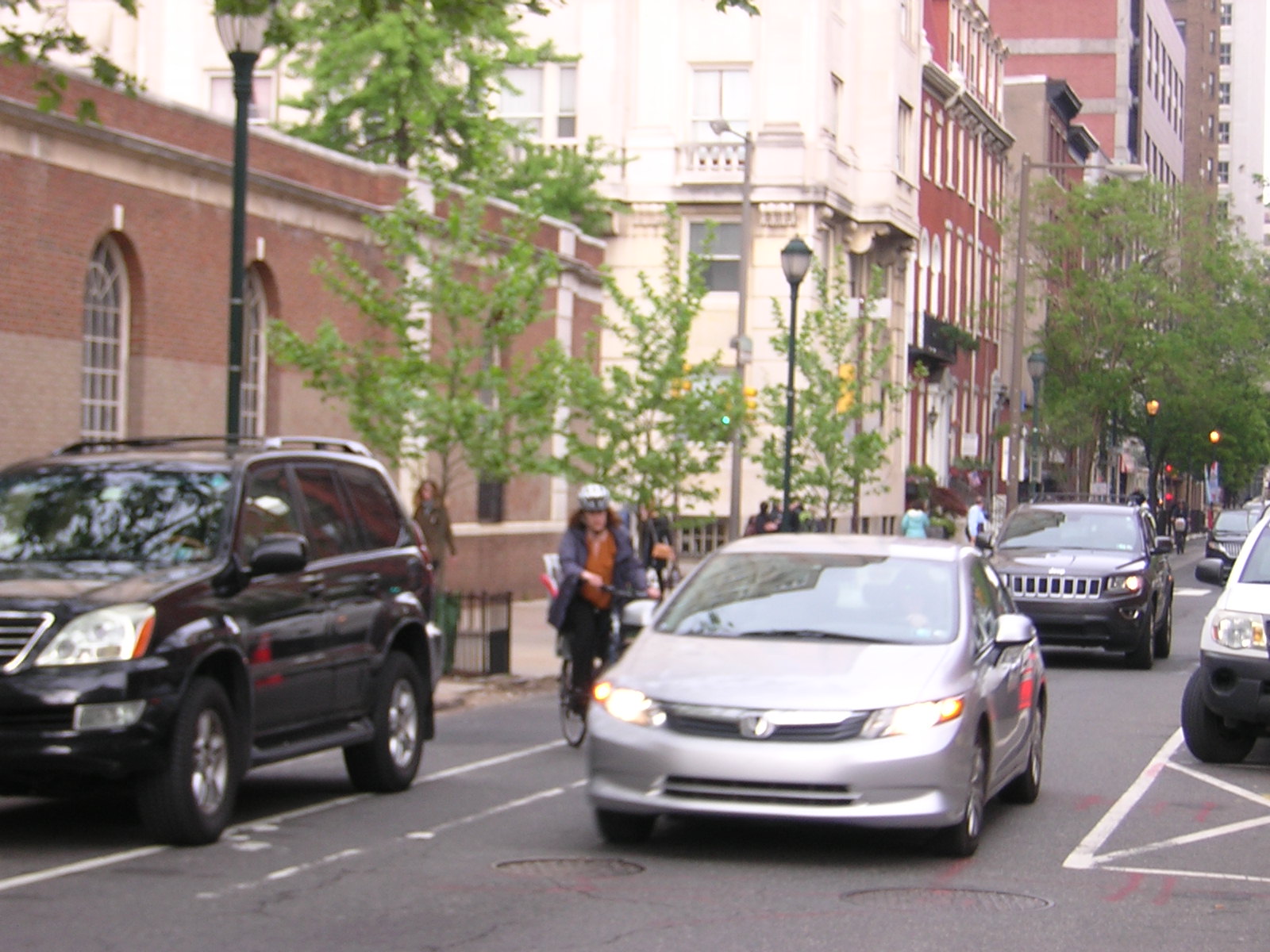
1600 block of Spruce street. Bike lane at left.
There is a proposal to turn the bike lanes on Pine and Spruce streets into protected bike lanes. This means that, in addition to the current (more or less) painted buffer zone between the bicycles and the cars, there will be a series of flex posts. These are plastic posts, usually orange, that you can now see in a number of areas around Philadelphia, perhaps most visibly on the Walnut Street bridge. The barrier they create is almost entirely visual and psychological. If a car hits them, they bend over. I used to call them wibble-wobble sticks, but my daughter tells me that is no longer accepted terminology.

(The posts on the Walnut Street bridge are white. They'd probably get hit less if they were orange, or yellow, or lime green. But I digress.)

I've now heard a number of well-meaning concerns about putting the flex posts in on Pine and Spruce. Most of these concerns, I believe, are related to an understandable reluctance to change the way things are. Cars currently use the bike lanes as loading zones. Moving vans use the bike lanes as loading zones. And houses of worship use the lanes on the weekends as parking spaces for persons attending services.

No stopping zone. Pine street bike lane.
My basic thought is that people need to take a step back and think about the street as a whole. There are currently three lanes - a parking lane, a traffic lane, and a bike lane.

The Parking Lane Is the Problem
I don't think the bike lane is the problem. I think the parking lane is the problem.

This thought crystalized when I read Jon Broh's comments in a recent Stu Bykofsky column. Jon is the current head of the Wash West civic, and his concern was for the merchants on Pine Street, who are apparently quite vocal about demanding that their customers have easy access to their stores by car.

Fine. The problem with access is not the bike lane. It is the fact that virtually all the spaces in the parking lane are given over to long-term storage of cars, and virtually no loading zones are available in the parking lane to provide the access that the merchants desire.

We need to think hard about balancing storage versus access at the curb. Currently in Wash West and CCRAville, there is no balance.

We also need to go back to Jeremy Bentham's thinking about the greatest good for the greatest number. In late 2014 and early 2015, Mike Axler and I conducted a survey of parking in CCRAville - the area west of Broad Street - and we came up with some surprising findings. The people parking on the street in CCRAville are a small minority. At least 87 percent of households in CCRAville do not park a car on the street. And yet we all suffer from the lack of access.

I haven't studied Wash West or Society Hill, but I'm inclined to think the numbers there would be similar.

Access on Pine and Spruce is part of a larger issue of access in many parts of the city. Recently the Crosstown Coalition, a group of 20+ civic organizations, conducted a parking survey. Of local businesses responding to the survey, 82 percent reported that delivery people and contractors had to park illegally. I do have a problem with a parking system that forces people to break the law just to do their jobs.

A piece of the solution to this larger problem is providing more loading zones. On Pine and Spruce I think two loading zones per block would do great good. I would put these spots at the front and the end of each block, because those are the easiest spaces to get in and out of.

I haven't made a study of this, but I have spent quite a lot of time on Pine and Spruce, in a car, on a bike, and on foot. My observation is that there are rarely more than one or two cars parked in the bike lane on each block. My proposal for two loading spots per block would clear the bike lane and not harm the motorists.

Large moving vans always pose a challenge. The city does allow residents to placard existing parking spots to make space for moving vans. And if the people parked in those spots don't move their cars, the cars can be towed.

As for the church and synagogue parking, I really think there is plenty of available curb space without blocking bike lanes. The houses of worship simply need to shift some cars to new locations. And perhaps some of those locations, dare I say it, could be off-street. Many of the garages in the affected neighborhoods have a significant number of vacancies on weekend mornings.

Why Should Anybody Care?
You may ask, Why should we ask non-bicyclists to go to all this trouble to accommodate bicyclists? The answer is this: With car-free, protected bike lanes on Pine and Spruce, the bike counts there could easily quintuple.

Right now, what we have out there are the "strong and fearless" and the "confident and enthusiastic." These groups total maybe 10-15 percent of the population. 60 percent of the population are called "interested but concerned." They're not going to come out if they're constantly having to merge into moving traffic to avoid cars parked in the bike lane.

On a personal note, I find that I'm slipping from the confident and enthusiastic category to the interested but concerned. I like to ride an Indego bike over to the Reading Terminal Market, but the constant lane-shifting is getting to me. I've had enough unpleasant experiences with oblivious or entitled drivers that I now often simply dismount and walk on the sidewalk around the parked car.

I think people who ride bikes will easily understand what I'm saying, but I've struggled a bit to find a way to explain it to non-bicyclists. Here's an attempt - it's not an exact analogy, but perhaps it's good food for thought. Think about the last time you were on the access lane to an Interstate highway, trying to get into the right traffic lane. The cars already in the right traffic lane are going 65 miles per hour or more. You need to accelerate to that speed and slip into a gap between two cars.

Not only are you relying on the courtesy of the motorists already in the traffic lane, you're having trouble seeing them, because your view to the rear is partially obstructed by the structure of your car.

Now imagine performing a slower version of that merge every two minutes for your entire trip, craning your neck to try to see what's behind you while also making sure you don't run into the parked car that's directly in front of you.

Change is difficult. However, I ask motorists and residents - and particularly those attending our local houses of worship - to engage in an act of empathy. Some small adjustments on their part could make a huge difference for bicycling in this city. And it's not just about the bicyclists. If the city is going to reach its goals for Vision Zero and clean air, among other things, it needs a lot more bikes on the road, riding safely.
And my boat is so small.
See also Parking: Storage v. Access, The Supreme Court and Parking, Why Are European and American Bicycling So Different?

Tuesday, June 9, 2015

Parking Permits and Musical Chairs

A few years ago, the Beacon Hill neighborhood in Boston set what I hope is a record. Beacon Hill is a prosperous residential neighborhood near the central business district. It's quite compact; there are only 983 on-street parking spaces. Residents with parking permits had the exclusive use of these spaces. The city issued the permits for free.

So how many of these parking permits were there? 3,933, or four for every spot.

I have this story from Professor Donald Shoup (The High Cost of Free Parking, 2011 edition, p. 516 and footnotes 31 and 32 on p. 552). After I read it, I started to wonder about the number of active parking permits in my neighborhood in Philadelphia, which is covered by residential parking permit Zone 1.

My neighborhood is essentially the southwest quadrant of William Penn's original plan for the city, centered on Rittenhouse Square. Sometimes it's called Greater Rittenhouse. I've taken to calling it CCRAville, after the Center City Residents' Association, the local civic group.

CCRAville extends south to South Street, but Zone 1 keeps going all the way down to Washington Avenue. The South of South Neighborhood Association looks after the area from South Street to Washington Avenue, which I call SOSNAland.

Both of these groups have recently performed parking inventories. CCRAville found 1,584 Zone 1 spots. SOSNAland, which is larger,  found 2,103. So there are 3,687 Zone 1 parking spaces in Zone 1.

And how many parking permits are currently in effect? Take a guess. Go ahead. Get a piece of paper and write your number down.

Okay. I filled out yet another Right to Know request and sent it off to the Philadelphia Parking Authority. A few days later they sent me a note saying they needed a little more time, and a few days after that they sent me the numbers.

As I've said before, I've found my recent interactions with the PPA to be productive and even pleasant. (There was that parking ticket six years ago.)

There are 6,957 Zone 1 parking permits currently active -- roughly two permits for every available Zone 1 spot.

How does that compare to your guess? Were you higher, or lower? Perhaps I influenced you with my story about Beacon Hill. Or maybe you couldn't believe a government agency would invite 12 people to play musical chairs when there were only six chairs.

Where Are the Extra Cars Parked?
One interesting question is where all those extra sticker owners are parking. I think the Beacon Hill story can give us some guidance here. Professor Shoup reports that in 2004 the price of a condominium parking space on Beacon Hill was as high as $167,500 (plus a monthly condo fee and annual property tax). Professor Shoup calculates the annual cost of one of these spots as $11,000. People are willing to pay a lot to be sure of a space.

By contrast, here in Philly in 2015 there is a garage a block from my house that charges $250 a month, or $3,000 a year. I've always thought that was kind of expensive, but it depends on what you compare it to -- $11,000 in Boston, or $35 at the curb in Philadelphia.

At any rate, Mike Axler and I have shown that at least 87 percent of households in CCRAville are not parking on the street in their neighborhood.

Why would you buy a sticker and never use it? The answer is that you can use it occasionally.  Every once in a while there's an open spot on my block. If I know I'm going out again in an hour, I may park at the curb instead of putting the car away in the garage. It doesn't happen very often. But it's only $35.

Splitting Zone 1
There's a proposal to split Zone 1 at South Street, so SOSNAland and CCRAville would each have their own parking zones. SOSNAland seems to feel that some of its congestion issues come from CCRAvillers parking south of South. I'm inclined to agree that this happens, but I have no way to size the phenomenon.  Personally I'm in favor of the proposal because I think it would make it easier to raise the price of a parking sticker in CCRAville. (There's no particular reason why all the zones in the city should have the same permit price, and yet they do.)

As part of my request to PPA, I asked for a breakout of the number of Zone 1 permits held by residents living in each of the two proposed zones. I combined those numbers with the number of spots in each area to produce these two tables.

CCRAville
Total on-street spots - 3,161
Zone 1 spots - 1,584
Zone 1 permits - 3,863

SOSNAland
Total on-street spots - 4,884
Zone 1 spots - 2,103
Zone 1 permits - 3,121

As you can see, CCRAville has 2,000 more stickers than Zone 1 spots, and it seems likely that some of them are parking south of South, although I think the bulk of them are parking off-street.

On the other hand SOSNAland, on its own, has 1,000 more stickers than Zone 1 spots. So splitting Zone 1 into two pieces will not be a panacea. There still won't be enough Zone 1 parking spaces for all the permit holders.

But wait -- SOSNAland is blessed with quite a few parking spaces that are not Zone 1 -- or at least not yet. There are 2,781 of these spots. Some of them are two-hour spots, which means they're not suitable for long-term storage, although they're a good place to park overnight. Many of the spots, though, are uncontrolled -- anybody can park for as long as he or she wants.

The uncontrolled blocks are often completely filled with parked cars. Who owns them? Once again, residents tend to point to outsiders -- for instance, Penn and Drexel students who bring their cars to school and store them for extended periods. I expect this happens, but again I have no way to size the phenomenon.

What if the vast majority of people parking in these uncontrolled spots are actually residents of SOSNAland -- Zone 1 permit holders who can't find a Zone 1 spot, and other residents who choose not to buy a Zone 1 permit?

It would be good to know who's parking there. If you convert these blocks to Zone 1 status, and the people currently parking there either have Zone 1 permits or can easily buy one, then you have gone to a considerable effort and made precisely no progress in controlling parking congestion.

This brings us to an important lesson: Parking permit zones are good at excluding outsiders. When the problem is too many insiders, things get complicated.

Thursday, April 23, 2015

Alleys

In Philly we have big streets, like Market Street; we have regular streets, like Walnut Street; and we have little streets, like Addison in, say, the 1700 block. I love this block. It's a narrow street, with no curbside parking allowed. The trees are decorated year-round with strings of white Christmas tree lights. (I'm told they're LEDs, so this exercise may even be reasonably green.)

Sometimes these little streets are called alley-streets, but we also have genuine alleys, which are even narrower and rarely beautiful. I would like to talk to you today about the alleys of Philadelphia.

Matchbox Cars
Let's have a look at the 1700 block of Waverly, which lies directly north of Addison. Here it is, tucked in between Addison and Pine, which is also a very attractive block. Waverly is a mess. The main culprit is the parked cars, which are shoehorned at odd angles into small spaces behind the houses that face Pine and Addison. This little alley looks somewhat like my living room floor years ago, after my son was finished playing with his Matchbox cars, and before we had agreed to clean up.

There are alleys like this all over the neighborhood. We tend not to notice them.  Why walk up 1700 Waverly when you can walk up 1700 Addison?  I only started paying attention when I was working on the inventory of parking spaces for the neighborhood, and I had to walk up these alleys. That was where the parking was.

I understand that the space available is frequently very tight.  But is this an excuse for turning a whole street (alley, excuse me) into a hodgepodge? After all, we're talking about the backyards of some very nice buildings.  I can vouch for the front facades being nice, and the houses I've been inside have generally been quite nice as well. But then we walk out the back door into an inartful jumble of architectural afterthoughts.

It's a shame that some of the city's prettiest streets are backed up by these automotive shantytowns. We might as well put up a sign: Abandon All Standards, Ye Who Enter Here.

So that's the way it is, but I don't think it's necessary. All we really need to do, I think, is pay a little attention.

Trash
The same thing goes on up in the Central Business District, only there the main culprit is trash, not cars. It is apparently a Philadelphia custom for merchants and restaurateurs to store their trash in the alley. While I'm sure this delights the city's population of rats, I, as a human, find these alleys quite distasteful.  Have you ever walked down the 1700 block of Moravian? It's far from the worst, but it's bad enough. And there it is, sandwiched between Walnut, our premier shopping street, and Sansom, home to the Sofitel Hotel (they're from France, you know) and also a very nice row of small shops and restaurants.

F for Functional
I've actually developed a grading scale for our alleys. If you're interested, feel free to use it as you walk around town. You don't really have to walk down the alleys. You can just peek from the corner.

Here's the scale:
F - functional. A place to stow cars or stash trash. No redeeming qualities.
D - depressing. Many defects, but not the worst.
C - crummy. A few defects, lacks cohesive vision.
B - borderline. No defects, but doesn't spark joy.
A - actually attractive.  A good, integrated design showing imagination and possibly a bit of whimsy.

I could hand out a lot of Fs at this point, but instead let's look at a block that almost has its act together -- the 2100 block of Cypress.

In fact, I'll give the south side of this street an A. The north side is a C, but it would be a B if two garages with derelict but functional facades were fixed. However, to become an A the homeowners would have to get together. On the south side there is a theme with variations. On the north side there is cacophony.

Perhaps the Center City Residents' Association could branch out from horticulture and have an alley contest.  I think I'd withhold a prize for best alley, at least for a few years, but perhaps award several prizes in the most improved category.

Progress is possible, folks.  It doesn't have to be this way.  Just pull the camera back from the neighborhood where I live and take a wider shot that includes all of Center City.  There are many lovely alleys in places like Washington Square West and Society Hill.  There's even the grand-daddy of them all, Elfreth's Alley, the oldest continuously occupied residential street in the country.

Pasadena
Or we could pull back further and then zoom in on Pasadena, California.  Pasadena's downtown, known as Old Pasadena, is Professor Donald Shoup's shining example of a successful Parking Benefit District.

In his book The High Cost of Free Parking, Professor Shoup recommends Parking Benefit Districts as a crucial key to solving our parking problems and improving our neighborhoods. PBDs receive a portion of the parking revenue generated within the district and spend it on neighborhood improvements.  Generally Professor Shoup recommends fixing the sidewalks, planting trees, and burying utility wires.

In Old Pasadena there was an additional improvement opportunity -- the alleys. Meter money, says the Professor, "helped convert what had been a commercial skid row into one of the most popular tourist destinations in Southern California." (Shoup, High Cost, 2011 edition, p. xxviii.)

I've been to Pasadena, and I've seen the alleys.  They're really nice -- "safe, functional walkways with access to shops and restaurants," as the Professor puts it. (Shoup, p. 406.)

Stone Street
If we come back to the East Coast, we can find a particularly attractive alley in Lower Manhattan. It's called Stone Street. According to the indefatigable researchers at Wikipedia, an alliance of property owners, city agencies, and do-gooders "transformed Stone Street from a derelict back alley into one of Downtown's liveliest scenes.  Restored buildings, granite paving, bluestone sidewalks and period street lights set the stage for the half dozen restaurants and cafes, whose outdoor tables are very popular on warm summer nights."

I was there with my brother a while ago.  It was a pleasant morning, and I recall having cappuccino and a croissant on the cobblestones. Lovely.

On Stone Street we also encounter the curious phenomenon of the two-faced restaurant.  It seems almost all the places that open onto Stone Street also open onto one of the neighboring streets. This takes a little getting used to, but my sense is that two entrances on two streets can be good for business.

I know of one two-faced restaurant in Philadelphia.  It's called Bru: Craft and Wurst, and it's located on the 1300 blocks of Chestnut and Drury.  If you stand on Chestnut and look in, you can see McGillin's on the other side of Drury Street.  It's an unusual view.  Ordinarily you can't see through a city block.  Too much stone in the way.

Moravian Again
Which brings us back to the 1700 block of Moravian Street in Philly, nestled quietly between Walnut and Sansom.

Time has not been kind to this block of Moravian, but guess what? Virtually all of the buildings on Moravian seem to extend through, either to Walnut or to Sansom.  On the south side there are a bunch of blocked up doors and windows just waiting to be daylighted, and on the north side a number of the buildings have actual front facades, instead of the familiar turn-your-back-on-the-back-alley treatment.

Does it have the potential of Stone Street?  Probably not.  But this block of Moravian sits in the lap of two of the hottest retail blocks in Philly -- the 1700 block of Walnut, and 18th Street from Walnut to Chestnut.

I look forward to a tranquil cappuccino amidst the happy bustle of commerce.  Probably not soon, but I'm a patient guy.

Monday, April 6, 2015

Parking: Storage v. Access

At the end of March, my friend Mike Axler and I were walking home from the Kenyatta Johnson-Ori Feibush city council debate. It was actually warm.

I suggested that we were done with our field work. Mike noted that we managed to finish just as the weather was starting to warm up.

Since the previous fall, Mike and I had been trudging around the CCRA village (basically the southwest quadrant of William Penn's original plan for Philadelphia). Working as volunteers for the Center City Residents' Association, we were counting parking spaces -- on-street and off-street, in big garages and little.

There was more we could have done, but we were tired, and what was the point of running up the score. We'd already established that at least 87 percent of households do not park a car on the street. We probably could have gotten the number over 90 percent, but what's the point?

I'll go over the numbers in a minute, but let's look first at what they mean.

The Plumber
Some time in the good weather last year, there was a knock on my door about 7:30 in the morning. It was a plumber, and he needed to replace a connection in the street. There was a car parked where he needed to dig, and he was wondering if I knew who it belonged to. Perhaps we could knock on that person's door, and ask him to move his car?

I was speechless. This very nice man thought the cars parked on the street belonged to the people who lived on the street. Maybe in Mayberry, but not in Center City Philadelphia. When I was parking on the street, I was happy if I found a spot within three blocks of my house.

However, the West family was able to help the plumber. My wife glanced at the rear window of the car, noted that there was no Zone 1 parking sticker, and suggested that the car would probably be leaving shortly after 8 a.m. Which is what happened.

Underlying Assumptions
We all know that curbside parking in the CCRA village is very tight. And people are constantly looking for ways to expand the supply of on-street parking. Can't we add one more spot at the head of the line, up by the corner -- thereby decreasing visibility and dramatically increasing the likelihood of pedestrians getting hit by cars in the intersection.

There are a couple of underlying assumptions here. One is that it is possible to increase the supply of curbside parking in a way that would help to meet the demand for spaces. It's not true.

Another is that most people with cars are parking them on the street, and that the street is the primary and natural resource for parking an automobile.

Well, no. As I noted above, at least 87 percent of households in CCRAville do not park a car on the street.  Three-quarters of those who own cars park them off the street.

And half of households don't own cars. Some people seem to have difficulty processing the idea that there are parts of the United States where most people don't own cars. However, in some parts of the CCRA village, the figure is over 60 percent.  (See Philadelphia City Planning Commission, Philadelphia 2035: Central District Plan, Existing Conditions, Issues, and Opportunities, May 2012. The relevant chart is entitled Vehicle Availability.)

It's not Mayberry.  It's not even South Philly.  It's the big city.

The Dream
The Dream will always be there. I should be able to park my car for free at the curb in front of my house whenever I want. Well, no. That's not the way it works here.

But because a lot of people think that wishing makes it so, a lot of things have gone remarkably askew on our streets.

The Zone 1 parking sticker, priced at $35 per year, allows residents to store their cars on the street, which they often do for weeks at a time. This use -- long-term storage -- conflicts directly with another important use of curbside parking -- short-term access.

Short-term access barely exists in the southern parts of CCRAville. However, if you go up to Rittenhouse Square, you can get a glimpse of what it looks like. With the exception of the north side of the square, most spots are loading zones. There's never a problem dropping Aunt Tillie off at the Barclay.  And then you put the car in the garage.

The Numbers
Okay, so how about the numbers? Mike and I have previously reported that we found 1,584 Zone 1 spots in the CCRA village.  (Total on-street spots, including the regular two-hour spots, the Zone 1 storage spots, and spots for diplomats, the handicapped, registered packaged delivery companies -- let's not forget car share and taxi stands -- were 3,161.)

Off-street facilities with less than 30 spots totaled 1,930.

As to garages and lots with a capacity greater than 30, we knew there were well over 11,000 of those, but we didn't know how many were monthly rentals -- as opposed to short-term visitors.

So Mike, who used to do this kind of work for a living, rolled up his sleeves, made phone calls, met with garage managers -- and very often came away with valuable information. Not everybody was willing to talk, but he found 2,894 monthlies in the big garages.

There are more, and we probably could have verified more, but we had what we needed, and we stopped.

Here it is:

2,894 (over 30) + 1,930 (under 30) = 4,824 parking off the street.

Versus 1,584 storing their cars in Zone 1 spots. So 25 percent of cars are being stored on the street:

4,824 (off) + 1,584 (on) = 6,408 (total).

1,584 (on) / 6,408 (total) = .247 or 25 percent.

But half of households don't own a car.  So 12.5 percent -- be generous and make it 13 percent -- of households are parking on the street, and 87 percent are not.


What Do We Do?
The constituency for on-street storage is 13 percent.  But, as I've said before, the constituency for access is 100 percent.  Everybody wants the plumber to be able to visit.

We need change.

So what do we do? Well, here's a start:  On page 696 of his book The High Cost of Free Parking, Professor Donald Shoup recommends destickering some of the spaces on each block in a neighborhood like the CCRA village. The rest of the spots would remain Zone 1 storage spots. The destickered spaces would become standard two-hour access spots during the day, and still be available for overnight parking.  It won't solve the whole problem, but it's a start.

(See previous posts in this blog:  The Parking DreamProfessor Shoup's Parking BookParking in San Francisco.)