Wednesday, September 5, 2018

Narcissism and Dictatorship


Benito Mussolini near the end of his career.

 "Count Carlo Senni has just been talking about his years with Mussolini, to whom he is whole-heartedly, but not wholly uncritically, loyal. He emphasizes one trait which strikes everyone who has ever worked with Mussolini: his unbounded, almost undisguised, utterly cynical contempt for his own human instruments. Except for his brother Arnaldo (now dead) and perhaps, to a lesser extent, his daughter, there is no human being in the world whom he loves and trusts. He believes in the ability of his son-in-law; he does not trust him. A sentimentalist about 'the people' en masse, he is completely cynical about all individuals, and measures them only by the use he can put them to... Yet so great is his personal ascendancy that his underlings - knowing that they themselves will be kicked away as soon as they cease to be useful - still retain their personal devotion to him."

- Iris Origo, A Chill in the Air: An Italian War Diary, 1939-1940 (2017) p. 66.

See also Fascism,  An Inflection Point, What Can Pierre Laval Tell Us About Donald Trump?

Tuesday, September 4, 2018

Blame the Victim and Privatize the Grief

If You're Wrong, Go with the Big Lie

June 3, 2018. I got my t-shirt at 22nd and Spruce.

There's a well-worn playbook that's been used by the tobacco and asbestos industries and now seems to be an integral part of virtually any reactionary movement that deals with ideas. The basic principle is quite simple: Deny the premise. If scientists are saying that tobacco causes cancer, find some scientists who are willing to disagree. If argument doesn't work, go buy some scientific research that backs your side. If the war goes on long enough, found think tanks and give your best propagandists fancy, academic-sounding titles. (For background on this topic, see Wendell Potter, Deadly Spin, 2010, chapters 2 and 3. See also Jill Lepore, "The Lie Factory," The New Yorker, September 24, 2012.)

There's another template that came to my mind recently, after the shootings at Marjory Stoneman Douglas High School in Parkland, Florida.

Back in the 1920s, a new-fangled contraption called the automobile was busy slaughtering children in the streets of our nation's cities. And many people were unhappy about that, and they protested - there were marches, all kinds of things. (See Peter D. Norton, Fighting Traffic, 2011.)

The auto industry and its allies were taken aback by this uproar, and so they organized on a number of fronts. In particular they got state legislatures to change the traffic laws to make it illegal for pedestrians to cross in the middle of the street. This was a novel idea, and so "motordom," as it was called, didn't just sell it to the lawmakers. It also mounted a huge public relations campaign, even inventing the term "jaywalking."

With the law on their side, the auto lobby could then blame the victim. Little Johnny shouldn't have chased that ball out into the street. Or, what was he doing wearing dark clothes at dusk? On it goes, and it still goes on today. When a Duck boat driver killed a pedestrian down by the Reading Terminal Market, here in Philly, there was much tsk-tsking about how the pedestrian lacked sufficient situational awareness.

I wish I could say that the media have not been complicit in all this, but they are. Let's face it: Car ads are a huge category for print, television, and online media. Last year, for instance, a local television station did its best to blame a 14-year-old girl who was hit by a car while walking in a crosswalk in suburban Abington. (For a story on this, click here.)

In the end that driver was charged. In the Philadelphia Duck case, it was the insurance companies that finally shut the company down.

Okay, so blaming the victim is the setup punch. And here's the money punch. Motordom can say, with a straight face, that death on our roads is a private matter, not a concern of public policy. Mothers just need to do a better job keeping their children inside, playing violent video games and getting fat. The government doesn't need to do anything. Shouldn't do anything.

And by the way, speed limits are an un-American infringement of citizens' God-given rights. So our political class needs to balance freedom and death.

And the same thing happens with guns. Here the NRA has the advantage of the Second Amendment, which the Supreme Court has obligingly interpreted in a profoundly screwy way. So they've got the law.

But I don't think they're doing very well on blaming the victim, and we need to make sure that that continues to be the case. Because if they ever do get traction on that, then I think they'll have a good shot at privatizing the grief and removing the issue from the public agenda.

Fortunately, I think the NRA is playing a weak hand. Wayne LaPierre's famous statement that "The only way to stop a bad guy with a gun is with a good guy with a gun" is problematic on a number of levels. First, we now have many instances where a good guy with a gun was present and failed to prevent mayhem. Second, there are alternatives, like seeing that the bad guy doesn't have a gun. In a school setting, LaPierre's dictum also conjures the image of giving guns to kindergartners. Even the idea of arming teachers takes many people to a place they don't want to go.

At its core, the NRA's vision is profoundly dystopian, and their argument for irresponsible freedom only appeals to certain people.

That leaves them with raw power. But power in America almost always comes cloaked with virtue. Naked, it's a tough sell.

I think that leaves a very large gap for the kids from Marjory Stoneman Douglas to rush through, and I think the rest of us should follow. Call us the Utopians, or maybe the Shining City on a Hill Mob.

See also Cars and Bikes - the Back Story, Gunfight at the O.K. Corral, Guns Without Responsibility

Friday, August 17, 2018

A Larger Story Coming On

Rescuing the West Side of Philadelphia's City Hall

Pedestrians not cowering behind the parapet. No parapet.

I feel a larger story coming on, but let me steal my own thunder and sketch it out here.

People are complaining about the new Love Park, and still complaining about the new Dilworth Park, and not complaining at all about the old plaza around the Municipal Services Building, and its defensive ramparts.

All three of these areas were rebuilt in the years after World War II, and in each case that design was a reaction to the takeover of our streets by motor vehicles. Love Park and Dilworth Park have been rebuilt more recently, and I think the criticisms of these rebuilds may, in certain cases, be overlooking the very serious deficits that have been remedied.

I think the area west of City Hall, in the center of William Penn's 1682 plan for the city, is a Petri dish for what happened to cities after World War II (although things were definitely getting started well before that war).

Basically, planners were trying to figure out how to keep motorists from killing pedestrians. If you think the casualty numbers are bad now, you should have a look at what they were back then, and then remember that the country's population was much smaller than it is now.

So what did planners do west of City Hall? They ceded the streets to motor vehicles. Pedestrians were allowed on sidewalks, and possibly tolerated at crosswalks, as long as they ceded priority to the cars and trucks. Failure to do so could easily result in death, or serious injury.

But what about people gathering in public spaces? This was of course, the civic center of the city of Philadelphia, birthplace of the nation and presumably a place that should value people gathering together and exercising their Constitutional right to free speech. Well, okay, we'll have some places for people to get together, and we'll make sure they won't be run down by an errant drunk in a Ford Model T, or possibly a Mack truck.

So we'll create defensive positions around these public spaces that would make the Wehrmacht proud. Those of you who have seen the movie Saving Private Ryan will probably recall the landing on the beach. Well, those defenses were rather unambitious compared to what we erected on the west side of City Hall, and around Love Park, and up around the Municipal Services Building.

And so that's what they did. And very few motorists seem to have found their way into these spaces (except the north apron of City Hall, which became a parking lot for city officials and frankly, was easy to get into compared to the west side of City Hall).

And the people huddled in their designated gathering areas, presumably grateful that they could do this without getting killed.

As I look at the only remaining piece of this architecture of defense, surrounding the Municipal Services Building, I continue to see what I saw throughout this area - very good machine gun emplacements and rifle pits, and the occasional mortar pit.

I personally don't think that military architecture is a good model for civic architecture, but that's what we had here. And it's going away. And I'm grateful for that.

See also Transportation Should Not Trump Destination.

Thursday, August 9, 2018

The Future of Christ Church Park

Looks Like This

Billy the Goat and some friends in Rittenhouse Square.

Steal Billy! No, just steal the kids. They don't have to be these exact kids. They might even live close to Christ Church Park, at Second and Market, instead of over by Rittenhouse Square. But children and their moms and dads are crucial to the future of Christ Church Park.

There was a wonderful design workshop on the afternoon of Wednesday, August 8, on Church Street, between the church and the park. The workshop simply took half a tent in the regular Wednesday farmer's market, and it blended well, people trading in vegetables, handiwork, and ideas.

It was a warm day, but a lot of people found the time to stop by and put stickers on a sheet to show their preferences for various things (it turns out the park's walls and fences are not terribly popular). They could also write a comment on a small slate board and be photographed with their comment. Then the slate board would be erased for the next customer. And they could draw on tracing paper over a plan of the park and its environs, showing where they wanted new gates, new paths, more trees, etc.

All this will be processed and reported by the appropriate authorities. My immediate takeaway is that a lot of people do care about this park and see that it could function better than it currently does.

I spent several hours at the park during the design workshop. I watched and chatted, got an iced latte from Old City Coffee, took pictures, and spent some time with the park's official storyteller, whose bench is very near the grave of Founding Father James Wilson. Wilson signed both the Declaration of Independence and the Constitution, he served as an associate justice on the U.S. Supreme Court, and  he became the first professor of law at the University of Pennsylvania. Christ Church Park is officially named James Wilson Park.

The official storyteller told me and a couple from Virginia about Benjamin Franklin's wife, and we compared notes on literature. She told me Erik Larson's The Devil in the White City was one of her favorite books. It turned out she is from Delaware, so we also got to talk about Caesar Rodney and his famous ride through a thunderstorm to sign the Declaration of Independence.

All this was in the afternoon. In the morning I went to Sister Cities Park, in Logan Square, to take some pictures of the water features there. I have no idea whether Christ Church Park could pull off something like what's going on at Sister Cities Park, but I sure hope it can.

The wading pool and the rock garden.

The wading pool and rock garden are to the north of the cafe; the sprinkler field is to the south.

Sprinklers. Kids.

One thing that Christ Church Park doesn't need is a cafe. Old City Coffee is happily taking care of business at 221 Church Street. You can crawl there from the park, and that's almost what I did. It was a hot day. They do have air conditioning in addition to latte.

Old City Coffee.

See also The Invitation.

Wednesday, August 1, 2018

The Invitation

Christ Church Park, An Underperforming Asset


The corner of Second and Market. No gate.

So maybe we should ask people to come into the park. Just a thought. It's a nice park - I've often admired it walking by, on either Market or Second, on my way to somewhere else. I've hardly ever gone inside the park, and when I have I wasn't quite sure what to do there.

Let's face it: I've been coddled by Rittenhouse Square, where there are benches, other people, yadayada. Oh, yes, and there are ways into Rittenhouse Square.

How do you get into Christ Church Park? It's almost a secret. Is there an entrance at or near the corner of Second and Market? No. Think about Rittenhouse Square and the corner of 18th and Walnut, with massive quantities of pedestrian commuters in the morning and evening rush, bike messengers hanging out all day, socializing and waiting for their next call, various solicitors for religious, political, and other causes. The occasional odor of marijuana. Nothing like this happens at Second and Market. There's no gate there, you know.

Gate on Market Street, recessed in midblock.

There are two entrances to Christ Church Park, and frankly they're almost hidden. There's one on Market in the midblock, at the southwest corner of the park. The other one is at the northwest corner of the park, near the entrance to Christ Church. The two gates are connected by a brick walkway, the only path in the park.

The Market Street gate and the walkway.


Gate on Church Street.

Urbanist Jan Gehl likes to talk about the invitation. If you want people to come into your park, you need to invite them in. (See Jan Gehl, Cities for People, 2010, pp. 15, 17, 21, 236-237.)

View from Church Street gate, Christ Church across the street.

Okay, so let's assume you're in Christ Church park. What do you do then? Good question.

I'm a simple guy. My main park activity is hanging out. I don't need rope courses or zip lines. A place to sit would be nice. The park currently has five stone benches strung along the walkway. They do not have backs or armrests, but they are backed by a brick wall. Here's a picture.

Four of the five stone benches. The walkway. The brick wall.

Behind the brick wall, by the way, is a parking lot. It is virtually invisible. I wish all the parking lots in Philadelphia were as demure as this.

This parking lot is on line with American Street. 

Given the configuration of the park as essentially a pilgrim's path to the church, it is perhaps not surprising that park utilization leaves something to be desired. Dog-owners walk their dogs here, and even that has its ins and outs. This is a National Park Service park, and the Park Service requires dogs to be on-leash at all times. It's in the Code of Federal Regulations:  36 CFR Chapter 1, Section 2.15(a)(2).

Reimagining the Park
I picked up these tidbits at a July 18 meeting in Christ Church's Neighborhood House, next door to the church itself. On the fourth floor, in an auditorium that used to be a gym (there are still basketball-court markings on the floor), I watched and listened as various speakers discussed various aspects of the park.

All this gabbing was in service of a project sponsored by the Old City District: Reimagining the park at Second and Market Street.

Ideas? Yes, I Have a Few
Here are a couple of ideas off the top of my head.

My top priority. Figure out how to get little kids and their moms and dads into the park. You definitely want them in the mix of park users. They bring a whole new and very positive vibe.

Just look at the statue of Billy the Goat in Rittenhouse Square. The goat is the center of a seating area largely but not exclusively occupied by small children and their parents. This place is so popular with kids that, after a century, a literally worn-down Billy is retiring to a nice pasture across the street in the Philadelphia City Institute Library. He will be replaced by Billy Jr., an exact replica.

Second idea. Plan for a mix of uses. In The Death and Life of Great American Cities (pp. 96-97), Jane Jacobs explains the secret of Rittenhouse Square's success. Because it borders a residential district and a commercial district, the park draws different people at different times of day. Aside from small children and their parents, and the old people who like to sit on benches and watch them, you have pale-faced office workers who come to get some sun and exercise while walking on the park's ring path. The benches welcome people eating takeout lunches.

I could go on, but you get the idea.

So here are some physical changes that would undoubtedly make Christ Church Park more popular.

- More gates, better placed.

- Diagonal paths. These would encourage people to shortcut through the park. A valid use to my mind (I certainly do it a lot myself), and some of the people passing through may sit down for a few minutes, rest their feet, and look around.

- A water feature. Philly has lots of great water features, none better in my estimation than the two at Sister Cities Park by Logan Square (talk about child magnets). I personally think the water feature at Christ Church should include a watering trough for horses.

- Interpretive plaques. And here's why we should have a horse trough. Somebody needs to step up and educate tourists and locals about the history of the nineteenth-century city they are standing in the middle of. Explaining to people what a horse trough is could be a good place to start.

Why All the Low-Hanging Fruit?
As I learned at the information session, Christ Church Park is a child of the 1960s. The Park Service wanted to create a view shed for the church, so it pulled down the buildings where the park now is and created a very pretty space that would allow tourists to stand at Market Street, where the sidewalk has been widened and a raised planting bed with low walls appropriate for seating has been provided. (These walls currently sport a don't-sit-on-me rail running along the top.) Tourists could view Christ Church from a distance and then possibly walk on the walkway at the west side of the park to view the church exterior close-up and possibly even go inside the front door, just a few feet from the park's northern gate. Any other uses by pedestrians do not seem to have been in the program.

That's simply how people were thinking then. Take Mies van der Rohe's iconic Seagram Building, on Park Avenue in Manhattan. A product of the 1950s, it stands in magnificent isolation behind a very effective view-shed plaza. Later on, people did get the idea that maybe there should be, you know, people in the plazas, but in the beginning it was definitely look but don't touch. It might be a step too far to say that the only pedestrians welcome were architectural photographers. Or it might not be a step too far.

The view of Christ Church from Market could actually be improved by lowering the fence. New York City's parks department has a program called Parks Without Borders; it does advocate in certain situations for taking down fences entirely. I wouldn't do that here because I think the moms and dads will want some perimeter definition to help keep their little ones from wandering out into the middle of Market Street.

Learning from Love Park
Part of Old City District's reimagining process will be looking at ways to further civilize the streets adjacent to the park.

I watched this mission civilisatrice (as the French would call it) fail at Love Park. I love the new Love Park itself, but nothing was done about the surrounding streets despite promises and hints.

I'm still angry about Love Park, but I'm working resolutely to set that anger aside and focus on the opportunities presented by Christ Church Park. I think, with a little help from well-meaning people, the park could raise its game significantly without spending a lot of money.

There's an open design workshop at the park Wednesday, August 8, from 2 to 7 p.m. The workshop will be at the farmer's market, which is next to the church.

There is naturally a page on the Old City District's website. Linked from the page are a survey and the slide deck from the July 18 presentation. Click here to view.

See Do We Secretly Want Ugly Cities and Dangerous Streets? Also Road Diet by Love Park - a Natural Experiment.

Monday, July 16, 2018

An Inflection Point


I could feel some tectonic plates shifting after the meeting in Helsinki between Putin and Trump. Some are calling Trump a traitor, which in my opinion is probably true. Others are asking what actually went on behind closed doors for two hours, since Trump is well known to have an attention span of about 18 seconds. The idea of him carrying on a sustained conversation for two hours with no aides to prompt him is laughable. So there will be the inevitable jokes about the Putin-Trump tryst. Was there spanking? Were there whips?

All of this is amusing, but I think it's not the main point. And I don't think that Trump's childishness or his petulance are the main point.

I think the main point is that Trump showed weakness. His painfully servile performance can be indicative of a number of things. Perhaps there really are pee tapes. More likely, the Russians have been financing Trump for many years, after the New York banks gave up on him, and so the Russians have the ability to ruin him financially, politically, any way you wish to name.

But we live in a world of carnivores. Putin is not alone. There's an old line about never showing weakness to a wild animal, because when the wild animal senses weakness, it automatically attacks.

The wild animal Trump needs to fear, more than Putin, is the American people. Right or left, we see ourselves as a great power, and when questions arise about what Mr. Trump was doing on his knees in front of Mr. Putin for two hours, I think the worm may just turn.

See also Bannon and Co. Aren't Very Good at Being Evil, Fascism, What Can Pierre Laval Tell Us About Donald Trump?

Monday, July 9, 2018

Second and Chestnut


200 block of Chestnut, the interesting side.

As regular readers probably know, I get to Tuesdays with Toomey as often as I can. Which is pretty often. Our venue, at Second and Chestnut, is on the southern border of Philadelphia's Old City, and I've fallen in love with it.

You may also know that I'm fond of color in buildings, and as the picture above shows, there's quite a bit of color in the architecture of Old City.

Here's a picture of what our meetings are like.

Tuesdays with Toomey, June 5, 2018.

We've been meeting here since Toomey moved his office to the well-fortified Custom House in early 2017. Before that, he was up on JFK near the Comcast building, and those Comcast folks would come pouring out at lunchtime and join the rally. I once estimated our crowd at 700. Today, it's more like thirty, sometimes fifty. When John Fetterman showed up, we were over 100.

So the crowd is smaller, but guess what? The snowflakes didn't melt in the spring of 2017. We have persisted.

I'm not terribly fond of Pennsylvania's junior senator, but I am grateful to him for bringing me to this neighborhood. And, as a bonus, I'm quite certain that I will never, ever see him here.

I've had the opportunity, before and after our rallies, to wander around the neighborhood. In the 200 block of Chestnut there are two little streets, Strawberry and Bank, that run north to Market. And, if you're in the mood, you can do some time travel. But this is also a very modern, hip locale that is using its old bones well. Here's a view down Strawberry to the Custom House, where Toomey's office is.


And here's a shot north on Strawberry, showing the spire of Christ Church on the other side of Market.


Here's the view north on Bank.


Strawberry Court, Bank Street facade.


Okay, let's walk up Elbow Lane to Bodine Street and have a look at the beer garden there.

A different take on parking.

Strawberry Street and Trotters Alley. A parking lot and Second Street are reflected in the windows.


In the days before electricity, vault lights were used to let the sun shine in to basements, which typically extended under the sidewalk. Here's a vault light on Chestnut Street.


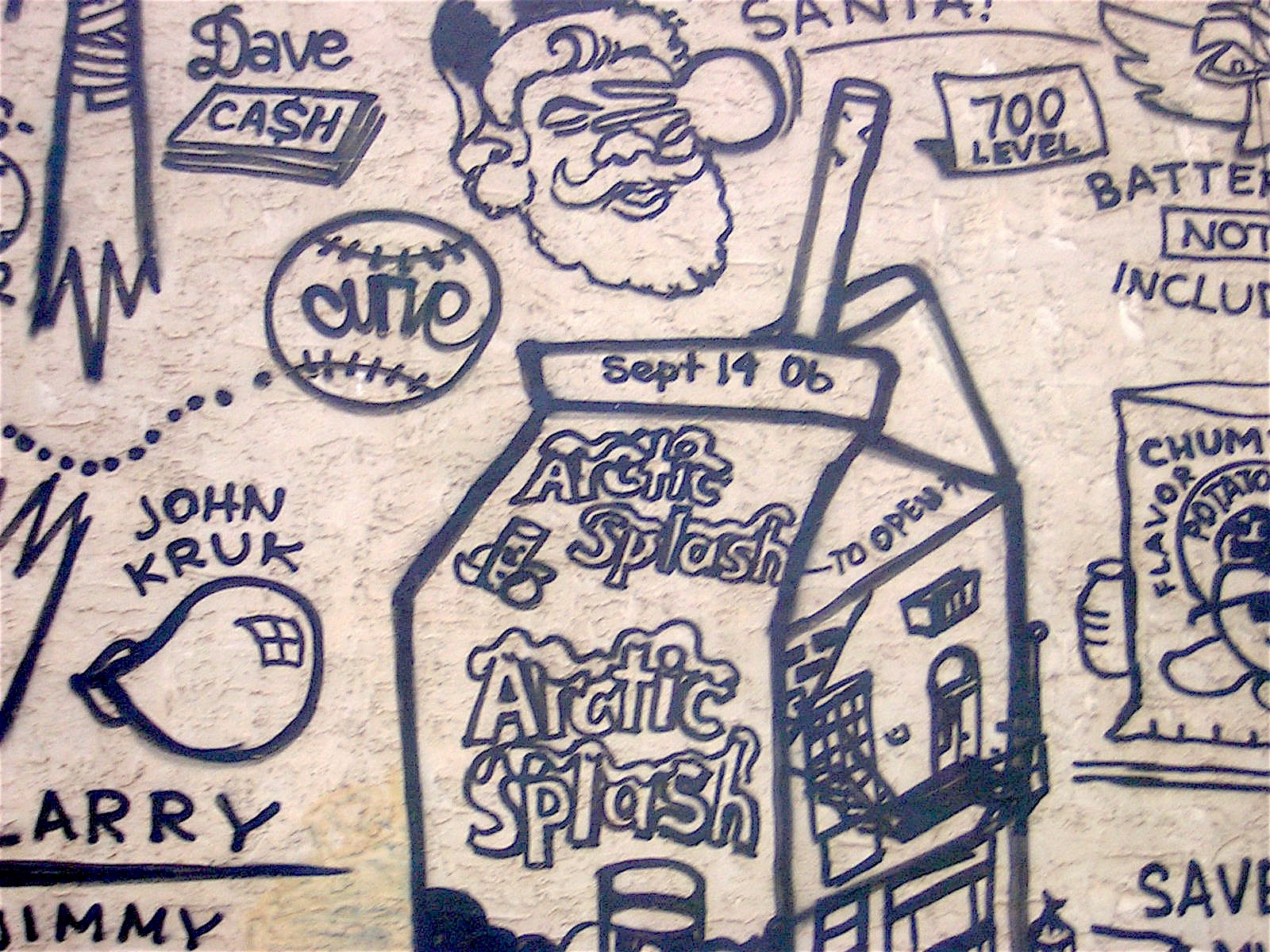
The shot below is for my friend Justin Coffin, who has been photographing real Arctic Splashes for years. The rendering here is part of a large and pleasantly incoherent mural on a wall that helps to define an utterly unremarkable parking lot.

Strawberry and Trotters Alley.

Sticking with the monochromatic approach, here's something I stumbled across in a little alley next to the Ritz garage. Aside from the poorly maintained Belgian block pavement, this was literally the only point of visual interest on the entire block. Calling Isaiah Zagar.

Ionic Street.

Back to color: How about some orange?  Here's the sidewall of the European Republic restaurant on Strawberry. Decent food.

Strawberry at Chestnut.

See also Senator Skedaddle, Senator Toomey Called My Son A Burnt-Down House, My New Favorite Alley.