Showing posts with label Isaiah Zagar. Show all posts

Wednesday, October 17, 2018

Permeable Blocks

Going Off the Grid in Old City

Old City Philadelphia, 1811.

When I got to the top of the stairs and saw the dead squirrel lying in the dirt, barely three blocks from the Liberty Bell, I mused once again on Philadelphia's apparent inability to sustain a performance. Maestro, cue the tone-deaf trombones.

My friend Joe Schiavo tells me it used to be a lot worse. The area at the top of the stairs, now a parking lot, used to be a hot spot for short dumping. Still, the center of this block should be a Grand Central Station for distributing pedestrians - both tourists and locals - among the various destinations that lie a stone's throw from my dead squirrel. And it's not.

The pedestrian walkways through this block already exist. The east-west route actually extends from the mall, between Fifth and Sixth Streets, past Christ Church at Second Street, and all the way through to Front Street. The north-south route joins the Arch Street Meeting House to the north with Franklin Court just south of Market, and continues through the National Park to Old St. Joseph's Church, just south of Walnut.

However, there is a hitch in the north-south route - a gate at the southern edge of the Arch Street Meeting's property. This gate seems to be locked all the time.

Here's what the area around the gate looks like. The dead squirrel is just to the right, out of the picture.

Perhaps not a jungle, but definitely a jumble.

The gate is actually separating two parking lots - the lot for the Arch Street Meeting House to the north, and the parking lot to the south, which lies behind buildings that front on Third and also Market.

The gate issue is easily fixed with a key. But there's a reason the gate is locked. The parking lot at the center of the block - where all the walkways converge - is a very uninviting space. To put it charitably, this lot does not meet the City's current design standards for parking lots. (See Putting Some Park into Old Parking Lots.)

Here's what the bad-boy lot looks like. The stairs that lead to the walkways running south and west are just out of sight to the right.


There's also room for garbage. (Think sheds, at the very least. See What Should We Do With the Humble Dumpster?)


And here's my favorite wall. Something assembled by people who simply do not give a damn.


The one good thing about the mess in the middle of the block is that it's hard to see unless you're standing right on top of it. There's a significant grade change right in the center of the block, which is why there are stairs.

Don't forget to set the hand brake.

From Fifth to Third
Let's back up and talk about some of the parts that are pretty. The walkway, as I mentioned, begins in the west at Fifth Street, across from the mall. It would be nice if there were a mid-block crossing here, so people visiting the mall might actually feel invited to go see where the walkway takes them.

Between Fifth and Fourth things are quite lovely. I was puzzled by this oddity. My brother thinks it may be a work of art - bench frames standing in for benches, part for the whole. Sort of like the ghost structures at Franklin Court.

Ghost benches.

The pretty part continues across Fourth Street, which could also use a mid-block crossing. This area is formally known as the Commerce Street Walkway, after a street that used to run just north of Market and now lives mainly in memory and old maps. Commerce Square, in the 2000 block of Market, takes its name from Commerce Street.

Commerce Street Walkway, from Fourth Street.

If you look carefully, you can see the wall and the parking lot in the distance, but they're hardly detracting from the bucolic ambience.

When you hit the wall, you need to turn left to go up the steps or right to go to Market Street. The walk down to Market is rather barren, but there is a nice outdoor eating area attached to a restaurant.

This may be Orianna Street. Or maybe not.

If you go left up the steps you come to the ugly part, but you can push through to Third Street on Wistar Alley.

Wistar Alley.

Some nice pavers in the foreground. I'd love to see what's underneath all the asphalt. The alley itself is rather dark and unadorned. Calling Isaiah Zagar. Let's do mosaics with lots mirror shards, like the 800 block of Pemberton. (See My New Favorite Alley.)

Building across the street not my problem today.

It's important to remember the purpose of the exercise here. The basic purpose of fixing the walkways in the 300 block is to allow people to move easily through the block to get to adjacent destinations, like Franklin Court south of Market and Christ Church east of Third. We need to raise our game on this block so that people will feel comfortable rambling east from the Liberty Bell and discovering Philadelphia as a nineteenth-century city.

For that we need to learn how to sustain our performance. No flat trombones. No dead squirrels.

Here's what's available just across Third Street, on Church Street, not far from Christ Church. We need to live up to this.

Church Street.

So Who Cares About Going Off the Grid?
I do, and I think I have very good reasons. But first let's back up and glance at a little history.

Philadelphia's basic street grid dates to William Penn's 1682 plan, which was "aspirational" - the city didn't exist yet. When settlers who had purchased land showed up, they rapidly started adding little streets between Penn's big ones. (They also built out the city north and south along the Delaware, rather than expanding west toward the Schuylkill, but that's another story.)

Most of these little streets run generally north-south or east-west, like the ones in Penn's grid, but they often don't line up from block to block. You need to scoot a little bit right or left to pick up your little street again - and it may have a different name. Sometimes a little street will just go away - sometimes they come back a block or two later; sometimes they don't. And sometimes a little street is just a stub, ending in the middle of the block.

So it's not a grid the way William's 1682 plan is.

This pattern recurs widely throughout the older parts of the city, but it is particularly notable in Old City. And it is in Old City where these little streets are best placed to be a major tourist attraction.

I think there has been a tendency to view these streets as a mildly embarrassing remnant of our pre-modern past - after all, some of them are so narrow you can barely fit a car down them, let alone a beer truck. (And some are really tiny, like Grindstone Alley near Christ Church. It's just about six feet wide, wall to wall. I measured it.)

Grindstone Alley.

The Role of Permeable Blocks
What purpose do such streets serve in a modern city? As you may have guessed, I have an answer to that question: I think that the little streets, or alleys, offer a significant and sustainable competitive advantage built around human scale.

Old City is really two cities laid on top of one another - the modern, car-dominated city, and an older, almost accidental city that is profoundly human in its scale and appeal.

The alleys of Old City can be charming, quirky, occasionally mysterious, sometimes surprising. Oh, did I mention historical? Elfreth's Alley, commonly known as the nation's oldest residential street, is a National Historic Landmark. Only a short walk from the Betsy Ross House, it is located between Front and Second Street, north of Arch and south of Quarry.

But my new favorite alley is Cuthbert Street between Front and Second, a bit south of Arch and a stone's throw from Christ Church. It's just loaded with charm.

Cuthbert Street.

Recently I was sitting in my new favorite cafe, Old City Coffee on Church Street, when a happy and energetic group of middle-aged Italian tourists bustled in. As they were settling in to a collection of tables, one of the cafe's more senior people came out and explained to them in Italian how to order. And I think they liked the place, and liked the narrow Belgian block street out the window, the virtual absence of cars, and even though it clearly wasn't home, I think they felt at home.

When it comes to tourists, I think the big issue is to lure them away from the Liberty Bell and into Old City. Once they get there, I think they'll like it. Foreigners may find it comfortable. Americans may find it unfamiliar - even odd - but perhaps also charming.

I think there are big benefits for locals as well. Whether they live in Old City or work there, or are in from another neighborhood, perhaps to go to an art gallery or the Arden Theater, or to buy a bar stool at Mr. Bar Stool (that's an actual store, not far from Elfreth's Alley), you have more than one way to walk to your destination. You can get off the big grid and have a quiet ramble, maybe even let yourself get a little bit lost, if you enjoy that sort of thing.

Sustaining the Performance
All of these possibilities already exist in Old City. There are just a few spots that could use some tidying up, and the block we've been talking about is, to my mind, at the top of that list.

I mentioned my friend Joe Schiavo at the top of this story. He and Janet Kalter and their non-profit organization, Old City Green, led the successful 2016 makeover of Girard Fountain Park, across the street from the Arch Street Meeting House, and are now leading a project, including a Community Design Collaborative planning grant, to bring the 300 block of the Commerce Street Walkway up to its full potential as a community amenity. I spoke with them, and also with David Rubin, the landscape architect, Job Itzkowitz, executive director of the Old City District, and Jonas Maciunas, who consults with the Old City District and was a principal author of the Old City Vision 2026 planning document. I'm grateful for their insights. However, the opinions I express here are my own.

My understanding is that soon we will be seeing some proposed designs. I look forward to commenting on them, but first I wanted to do this story, to lay out the context and to encourage people to think not just about what these improvements will do for the block, but also what they can do for the whole of Old City.

One Last Thing
I've concentrated in this story on the potential to make it easier and more pleasant for people to move around Old City. But Commerce Street Walkway should also be a place for people to hang out. In fact, it already is. The benches in the 300 block regularly sport a variety of people taking the air, wielding cigarettes, cell phones, and laptops, or just sitting.

Here's my idea. At the top of the steps, place a few tables and some chairs. (I am stealing this idea, of course, from Dilworth Park and Love Park.) Oh, and throw in a gelato stand. Call it the Dead Squirrel Cafe. Or maybe not.

Cobblestones, Cuthbert Street.

See also Alleys, This Isn't Just Any Alley, A Tale of Three Alleys, City Beautiful Sprouts on Cypress StreetSmall Streets Are Like Diamonds, Second and Chestnut, The Invitation, The Future of Christ Church Park.

Monday, July 9, 2018

Second and Chestnut


200 block of Chestnut, the interesting side.

As regular readers probably know, I get to Tuesdays with Toomey as often as I can. Which is pretty often. Our venue, at Second and Chestnut, is on the southern border of Philadelphia's Old City, and I've fallen in love with it.

You may also know that I'm fond of color in buildings, and as the picture above shows, there's quite a bit of color in the architecture of Old City.

Here's a picture of what our meetings are like.

Tuesdays with Toomey, June 5, 2018.

We've been meeting here since Toomey moved his office to the well-fortified Custom House in early 2017. Before that, he was up on JFK near the Comcast building, and those Comcast folks would come pouring out at lunchtime and join the rally. I once estimated our crowd at 700. Today, it's more like thirty, sometimes fifty. When John Fetterman showed up, we were over 100.

So the crowd is smaller, but guess what? The snowflakes didn't melt in the spring of 2017. We have persisted.

I'm not terribly fond of Pennsylvania's junior senator, but I am grateful to him for bringing me to this neighborhood. And, as a bonus, I'm quite certain that I will never, ever see him here.

I've had the opportunity, before and after our rallies, to wander around the neighborhood. In the 200 block of Chestnut there are two little streets, Strawberry and Bank, that run north to Market. And, if you're in the mood, you can do some time travel. But this is also a very modern, hip locale that is using its old bones well. Here's a view down Strawberry to the Custom House, where Toomey's office is.


And here's a shot north on Strawberry, showing the spire of Christ Church on the other side of Market.


Here's the view north on Bank.


Strawberry Court, Bank Street facade.


Okay, let's walk up Elbow Lane to Bodine Street and have a look at the beer garden there.

A different take on parking.

Strawberry Street and Trotters Alley. A parking lot and Second Street are reflected in the windows.


In the days before electricity, vault lights were used to let the sun shine in to basements, which typically extended under the sidewalk. Here's a vault light on Chestnut Street.


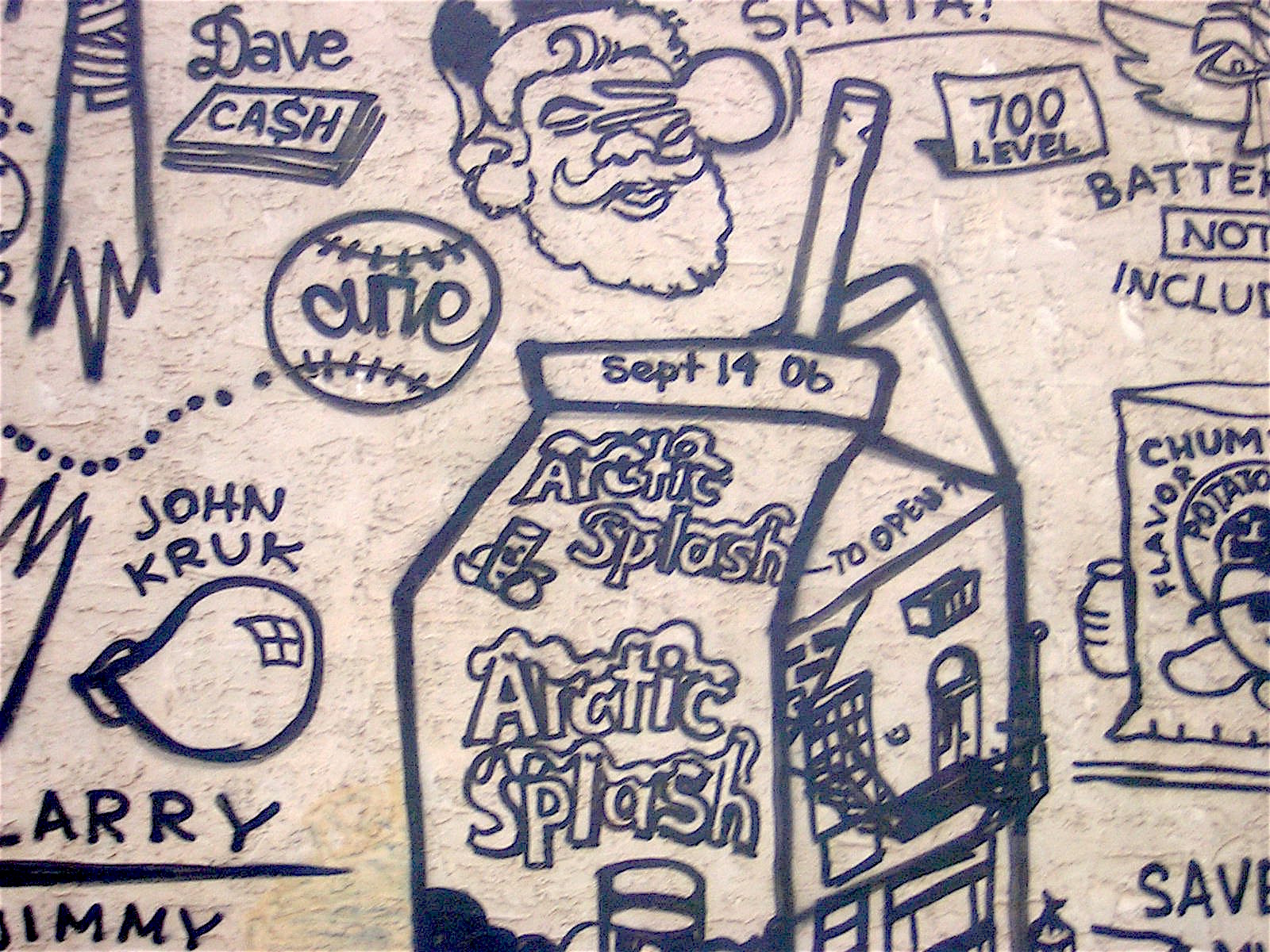
The shot below is for my friend Justin Coffin, who has been photographing real Arctic Splashes for years. The rendering here is part of a large and pleasantly incoherent mural on a wall that helps to define an utterly unremarkable parking lot.

Strawberry and Trotters Alley.

Sticking with the monochromatic approach, here's something I stumbled across in a little alley next to the Ritz garage. Aside from the poorly maintained Belgian block pavement, this was literally the only point of visual interest on the entire block. Calling Isaiah Zagar.

Ionic Street.

Back to color: How about some orange?  Here's the sidewall of the European Republic restaurant on Strawberry. Decent food.

Strawberry at Chestnut.

See also Senator Skedaddle, Senator Toomey Called My Son A Burnt-Down House, My New Favorite Alley.

Monday, March 5, 2018

Streets Without Joy


A happy street: Smedley between Spruce and Pine.

There was a highway in Vietnam called The Street Without Joy. Actually the French gave it the name - La rue sans joie.  The phrase dates back at least to a 1925 movie starring Greta Garbo, which in turn was based on a 1924 novel, Die freudlose Gasse by Hugo Bettauer. Bernard Fall, with his 1961 book Street Without Joy, brought the phrase to a wide American audience.

Too many of our alleys in Philadelphia have earned this name. One of the reasons is razor wire, which continues to show up in places that I would not expect it.

Let's talk for a minute about the semiotics of razor wire. I don't know what it says to you, but here's what it says to me: war zone. And while its owner may view it as a defensive device, preventing access by unwanted visitors, it also clearly has an aggressive function - to intimidate. Not just potential burglars, but anybody walking down the street.

If you're simply interested in protecting your home, modern technology provides a veritable cornucopia of products that are both discreet and effective. Sensors, cameras, the ability to berate an intruder while seated in front of your computer at work - I won't do the alarm company's sales job here, but really, if you're willing to give up the mine's bigger than yours thing, you're wasting your time with razor wire.

And if your psyche really cries out for some physical barrier to lacerate someone trying to come over a gate or wall, maybe it doesn't need to intimidate every passerby. Maybe it could even be funny. You could tear a leaf out of the Book of Isaiah Zagar. The presentation below is not particularly intimidating, but anybody trying to go over it is likely to lose some blood - maybe not enough to bleed out, as sometimes happens with razor wire, but certainly enough to enable identification. So it depends a bit on how much damage you really want your defenses to do.

900 block of Waverly.

I understand the romantic appeal of razor wire. The fact is, there was a war in our cities. As Adam Gopnik puts it in a recent New Yorker article, "it's hard for those who didn't live through the great crime wave of the sixties, seventies, and eighties to fully understand the scale or the horror of it, or the improbability of its end."

But that war is over, and maybe, just maybe, it's time for us to demobilize. I understand that the murder rates in Baltimore and Chicago are unacceptable - frankly, the murder rates in Philadelphia and New York are unacceptable - but this is no longer a war. Kaboni Savage is behind bars, and he's going to stay there. The same with Rudolph McGriff. Beyond Philadelphia, there's Whitey Bulger. He's behind bars too, at long last.

As Bertolt Brecht's Mother Courage cried out in panic during a lull in the Thirty Years' War,  "Peace has broken out!" Some people may be irreconcilable, but I suggest that perhaps it is time to turn our swords into plowshares and think about what a city at peace would look like.

Maybe we should think about streets with joy, rather than streets without joy. I think this may be a stretch for some people. It's not just a question of removing negatives, like razor wire. We need to think about what sparks joy.

Here, for example, is the 1800 block of Cypress. It's a nice street - no razor wire that I can find, clean, orderly, even reasonably well organized from a design point of view, at least for a service alley.

1800 block of Cypress.

But I'm just not feeling it. A while ago I put together a rating scale for our alleys, ranging from F to A. I'll give this one a C.

With the amount of money that's available on this block, we simply have to do better than a gentleman's C.

You don't have to go crazy. For instance, take Smedley Street, pictured at the beginning of this story. If Grandma Moses had lived in Philadelphia, she would have painted Smedley Street. Of course Smedley has the advantage of having the homes face on the street rather than being a service alley with a parade of garage doors.

So maybe you need to shift from Grandma Moses to Isaiah Zagar, or even Piet Mondrian. (Hint: Garage doors don't have to be boring. It's a choice.)

There's more in the bones of Philadelphia than the Federal style; we should recognize that and build on it.

Smedley again.

See also
Alleys, My New Favorite AlleyDo We Secretly Want Ugly Cities and Dangerous Streets?

Saturday, March 19, 2016

A Tale of Three Alleys


Panama
Go to Fitler Square. Look west. You'll see three alleys leading down to the park by the Schuylkill River. The 2400 blocks of Panama, Delancey, and Cypress. They can talk to us about what it's like to be an alley in Philadelphia.

Let's start with Panama Street. This is an old street that has seen hard use and survived in very good shape. Its scars (have a look at the tree behind the dog walker) should be seen as badges of honor. I don't want to turn Philadelphia into Disneyland.

I think this is one of the most beautiful streets in Philadelphia. On my rating scale (see Center City Quarterly, Fall 2015, p. 1), I give it an A. I choose not to see its flaws, and it sparks joy. Make that an A+.

Pavement on Panama Street
Next is Delancey. A very different block from Panama, with a lovely Mediterranean vibe. Don't know how to improve it. It's been on my basic running route for many years, and I've watched the work that got it to where it is. Another A.

Delancey
Ah, Cypress. There are some very good elements here, but the block hasn't gelled. The other two alleys hold you, but this one lets the space bleed away on the north side, over the garage gates.

I think part of the problem is that the alley is so wide. The gates simply aren't tall enough to provide closure.

Cypress
And there are no sidewalks. Well, there are some remnants, but mainly this alley is wall-to-wall asphalt. I feel adrift, and it's not a wine-dark sea. We need a little poetry here.

What to do? Sidewalks would be nice; they would help define the space. But they would be expensive. Strings of LED lights over the parking spaces on the north side would provide an attractive visual closure, at least at night.

Have a look at the building to the left in the picture, with the red-painted brick. Call Isaiah Zagar and get a mural. One with lots of mirror shards. The light at this end is dead.

Also, the buildings on the south side might want to consider some Mediterranean pastels for their facades, which are actually quite nice in their current shades of off-white. But the block needs something. (The house facing the park, on the south side of the alley, has already made a nice start in this regard.)

 Cypress, corner of 25th
Bury the utility wires. Maybe some trees? There are a few, but not enough to pull the block together.

2400 Cypress is a clean utilitarian alley. There are no derelict structures. I'll give it a B.

See also This Isn't Just Any Alley.

Monday, December 14, 2015

My New Favorite Alley


It's the 800 block of Pemberton street. I don't know that it's Isaiah Zagar's masterwork, but it's the piece that speaks most directly to me. And I know why. It's a complete environment. There are a few spots on this block where Isaiah's murals give way, but to my mind that simply provides a pleasing counterpoint.

This is basically a trash alley. No houses front on it. But look at what they've done. The art is one thing. But there's also the fact that a whole little community came together, with the artist, to make this happen.

When I first walked onto this street a few weeks ago, I had a feeling that I don't often get. I felt I was being embraced by a slightly different world. One that Isaiah - and his patrons - had created. I know they didn't create it just for me. But at that moment, that's what it felt like.

This is the feeling that I want to have when I walk onto the 1400 block of Moravian, by the Union League and Banana Republic. I know it wouldn't look the same. But these alleys are small, almost womb-like, and they have a way of speaking to us that the Vine Street Expressway will never have. If only we will let them.

The 800 Pemberton block is only about two blocks from the Whole Foods market on South Street, at 9th. But it can be a bit tricky to find. On South, walk east past 9th, then south on Schell. At Bainbridge, do a little dog-leg and continue on Schell. Pemberton will show up on the left before you hit Fitzwater. It only extends from Schell to Mildred, so you can't actually get there from 9th or 8th.

Enjoy your walk. Isaiah has been doing a bunch of new work in this neighborhood. And enjoy 800 Pemberton. A fully realized environment.


And here's the neighboring block of Kenilworth street. Note the person sitting outside in a chair. She's kind of small, but she's there. This is what a city can do when it's not drowning in cars.


See also Alleys.