Wednesday, May 17, 2023

The Beach Without People

Quiet Moments in Asbury Park

It used to be easy to go to Asbury Park and take pictures without people in them. Now it's getting to be a challenge. Not that I dislike having people around - quite the contrary. But I think, when other people are around, people tend to look at other people.

And maybe we can miss some things. Things that we tend not to notice, but which are actually a big part of what attracts us to this place. The sea, the sky, the boardwalk, they all provide the stage set for summer's permanent floating celebration of being alive. 

In the off season, you get to look at the stage set. Above you have the Casino, at the southern end of the boardwalk, embellished with some modern arrivals. There are the murals, and then the plantings. 

This kind of a backdrop doesn't just happen. People - people with lots of talent - think hard and work hard to produce a view like this. All I had to do was point and shoot.


And then there's Mother Nature - beautiful, nurturing, and never far from powerful violence. We build bulwarks to ward her off - in this case to protect Convention Hall, further north on the boardwalk. And we have some success. People used to talk about conquering Mother Nature, or taming her. I think, nowadays, we're a bit wiser, and perhaps slightly more humble. 


In addition to Mother Nature, Asbury Park is blessed with some remarkable works created by human hands. Convention Hall is one of them. I don't think the architects, Warren and Wetmore, had any idea in 1927 that their structure would be reflecting a rather adventurous mural painted on the Sunset Pavilion. But the building definitely created possibilities, and it welcomes new arrivals. 


Last year I ran a story about layers at the beachfront. There are a number of distinct zones in the design of the beachfront, each of which provides a different experience. But I left something out. The strip just inland from the boardwalk contains the pavilions, with their restaurants and shops, and also a water park and a miniature golf course - remnants of the city's once-bustling amusement industry. I forgot to mention the "wild" patches that have arrived in recent years.

When James Bradley bought his 500 acres in 1870 to found Asbury Park, he proceeded to clearcut the whole area, and he leveled the existing dunes. The current effort to bring back some dunes does increase our resilience in the face of inclement weather, and it also provides us with at least an idea of what was here before Bradley launched his improvement project. To be sure, we are looking at highly manicured gardens, but I think they are a valid nod to the past. And I love them.


The absence of visible people does not mean the absence of life. Here we have a seagull looking at a ship that undoubtedly contains humans. Humans we will never see. 


Here's a human you can see - just barely. Sitting on a bench. Can you tell me which bench?


To paraphrase an old baseball saying, some days you win, some days you lose, and some days it rains.


These days, when I go to the beach in the off season, I'm hardly ever the only person there. But still I think each of us usually has enough space to commune quietly with the sea, and the sky, and the sand. I think the fellow above, standing on the jetty, virtually surrounded by water, might well agree. But let's not ask him. Let's leave him alone.

Monday, May 1, 2023

Hector at Troy

War Is Not His Native Element


"The arts of peace are useless now. Troy will not be saved by the magnanimity and tender-heartedness of Priam nor by Paris' brilliance in the courts of love. If it is to survive it will do so because of the devotion, courage and incessant efforts of one man, Priam's son Hector. On him falls the whole burden of the war. He is a formidable warrior, formidable enough so that in Book 7 no Achaean volunteers to face him in single combat until they are tongue-lashed by Menelaus and then by Nestor. But war is not his native element. Unlike Achilles, he is clearly a man made for peace, for those relationships between man and man, and man and woman, which demand sympathy, persuasion, kindness and, where firmness is necessary, a firmness expressed in forms of law and resting on granted authority. He is a man who appears most himself in his relationships with others." 

- This is from Bernard Knox's introduction to Robert Fagles' translation of Homer's The Iliad (1990), p. 33. 

See also And So the Worm Turned, Little Karl, Wartime Presidents, What the Greeks Knew.

Monday, April 10, 2023

Rebecca Rhynhart for Mayor

She's Up to the Job

The Others Aren't


I've volunteered on a bunch of political campaigns, and many of the stories on my blog are political, but I've never endorsed a candidate on the blog before. First time for everything.

Why now? Because I see something that I think a lot of people are missing: I think Rhynhart is the only candidate who actually knows how to fix the bureaucracy. That's because she's the only one who's been inside - in the belly of the beast, if you will.

And yes, she's smart, she's worked in the private sector, and I think she has the tenacity and dexterity to tame the beast. 

A lot of people think that being on City Council is a good background for a mayor. I would argue the opposite. In City Council you learn City Council. And of course your focus is on city politics, not city administration.

And other people still think - in the age of Trump - that experience in the private sector is sufficient. Just run it like a business, they say.

Well, the city administration is not a business. It is a bureaucracy, and it shares that piece of its identity with large corporations. But it does not exist to make money, which is what businesses do.

Just take a look at Jeff Brown's lawn sign, at the top of this story. It says, "Fix the damn potholes!" A lovely sentiment, and Jeff seems to be a very capable businessman. But he's just skating on the surface. 

Let me bring in a military analogy. There's an old saying: Amateurs talk about tactics and strategy; professionals talk about logistics.

If you want to fix the potholes, you need to fix the streets department. And you need to ban non-performing contractors. None of that will be easy, and there will be a lot of complaining and whining and phones calls to City Council members.

Which brings me to my last point. We need to fix City Council. No mayor can do that alone. City Council really needs to step up and fix itself. And for that we need Council members who understand how the city works, and care about making it work better. I'm voting for Eryn Santamoor and Job Itzkowitz.

See also Ron DeSantis Comes to Philly, Rousseau and the Filibuster, A Message from Philly, The People Screaming Were White, Quo Vadis, Philadelphia?

Thursday, March 23, 2023

Riley Williams Sentenced to Three Years

Girls Just Wanna Have Fun!

Riley June Williams, Felon


It turns out that trying to overthrow the government on a lark may be a bad idea. I've been checking in with Riley Williams for quite a while. She may or may not have stolen Nancy Pelosi's laptop (that charge was eventually dropped), but she definitely had fun in the nation's Capitol on January 6, 2021. 

I was worried early on that the Feds would tire of the workload generated by January 6 and, after a certain amount of time had passed, start to let the small-fry cases slide. Riley was my test case, and I was wrong. She was definitely never at the head of the line - other, more important, cases clearly came first - but she never fell out of the line. 

Riley was arrested on January 18, 2021, but allowed to remain at her mother's home in central Pennsylvania while her case was pending. And it pended for quite a while. I do think the prosecutors were interested in getting Speaker Pelosi's laptop back, but Riley clearly was not willing to play ball. 

She also didn't like the conditions of her home detention and quietly violated them on several occasions, presumably thinking her transgressions would not be detected. 

In America you're innocent until convicted, so at this point Riley was innocent. But, golly, she seemed blissfully unaware of how nice the authorities were being to her. The judge even allowed her to go to the Pennsylvania Renaissance Faire. The prosecutors argued from the beginning that she was a flight risk,  and I think they would have been happier with Riley in jail.

At any rate she was finally indicted on October 6, 2021. And then the case dragged on again, eventually going to trial on November 7, 2022, in Washington, D.C. A jury found her guilty on November 21, and the judge ordered her to go to jail and await sentencing. Riley, who was 23 years old at this point, appeared shocked that she was going to jail.

On March 23, she was sentenced to 36 months in jail.

Riley strikes me as a somewhat aimless, slightly bored young person who wanted to have some excitement in her life. Nothing criminal about that, but then she seems to have fallen in with some bad company. Politico reported that she was a Groyper, which seems to mean she was a fan of Nick Fuentes, a rather appalling young man. You may recall that, late last year, he brought Kanye West to dinner with Donald Trump at Mar-a-Lago. 

Riley's lawyer, a hard-working Federal Defender named Lori Ulrich, did what she could, and two of the most serious charges against Riley wound up being dropped. But the evidence on the remaining charges was overwhelming, and the verdict was fair.

Jail changes people. I'd like to think that Riley will come out of the penitentiary a better person, but frankly I doubt this will happen. I don't ever expect to hear her start a sentence with, "I made some bad decisions." Instead I think she'll come out hardened and bitter. And that's a pity.

See also What a Cold Civil War Feels Like, A Shortage of Serviceable Ducks, Slingshot, A Home Invasion, As the Tide Goes Out.

Saturday, March 4, 2023

Lighting Rittenhouse

Too White, Too Bright in the Square

Addison Street from 18th.


I'm starting this story on Addison Street because my underlying purpose here is to expand people's horizons when it comes to how we light the outdoors. Don't worry. I'll be getting to Rittenhouse Square very soon.

Addison Street is approximately two blocks from Rittenhouse Square. Quite a while ago now, the residents decided to wrap their trees with Christmas lights.  Currently the lights are on, as far as I can tell, around the clock and every day of the year. The bulbs are LEDs.

There are actually two regular street lights on this block. They're standard highway lights, very tall, with goose necks. These lights work well on highways, particularly Interstates, where they provide even illumination across large areas that are not obstructed by objects like trees, and where motorists can be relied on to be staring at the highway in front of them, and not trying to look up at the night sky.

On Addison, the two highway lights are almost invisible. If you look carefully at the picture above you can see one of them, hiding up among the trees in the background. There's a patch of pavement directly under that light that's a bit brighter than the surrounding street. 

The trees are basically eating the light from these two highway lamps, and much of the illumination on this block comes from the lights on the trees and the porch lights on the houses. 

 Mixing Light, Balancing Light

Let's have a look at how the tree lights work during the day - remember, they're on just about all the time.


I love the way the afternoon sunlight in this picture, painting the facades of the houses, receives a delicate complement from the bulbs wrapping the tree.

Mixing light from multiple sources goes on all the time. I don't think people necessarily think a lot about mixing sunlight with artificial lights, but frankly it also goes on all the time, and this is a particularly pleasant example. 

When mixing lights it's important to see that they're balanced. Balancing doesn't mean every light needs to be the same. It means the lights need to work together and not fight one another.

Afternoon on the Square


Let's have a look at how sunlight works on Rittenhouse Square. Mother Nature, and her buddy the sun, have been teaching humans about light for a very long time. And I think it's fair to say that the impulse behind artificial illumination is to extend some form of daylight into the hours and places of darkness.

I think Mother Nature does a particularly good job of lighting Rittenhouse Square during the day. In summer the dappled light, created by a collaboration of the sun and trees, creates a very pleasant effect.


The only lighting problem during the day lies on the south side of the square, which is largely covered in shadows cast by the tall buildings on that side. The area still gets quite a lot of use, just not very much from sunbathers.

As Day Turns to Night 

My favorite part of the day is the time around sunset, when the sun shows what a talented lighting designer it really is.

First, late in the afternoon, comes the golden hour, when the low sun floods planet earth with gorgeous, powerful, golden light. In this context, "hour" is a flexible term. And the golden hour doesn't happen every day - the weather needs to cooperate. But that just makes it all the more precious.

Sunsets can bring their own joys of course, but they tend to be hard to see from the square, so I'm not going to talk about them here.

Starting as the sun sets we have the blue hour. With the departure of the sun's rays, the surface of the earth needs to look to the sky for light, and that light is blue. (The sun is still shining up there.) So the earth becomes blue, and the people walking around are blue, although we know they're not really blue. 

At its best, the blue hour is a soft, subtle time before the sky goes a velvety black. Many of the pictures in this story were taken during the blue hour. I find they're just nicer pictures. Here's a shot of a building entrance on the south side of the square. 


I love the warm, even illumination of the canopy lights, and I'm very fond of the blue masonry in the facade above the canopy. Again, it's not really blue, it just looks that way. At night, when the light of the sun has completely left the sky, the upper part of the facade will be black, perhaps punctuated by a few lit windows. 

I can work with the blackness of night. Here's a shot of the holiday decorations at Longwood Gardens.


Note that, in this picture, virtually all of the background details have dropped out. You can just barely make out a few figures walking on the path by the trees. They're being lit by the lights on the trees.

Talk about abstract art. The trees have been abstracted from their environment.

To Balance or Not to Balance

Also on the south side of the square is this building. Years ago I photographed Ted Kennedy coming out of a fundraiser here. There are a lot of different lights in this picture, but they are all balanced - it's almost balletic - and the overall result is, to my eye at least, very pleasing.


Across the square on the north side, we have this. Note the very bright lights on each side of the doors. They're trying too hard, and the result is an unbalanced lighting scheme.

Attack of the killer photons.


Let's now go across Walnut street and into the park. Recently the park's complement of street lamps got some new bulbs. They are the reason I'm writing this story.

Have a look at this picture of the center of the square. Those are very bright streetlights.

Help! I'm melting ... I'm melting.


Then look at the snowflakes in the trees. The snowflakes and the lamps are fighting one another, and the snowflakes are losing.

As I said earlier, these new lights are too white and too bright. I had been struggling to articulate exactly why I had such a visceral dislike for them, and then I read Vasily Grossman's Life and Fate (English translation 1985). It's a sprawling novel centered on the Battle of Stalingrad during World War II. Here's part of a description of the morning routine at a Soviet labor camp:

"The prisoners were woken by the orderlies at five in the morning. It was still pitch dark; the barrack-huts were lit by the merciless light that is common to prisons, railway stations and the waiting-rooms of city hospitals." (P. 174.)

Merciless light. I like that.

I don't think I'm alone in my concerns about this new, intense illumination. One evening recently, I was leaving the park, a short time after the lights came on, and I passed two women who were entering the park. One turned to the other and said, "Who wrote this lighting plan?"

Here is my surmise: Highway engineers wrote this lighting plan, and they did what they were trained to do.

All the Park's a Stage - or Many Stages

I hope we can all agree that this park is not a highway. I would like to go one step further. I suggest we look at it as a kind of theater - an open-air theatrical venue with a circulating audience and many stages of various sizes. This was clearly the intent of Paul P. Cret, the architect who, before World War I, produced the basic design we see today.

I frankly know very little about lighting design for the stage, so I went to the Free Library and checked out a book - J. Michael Gillette's Theatrical Design and Production (1987). Here's what he has to say about the purpose of theatrical lighting: 

"Obviously, there is something more to stage lighting than simply bathing the stage with light. Effective stage lighting not only lets the spectators see the action of the play but also ties together all the visual elements of the production and helps create an appropriate mood and atmosphere that heighten the audience's understanding and enjoyment of the play." (P. 263.) 

And here are four basic tasks for theatrical lighting, which I have adapted from pages 264-265 of Professor Gillette's book.

Illuminate the stage. The audience needs to see the action on the stage.

Highlights. The most important elements, such as the prima ballerina or the prima donna, should receive extra light. And God help you if you don't have a spotlight on the diva's face at all times.

Modeling. Figures need to appear three dimensional, and faces shouldn't look scary unless it's Halloween.

Mood. Lighting, and particularly color, are powerful generators of mood.

So how are we doing in the square? Let's have a look. Here's a view to the southwest down the main walkway, with a person striding purposefully in our direction.


Even though we're still in the blue hour (note the sky in the background), the wooden benches on the right are highlights threatening to blow out, and the shrubbery on the left is a murky, almost featureless blob. The walkway and the person in the middle of it are bathed in contrasty light that feels chillingly cold.

What young couple would want to pause for a romantic kiss in light like this?

Highlight the Sculpture

Let's have a look at how we're treating the stars of the show out here. They would be the park's sculptures, of which I'm counting five. There's the Duck Girl in the reflecting pool - I think of her as our prima ballerina. And then there are M. Barye's Lion, Billy the Goat, the Giant Frog, and the Sundial. (I'm leaving out a few smaller pieces. For more, click here.) 

These five sculptures all work beautifully in the sunlight. I feel badly for them after sunset. They all basically disappear. Have a look at the Duck Girl. She's a dark blob out in the reflecting pool, and you certainly can't see her face.


I did notice a little something in the drained reflecting pool, directly in front of the Duck Girl. I think this may be a light, but I'm not sure because I don't recall ever seeing it lit.


You may have noticed, in the wide shot of the fountain and the reflecting pool above, that the right side of the fountain wall is brighter than the left side. A few days later I had a closer look and discovered this.


The reason for the light differential is that the easternmost of the three bulbs jury-rigged in here is not functioning. (A few days after I took this shot, I went back, and the bulbs had been removed.)

The only sculpture that is currently lit is Barye's Lion.  I'll be gentle and say the lighting here has been inadequate for a long time, and the situation has only gotten worse with the arrival of the new bulbs in the street lamps. 

The other three sculptures are the goat, the frog, and the sundial. They all lack dedicated illumination.

The Guardhouse

I would be remiss if I didn't mention the guardhouse in the center of the square. It is a lovely structure, beautifully lit, and I think it bears up reasonably well under the new lights. But it looks better when the streetlights are turned off.


Rescue the Blue Hour

So, beyond the sculpture, how do we fix the overall lighting scheme in Rittenhouse Square? Let's start our planning with the blue hour.

I think a lot of city dwellers are blissfully unaware that the blue hour exists. That's partly because we hardly ever get its full effect in the city - the artificial lights are too bright. Instead of trying to drown the blue hour in photons, I suggest we celebrate it. 

Time is a dimension. The gates of night lie in the blue, but we don't need to rush through them. Let's see how the lights can help us with that. Right now, they don't actually all come on at once. They seem to go on by segments - a line here, a group there. But they all go on within about ten minutes of sundown.

Let's organize this process around something other than the demands of electrical circuitry, increasing the light gradually as the need for illumination increases. We might even want to put all these lights on dimmer switches, so a lamp could start softly and gradually get brighter. 

That way we'd be able to see more of the blue hour, instead of essentially shutting it down shortly after it starts.

Soften the Night

Leaves eat light. Grass eats light. It's what Mother Nature designed them to do. If you want to replicate daylight in the nighttime park, you need to cut down the trees and pave the lawns. Then you will have a facsimile of a parking lot in a suburban shopping mall. I suggest we instead aim to get our nightlights to work with the park instead of fighting it.

The point here is to put the light where it's needed to achieve your goals - which I think should be illumination, highlights, modeling, and mood. Instead of wasting electricity to feed trees from lamps on high poles, put the lights where they're needed, which is generally close to the ground.

You want people to see the pathways they're walking on, so they don't trip and fall. Put low lights on short poles - knee-high or waist-high - along the edge of the walk. 

You're worried about women being dragged off into the bushes? Light the bushes. There's no place to hide on Addison street at night. To quote Ernest Hemingway, a clean, well-lighted place. 

And yes, the very bright, merciless light that we're getting more and more of in this town actually makes the shadows look darker to the human eye. 

You want a soft, romantic mood? Kill the NASA-spec lights. They're useful on a launch pad at night, but we don't need them here. 

Will Rittenhouse Square ever look like Longwood Gardens, or even Addison street? I doubt it. But there are many opportunities for improving the light in Rittenhouse Square. It would help to start with a lighting plan that makes sense.

(The Chestnut Hill Local has been doing a good job covering the new streetlights in its area. For three stories and a letter to the editor, click here, here, here, and here.)

See also Paul P. Cret and Rittenhouse SquareNight Lights at Coney Island, City of Lights.

Friday, February 3, 2023

Why Did It Crash?

The Bicycle Boom of the 1890s

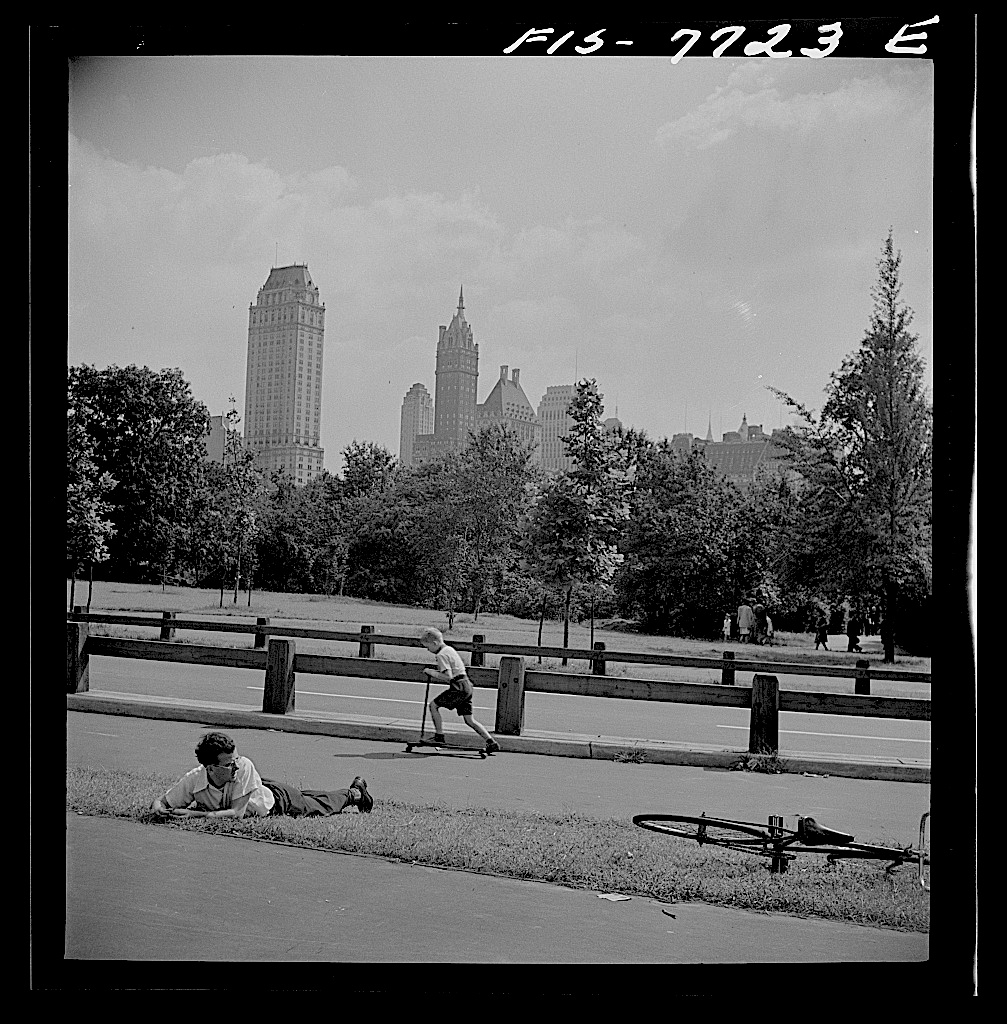
Sunday in Central Park. Marjory Collins/FSA, 1942.

There's a cloud that lurks over the current boom in bicycling. It's often invisible, but in stressful times it seeps in like a fog. And for veterans of the last few decades of bicycling in the United States, I don't think it ever really goes away.

The cloud is the meteoric rise and equally precipitous collapse of American bicycling in the 1890s. For most people, this history seems about as relevant as Homer's recounting of the fall of Troy.

And I think that's accurate. The fall of Troy, the fall of the Roman Empire, the Dutch Tulip Bubble, all this history lives today even for people who are unaware of it. And the collapse of bicycling in America, on a smaller scale, informs the views of bicycle advocates today, and I think it informs the views of the anti-bicycle group, many of whom are completely unaware of the history.

So will our present bike boom also crash? I don't think so. I think it's a durable boom. I think the only question is how big bicycling will become in places like Philadelphia.

Durability

But let's start with durability. Here's a story. On January 17 of this year, I had occasion to visit the medical city on the west side of the South Street bridge; as I was leaving, I decided to count the number of bicycles parked in the bike racks that are, at this point, basically everywhere on Civic Center Boulevard and on the surrounding streets. I found 244 bikes and electric scooters (there were about a dozen scooters; I didn't count them separately).

I thought that was a pretty good count, and then, as I walked home, I remembered that I had conducted the same count a few years ago.  

After I got home I searched around a bit on my computer and found the email I had written on August 28, 2015. I had had a doctor's appointment that morning, and I had counted the bikes around 10 a.m., the same time I counted this year. 

In 2015, I counted 335. (I don't recall any electric scooters.)

My first reaction was surprise. I hadn't expected to see a drop in the bike count. But then I said, Okay, knucklehead, have you heard of the coronavirus? 

And then I remembered that in 2015 it was a "beautiful day" in August, as I mentioned in my email, and this year's count was on a cool, overcast day in January. I'm willing to concede a certain amount of seasonality in the amount of bicycle commuting in Philadelphia.

Every year, the Bicycle Coalition of Greater Philadelphia counts the number of bikes crossing the Schuylkill River bridges at rush hour. In 2021, the rate was 639 per hour, down from the peak of 913 in 2017. In 2015, the first time I counted parked bikes, the count was 780 per hour. So the bridge counts and my parking counts seem to be roughly in agreement. 

Looking at my 244 count for this year, and thinking about all these things, I've decided 244 is good evidence that our current bicycle boom is remarkably durable. If this little cavalry squadron, parked around Civic Center Boulevard, could survive the Covid epidemic, I don't think it's going away.

(I've also been made aware that there are now indoor bike racks for about 50 bicycles in the 3600 Civic Center Boulevard garage, which I did not count. For a map of bike parking spots at Penn, click here. I only counted the racks on or very near Civic Center Boulevard.)

How Big?

So how big can biking get in Philly? As I've often said, I think bikes and their assorted fellow travelers could see a 50 percent mode share in center city and surrounding areas. This is essentially the older part of the city, which was originally built for pedestrians and horses and wagons, not cars. This area, with its many small streets, is where the viability of our current over-reliance on automobiles is most obviously in question every day.

The key to a 50 percent mode share for bikes and scooters is a complete, fully connected network of protected bike lanes. 

Here's why. When it comes to bicycling, people fall into four groups: the strong and fearless, the enthused and confident, the interested but concerned, and the no way, no how. The strong and fearless are people like bicycle messengers, and research indicates they comprise perhaps 1 percent of the population. The enthused and confident are those who are willing to share traffic lanes with motor vehicles when necessary. They are about 7 percent of the population. The interested but concerned are generally not biking around town for a simple reason: They fear a crash with a motor vehicle that leaves them with a life-altering injury, or possibly just dead. They are about 60 percent of the population. The no way no how group has several subgroups. Some people, because of illness or injury, are simply unable to ride. Some people actively dislike bicyclists and would never get on a bicycle themselves. And others are simply uninterested. The no way no how group is about one-third of the population. (For an interesting article on the history of this typology, click here.)

So the interested but concerned are 60 percent of the population. Here's how you get them riding. You build a complete, fully connected network of protected bike lanes. Then you'll be appealing to about 70 percent of the population, instead of 7 percent.

If we look at pre-pandemic bicycling data for center city and south Philadelphia, you can see that it's already over 7 percent in a few places. The Center City District reports that, in 2017, commuter cycling mode share was 7.3 percent in center city and 8.1 percent in south Philadelphia. These are the most recent data available from CCD.  In 2020 the Bicycle Coalition found a section of south Philadelphia where the bike commuter mode share was 21 percent. 

Have the interested but concerned started commuting by bike? Perhaps. Or maybe the 21-percent spot has a concentration of the enthused and confident? I think it's a good reminder that this typology is a useful tool, and not a sacred tablet.

Just in case you're thinking that everybody else is driving, pedestrian mode share in center city hovers around 30 percent. Transit, before the pandemic, was 20 percent. Motor vehicles had a mode share under 40 percent. (For more, click here.) This motor-vehicle mode share makes center city Philly look more like a European city than an American one, where the private motor-vehicle mode share is generally in the eighties or nineties. Munich, for instance, has a car mode share of 34 percent. But don't worry, we're still not Amsterdam! It has a private-car mode share of 27 percent. (For mode-share levels in cities around the world, click here.) 

How will things look as we finally get back to something resembling normal? I'm hopeful that we'll be getting data on this soon. But center city is definitely recovering. The Center City District provides monthly pedestrian counts, and in November 2022 it reported that pedestrian traffic had reach three-quarters of its pre-pandemic volume. (To see these reports, click here.)

What Does a Pretty Good Bike-Lane Network Look Like?

The medical city on the west side of the Schuylkill has some of the best bicycle routes in Philadelphia. They're not perfect, but they're pretty good, and they keep getting better. The South street bridge has very good bike lanes. They connect to other bike lanes east of the Schuylkill that carry you almost to the Delaware. Chestnut street now has a bike lane that runs from 45th street in west Philly to 22nd street in center city, where it connects with the 22nd street bike lane. In the near future we will be getting a new two-way cycle track on Market street between 20th and 23rd, also connecting with the 22nd street bike lane. (Construction is basically complete, and we are just awaiting a few final touches.) Penndot will also be rebuilding the Market street bridge soon, and the hope is that the bicycle connections there will improve dramatically, including a connection to the trail on the Schuylkill Banks.

I think you can get a sense of the effect of all this lane construction when you look at the bike racks around the Hospital of the University of Pennsylvania and Children's Hospital of Philadelphia. 

Bikes are here to stay. The only real question is this: Will we do biking well, or will we do it badly?
If recent history is any guide, progress will be slow, opposition will be intense and effective, and we will eventually get what we need. 

It Was a Different World

But there's always the fear that a new mayor will come along and decide to rip out all the bike lanes. This would be a popular move among certain segments of the population.

I don't think it will happen, but it could. Far too many people in this town still view bicycles - and scooters and all their cousins - as temporary interlopers. 

And bicyclists and bicycle advocates themselves, I think, harbor similar thoughts deep in their minds. The difference being that their thoughts are fears rather than hopes.

And I think a big part of this formless dread dates from the collapse of an astonishingly large bicycling culture - one which even had its own bicycle highways - in the years around 1900. (For instance, the Coney Island Cycle Path in Brooklyn ran next to the existing Ocean Parkway for 5.5 miles, from Prospect Park to Coney Island. Estimates of daily ridership during the mid-1890s regularly ran from 25,000 to 30,000. See Evan Friss, The Cycling City, Bicycles and Urban America in the 1890s, 2015, pp. 102-104. This path is still there, with less traffic.)

Why is this dark cloud - so very old - also so persistent? Perhaps it is because we still don't know the whole story of why the collapse happened. A number of good books have come out recently that look at the boom and the collapse, and we already know a lot more than we did. (In addition to Evan Friss's Cycling City, I look principally to James Longhurst, Bike Battles, A History of Sharing the American Road, 2015, chapters 1-3 and another book by  Friss:  On Bicycles, A 200-Year History of Cycling in New York City, 2019, chapters 1-2.) 

The bike boom of the 1890s was led by the League of American Wheelmen (bicycles were called wheels back then). This was an elite organization of well-to-do white men, who were only interested in bicycling as a recreational activity for people like them. They were uninterested in forms of cycling other than recreation - commuting to work, for instance - and they had no interest in bicycling by women or people of color. In other words, even though they clearly had a mass base available to them in the 1890s, they refused to connect to it.

The League was powerful, and it did a lot to promote better roads. At the time America's roads were - how should I put this? - just terrible. And the League had members like John Jacob Astor and John D. Rockefeller, and the roads got better.

But the lack of a mass base and the lack of interest in utility bicycling - commuting, to be sure, but also getting around town to run errands - meant that the movement lacked a firm foundation and was dependent on the whims of the super-rich.

The League's membership peaked in 1898 with 103,000 members. By 1900 it had to declined to 76,000, and by 1902 membership was at 8,000.

So where did all these avid bicyclists go? The obvious culprit would be the arrival of cars, but the real explosion of car ownership did not start until 1908, when Ford introduced the Model T.

In the past I have felt that the collapse was not due to the arrival of cars. However, I've been rethinking this. The Census Bureau reports that, in 1900, car companies produced 5,000 vehicles, and that 8,000 motor vehicles were registered in the United States. By 1907, the year before the Model T was introduced, there were 142,061 cars kicking around America's roads. 

I'm particularly interested in the Oldsmobile. Ransom Olds founded his company in 1897 and didn't do much until 1901, when he produced 425 cars. In 1902 production was up to 2,500, and we were off to the races. 

There was a car boom before the Model T. It was, compared to what came later, tiny. But were there enough of these cars to attract a relatively small market of prosperous young men looking to be early adopters of the next new thing? I don't know, but I'm intrigued.

Last year I was working on a story about the history of Asbury Park, a beach town in New Jersey, eventually titled "Layers at the Beach Front." My wife pointed me to a promotional pamphlet produced by the Pennsylvania Railroad in 1905, promoting a meeting of the National Education Association that would be in Asbury Park that summer. It had some interesting things to say about cars.

"No resort section in the world presents so many delights to the driver and automobilist as Monmouth County, in which is situated Asbury Park. Hundreds of miles of hard roads radiate in all directions, covering a country charming in natural beauty, enhanced by the development of money and brains, and filled with historic associations. ... One may procure vehicles of all kinds from the livery stables maintained in Asbury Park, so that driving and auto rides are frequent."

So cars were clearly an attraction in 1905, and it doesn't feel like they were a novelty. (To see the whole pamphlet, click here.)

I do have a concern about the idea that elite Wheelmen swapped out their bikes for cars. Let's call it the exercise factor. These were people who were accustomed to a certain level of physical activity. Where did they go to burn those calories?

Golf, maybe? Moderate exercise, a bit of competition, and of course the nineteenth hole for refreshments.

Again, I don't know. But it would be interesting to put the membership lists of the League and more local bicycling clubs up against the membership lists of golf clubs in a particular area - say, Philadelphia.

I never thought I'd be writing about bicycles and golf in the same sentence. but here goes: How many ex-Wheelmen joined golf clubs?

Resistance to Change

Today, many of the issues that contributed to the collapse of bicycling around 1900 simply do not apply. Most importantly, cycling today is a mass - and very open and inclusive - movement. But there were other issues - for instance, women are no longer expected to wear corsets when they go bicycling. (See Patricia Campbell Warner, When the Girls Came Out to Play, The Birth of American Sportswear, 2006, pp. 119-121.) It was indeed a different world.

There is today, however, a strong countervailing force that did not exist in the 1890s, which boils down to inertia. After a century of dominance by the car industry, people are used to things the way they are. To a very large extent, the general public and our institutions simply don't have a great interest in changing things on our streets. 

The Vision Zero initiative is useful in this regard, and I have seen some shifts. Not so long ago, a fellow who was president of a local community organization in Philadelphia told me that he thought 35,000 dead on America's roads and streets every year was a reasonable cost of doing business. I haven't heard that line recently. Instead, people seem to have retreated to denial: The numbers are wrong. They don't reflect what we see on our street every day. This is, of course, lunacy, but given the way things have been going in this country, I'm not sure it's going away any time soon. 

Traffic fatalities reached 42,915 in 2021. 

Philadelphia has a particular problem in its city hall, where I sense a profound entropy. When I look at city hall these days, I find myself thinking about an aging octopus, no longer fully in control of its tentacles, given to long naps and disorientation upon awakening. This syndrome seems to have enveloped the last several mayors, city council for as long as I can remember, and young staffers who quietly ask themselves if this is the way things are supposed to be.

Let's look at the city bureaucracy. Recently, I have heard that the Streets department in Philadelphia may, as an entity, be moving away from its fierce, if largely passive aggressive, resistance to bicycles. I'm going to wait and see on this one.

And there is substantial resistance to bicycling among some members of the general public. Part of this seems to be a simple, and very human, dislike of change. This can be paired with an automatic dislike of people who are not exactly like you. And if those people have different needs from yours, then that can be another catalyst for opposition. 

In addition, I've found that there seems to be an unwillingness to see bicyclists as they actually are. One of the most common misconceptions I run into is the idea that bicycling is still almost entirely about leisure. That simply is not true in Philadelphia today. As we saw in the bike racks around Civic Center Boulevard, there's a lot of bike commuting. Beyond commuting, there's utility biking that takes place throughout the course of the day -  taking kids to school (and home again), shopping, visiting Aunt Tillie - oh, and yes, delivering food. Bicycling - and scooting - have been integrated into the fabric of the city's life. 

Finally, we need to look at the people in the shadows behind the people. They've learned how to coopt community organizing and use it for their own ends. A good example is the recent fiasco on Washington Avenue, where community groups were essentially pawns of the local business establishment, and the folks in city hall were happy to play along. {For two stories on Washington Avenue, click here and here.)

This approach is qualitatively different from the more traditional approach that has its roots in the advertising industry - controlling people's minds to sell them a product or a candidate. Essentially the people pulling the strings have adopted the tactics of the left. This shift has been underway for a while. I remember, back in the 1990s, there was a push in the corporate world to develop their "grassroots." I don't believe this went well, because employees kept showing up at political events wearing polo shirts with the company logo. And people started referring to "astroturf." 

The new system, on the other hand, clearly works, and we can see examples of it all around us. I invariably find it sad to watch people being exploited in this manner, but it works, and I don't think it's going away any time soon.
Wednesday, January 25, 2023

Ron DeSantis Comes to Philly

And the Mighty Union League Stumbles


Poor Ron DeSantis, who really wants to be Benito Mussolini, got a warm reception on January 24, during an ill-considered visit to Philadelphia. I don't think it hurt DeSantis much, but I think the Union League is not going to have an easy time crawling back from this humiliation. 

There were actually two protest rallies in front of the League building on Broad street, two blocks from City Hall, and just across Moravian street from the building that, years ago, housed the Philadelphia Stock Exchange. The first rally began at noon and lasted about an hour. The second began at 4 pm and extended into the evening, with a dwindling but enthusiastic contingent of pickets.

For me, the protests felt a bit like a reunion. I found some people I hadn't seen since before the pandemic, and I met some new people. It's fun rallying in front of the League. And the building is so photogenic.


I also have memories of being inside. I ate there several times, many years ago. The food was profoundly old-fashioned. They even had succotash, which is a mixture of lima beans and corn. 

And here I was again, as darkness came over the city, standing on a picket line in front of the Union League, which at this point was protected by a long barricade of bicycle racks. The League members on their way to visit with Florida's governor had to walk along the sidewalk behind the barricade and then proceed up the steps to the main door on the second floor. They'd had to park at the Bellevue, a hotel in the next block, and they weren't wearing overcoats, and a few of the women were actually shivering.

Some of the protesters said they felt like they were watching a perp walk. And perhaps they were.

Oh well. So many clubs have died in Philadelphia. I'd hate to see the Union League building knocked down, but frankly the club just bet the farm on a turkey.


(For a story in BillyPenn, click here. For an opinion piece in the Inquirer, click here.)

See also And So the Worm Turned, On Demagogues.