Tuesday, July 4, 2023

Willoughby Avenue, Fort Greene, Brooklyn

Life Without Tinted Windows


Why aren't these people all in cars?


They shouldn't be outside and not also be in a car. It's almost like going outdoors without any clothes on.


And people can see you. In a car with windows tinted a deep black, no one can see you. Then you can turn your sound system up to the point where it damages your years, and you won't have to hear any of those annoying sounds of the city - you know, like fire engines and police cars and people screaming obscenities at someone who ran a red light. I wonder who ran the red light? 


Now, in America, that's what we call living outdoors. 


Just look at all these people walking and biking and sitting outside and having dinner. They actually look like they're having a good time. Poor deluded souls. I guess they're not really American.


Maybe we can help them. Let's trash the barriers keeping the cars out and restore the street to the condition that God intended. In the early days of the current mayor's administration, a call came out of city hall to give the street back to the cars, and the barriers were removed. But only briefly.


It turns out that these non-Americans actually have some political power. I was disappointed. Maybe I'll move to Montana. 


(For more on the removal fiasco, click here and here and here and here.)


All the photographs in this story were taken between 6:43 pm and 6:47 pm on Friday, May 12, 2023.

See also Up in the Air and Down on the Ground; South Portland Avenue, Brooklyn; Flexible Vanderbilt; Of Planters and Whimsy.

Wednesday, June 7, 2023

Come for the Sights

Stay for the Walkable City

Love Park on left. Moravian at 20th on right.


Center City Philadelphia comes in two pieces. First is the monumental city that draws office workers, shoppers, suburbanites looking for a decent restaurant, museum lovers, and general-purpose tourists. The monumental city is surrounded by another, more intimate city. This largely low-rise area flings a necklace of neighborhoods around the often very tall buildings in the downtown core.

One Liberty Place.


People who live in the inner parts of this necklace can walk fifteen minutes to a job in a monumental office tower - a commute that is inconceivable in many American cities. Thanks to the proliferation of bike lanes, people who live a bit further out in the necklace can readily commute by bicycle to work in the core.

Whose Streets? Our Streets!

A damp day on Addison Street.


Odd things happen in this doughnut of neighborhoods. People walk down the middle of the street. They walk their dogs down the middle of the street. This is something that is simply inconceivable in most of America.

In 2012, Jeff Speck came out with a book called Walkable City, in which he suggested that a good walking street is useful, safe, comfortable, and interesting for pedestrians. I think he would like this stretch of Addison Street.

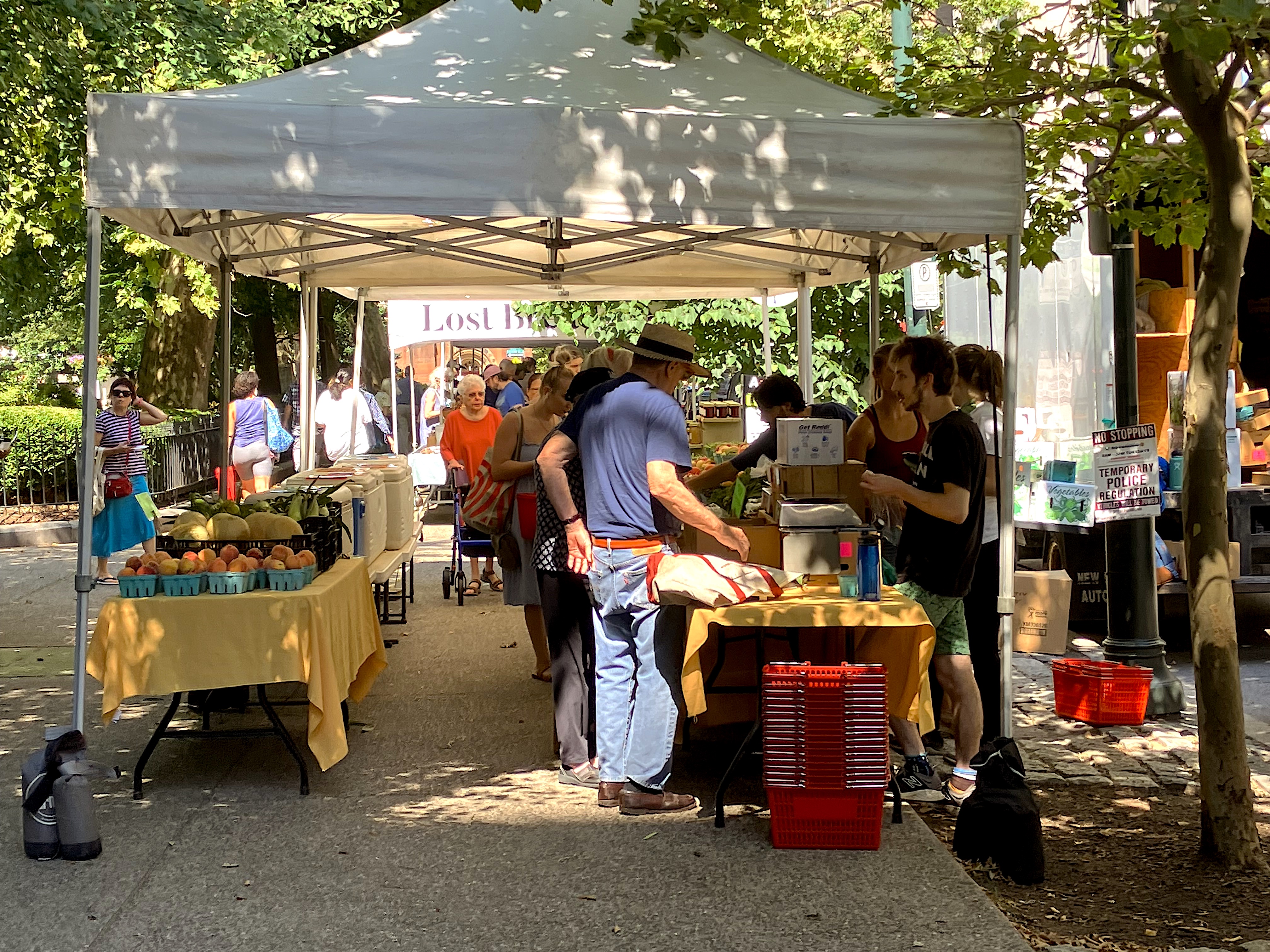
And I think it's time to raise the bar. We need, not just a walkable city, but a walking city. Like, you know, putting the farmer's market in the middle of the street instead of up on the sidewalk.

18th at Walnut.


Although this farmer's market, in Rittenhouse Square, does do just fine when it's pushed back on the sidewalk. 

On the Walnut sidewalk.


And things do get pushed back a lot in Philadelphia. Is it two steps forward and one step back, or one step forward, and two steps back? I'm often unsure. I do know that almost all of our political class views the city through a windshield.

But pedestrians and their allies, such as bicyclists and restaurateurs, have shown themselves to be a tenacious lot, and they're ingenious about inserting little pieces of civilization where they can. 

Spruce at 11th.


This cafe, with its sidewalk tables, is a favorite of mine. It's also an emotional place for me. Just to the right of this picture is the spot where, on the morning of November 28, 2017, Emily Fredricks was riding a bicycle to work when she was run down and killed by the driver of a garbage truck. There's still a memorial ghost bike on the other side of 11th street.

Despite political malpractice on a truly gargantuan scale, bicycling has become an integral part of the life of the city. Even people who hate bicyclists benefit from this development, because bikes are one way we are slowly civilizing our streets.

Here we have a picture of a bicyclist using the streetwall as a theatrical backdrop. There's a quiet intimacy in this photograph that I find attractive - can we say peaceful?

1500 block of Pine.


Speaking of peaceful, how about sitting on your stoop and reading a book on a warm sunny day, with a little help from a nearby shade tree? 

S. Carlisle street from Waverly.


I can't resist one more. Let's hear it for the contribution that shade trees can make to the mood on a street.

24th and Naudain.


Color

In 1908, Philadelphian S. Weir Mitchell came out with a novel entitled The Red City, which was a historical romance set in Philadelphia immediately after the American Revolution. The moniker has stuck because, even today, we do have a lot of red buildings.

There is a risk of stereotype, however. I've written before about the surprising variety of color available in the neighborhoods of Center City. (See Which Side Are You On?) Here's a relatively recent addition, mixing black, white, and red very nicely.

Locust at 20th.


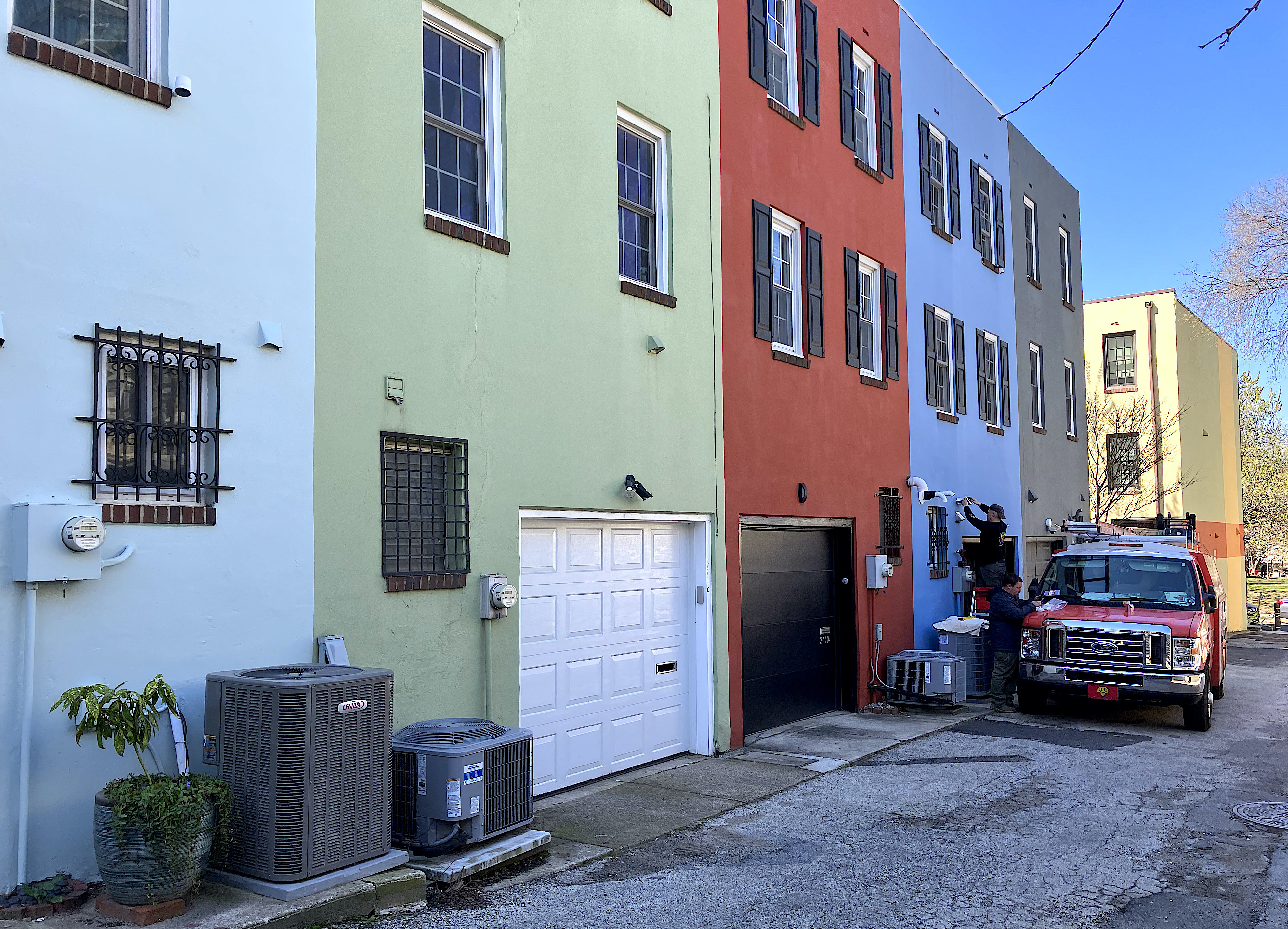
I wrote a whole story about the 2400 block of Cypress back in 2017. I felt moved to go back and take a new picture. These facades had all been a uniform white, somewhat grayish from age. The homeowners banded together and came up with - I think - a better idea. And one that is aging very well.

Mediterranean colors on Cypress street.


Clouds and Corridors

Rittenhouse Square has recently had quite a few hawk sightings. Generally the hawks hang out in the trees, but I'm reliably informed that they will occasionally come down and perch on the back of an unoccupied bench. This is just one more reminder that, despite superficial appearances, Mother Nature is never very far away in Center City Philadelphia.

This is particularly true of the sky. The built environment may block the last stages of a sunset, but if you stand in the right places, there are often symphonies playing out above us. The Schuylkill River provides an open corridor that can be quite entertaining on a cloudy day. 

Aramark building.


The natural view corridor formed by the Schuylkill also provides excellent views of the buildings that border the river. 

FMC tower.


Let's go back to the area around City Hall and have a look at Dilworth Park, which abuts the west front of City Hall. With some clouds, of course, and Vincent Kling's Municipal Services Building.

Dilworth Park, an urban oasis.


And let's close with a man-made view corridor, the Benjamin Franklin Parkway, with the Love statue in the foreground and a hint of the Art Museum in the distance. Although I confess I was more interested in the unusual cloud formation when I was taking the picture.

Love to Art on the B.F. Parkway.


See also A Few Deft Touches for Back Streets, A Tale of Three Alleys, Gordon Cullen and the Outdoor Floor, Quo Vadis, Philadelphia?

Tuesday, May 23, 2023

Sandy's Book

Teaching Democracy as a Way of Life


As we grow older, things change, and not always for the better. I've noticed, for instance, that my memory for people's names is not what it used to be. And then there is a decline in energy. But I have also noticed, among many in my age cohort, an interesting phenomenon: with a decline in energy there can be an increase in quiet tenacity. We don't quit.

Which brings me to my wife, Lois, and her good friend and former boss, Sandy Dean. Last year they recreated their work relationship and used it to produce a book, entitled Beyond Civics: The Education Democracy Needs

One of my favorite historians is Yale professor Timothy Snyder, who likes to suggest that we think of democracy as a verb, rather than a noun. And that is the key to the argument in Beyond Civics. It's not enough produce children who know the capitals of every state. It's not enough to have them read the Bill of Rights, or lecture to them about the Ten Commandments. Children need to learn how to be good citizens. 

I wonder if Thomas Jefferson realized the amount of work that he was creating for common folk when he decided that all men are created equal and governments should derive their powers from the consent of the governed.

It was a lot easier in the days of kings, when there was a strong man who, at least theoretically, ran everything. All the citizen (or subject) needed to do was follow orders. And that's the way it still is in some modern countries.

Being a good citizen in a democracy is a lot of work. And to do it right you need to learn some skills that aren't in great demand in authoritarian societies. These happen to be the skills that were at the center of the program in the independent school that Sandy ran for nearly a quarter of a century: seeking facts, thinking logically, and listening carefully to different views. 

The kids learned by doing. My wife taught an elective called Let's Go Lobbying. Students selected topics they were interested in and researched them carefully, both by reading and by hearing from grownups who were involved in the issue. They then thought about what their ask should be, what their supporting arguments should be, and how to respond to criticisms of their proposal. Then they went to the offices of members of Congress, state legislators, and City Council members to make their ask. Their teachers stayed in the background; the children had the floor.

Most of the people the students met with were surprised that middle schoolers could be that well prepared and that articulate. Some were pleased. Others seemed to feel threatened, and a few were quite patronizing. The kids learned from them all. 

A normal civics class in the United States does not look like this.

The school applied this basic approach across the curriculum, from science class to art class.

Writing the book was not easy. I watched Sandy and Lois over the course of the last year, wrestling with a large amount of material, giving it form and concision, and finding new ideas about what they were doing decades ago, incorporating current research results and reaching out to experts.

It did require new thinking. Some existing conclusions did require modification. And so, as they worked, they themselves were changed by the process - the same process they taught at school: finding facts, thinking critically, and engaging with multiple perspectives.

One of the most important changes had to do with the topic of democracy. I don't think many people, in the 1980s, thought American democracy was in peril. We knew it had problems, but we didn't think it was going to die. 

Today, the situation is different. And for that reason, the way we teach our children about our democracy is critically important. Jefferson gave us a heavy burden when he rested government on our shoulders, and none of us can afford to be a summer soldier or a sunshine patriot.

As John Lewis put it in his final message to us: "Democracy is not a state. It is an act, and each generation must do its part to help build what we called the Beloved Community, a nation and world society at peace with itself." 

Buying a new civics textbook won't do it. But reading this book can show you the way to redesign your classroom and your school so that everybody in the building enacts democracy, in small ways, every day.

(Beyond Civics is available on Amazon. To see the page, click here.)

See also Rebecca Rhynhart for Mayor.

Wednesday, May 17, 2023

The Beach Without People

Quiet Moments in Asbury Park

It used to be easy to go to Asbury Park and take pictures without people in them. Now it's getting to be a challenge. Not that I dislike having people around - quite the contrary. But I think, when other people are around, people tend to look at other people.

And maybe we can miss some things. Things that we tend not to notice, but which are actually a big part of what attracts us to this place. The sea, the sky, the boardwalk, they all provide the stage set for summer's permanent floating celebration of being alive. 

In the off season, you get to look at the stage set. Above you have the Casino, at the southern end of the boardwalk, embellished with some modern arrivals. There are the murals, and then the plantings. 

This kind of a backdrop doesn't just happen. People - people with lots of talent - think hard and work hard to produce a view like this. All I had to do was point and shoot.


And then there's Mother Nature - beautiful, nurturing, and never far from powerful violence. We build bulwarks to ward her off - in this case to protect Convention Hall, further north on the boardwalk. And we have some success. People used to talk about conquering Mother Nature, or taming her. I think, nowadays, we're a bit wiser, and perhaps slightly more humble. 


In addition to Mother Nature, Asbury Park is blessed with some remarkable works created by human hands. Convention Hall is one of them. I don't think the architects, Warren and Wetmore, had any idea in 1927 that their structure would be reflecting a rather adventurous mural painted on the Sunset Pavilion. But the building definitely created possibilities, and it welcomes new arrivals. 


Last year I ran a story about layers at the beachfront. There are a number of distinct zones in the design of the beachfront, each of which provides a different experience. But I left something out. The strip just inland from the boardwalk contains the pavilions, with their restaurants and shops, and also a water park and a miniature golf course - remnants of the city's once-bustling amusement industry. I forgot to mention the "wild" patches that have arrived in recent years.

When James Bradley bought his 500 acres in 1870 to found Asbury Park, he proceeded to clearcut the whole area, and he leveled the existing dunes. The current effort to bring back some dunes does increase our resilience in the face of inclement weather, and it also provides us with at least an idea of what was here before Bradley launched his improvement project. To be sure, we are looking at highly manicured gardens, but I think they are a valid nod to the past. And I love them.


The absence of visible people does not mean the absence of life. Here we have a seagull looking at a ship that undoubtedly contains humans. Humans we will never see. 


Here's a human you can see - just barely. Sitting on a bench. Can you tell me which bench?


To paraphrase an old baseball saying, some days you win, some days you lose, and some days it rains.


These days, when I go to the beach in the off season, I'm hardly ever the only person there. But still I think each of us usually has enough space to commune quietly with the sea, and the sky, and the sand. I think the fellow above, standing on the jetty, virtually surrounded by water, might well agree. But let's not ask him. Let's leave him alone.

Monday, May 1, 2023

Hector at Troy

War Is Not His Native Element


"The arts of peace are useless now. Troy will not be saved by the magnanimity and tender-heartedness of Priam nor by Paris' brilliance in the courts of love. If it is to survive it will do so because of the devotion, courage and incessant efforts of one man, Priam's son Hector. On him falls the whole burden of the war. He is a formidable warrior, formidable enough so that in Book 7 no Achaean volunteers to face him in single combat until they are tongue-lashed by Menelaus and then by Nestor. But war is not his native element. Unlike Achilles, he is clearly a man made for peace, for those relationships between man and man, and man and woman, which demand sympathy, persuasion, kindness and, where firmness is necessary, a firmness expressed in forms of law and resting on granted authority. He is a man who appears most himself in his relationships with others." 

- This is from Bernard Knox's introduction to Robert Fagles' translation of Homer's The Iliad (1990), p. 33. 

See also And So the Worm Turned, Little Karl, Wartime Presidents, What the Greeks Knew.

Monday, April 10, 2023

Rebecca Rhynhart for Mayor

She's Up to the Job

The Others Aren't


I've volunteered on a bunch of political campaigns, and many of the stories on my blog are political, but I've never endorsed a candidate on the blog before. First time for everything.

Why now? Because I see something that I think a lot of people are missing: I think Rhynhart is the only candidate who actually knows how to fix the bureaucracy. That's because she's the only one who's been inside - in the belly of the beast, if you will.

And yes, she's smart, she's worked in the private sector, and I think she has the tenacity and dexterity to tame the beast. 

A lot of people think that being on City Council is a good background for a mayor. I would argue the opposite. In City Council you learn City Council. And of course your focus is on city politics, not city administration.

And other people still think - in the age of Trump - that experience in the private sector is sufficient. Just run it like a business, they say.

Well, the city administration is not a business. It is a bureaucracy, and it shares that piece of its identity with large corporations. But it does not exist to make money, which is what businesses do.

Just take a look at Jeff Brown's lawn sign, at the top of this story. It says, "Fix the damn potholes!" A lovely sentiment, and Jeff seems to be a very capable businessman. But he's just skating on the surface. 

Let me bring in a military analogy. There's an old saying: Amateurs talk about tactics and strategy; professionals talk about logistics.

If you want to fix the potholes, you need to fix the streets department. And you need to ban non-performing contractors. None of that will be easy, and there will be a lot of complaining and whining and phones calls to City Council members.

Which brings me to my last point. We need to fix City Council. No mayor can do that alone. City Council really needs to step up and fix itself. And for that we need Council members who understand how the city works, and care about making it work better. I'm voting for Eryn Santamoor and Job Itzkowitz.

See also Ron DeSantis Comes to Philly, Rousseau and the Filibuster, A Message from Philly, The People Screaming Were White, Quo Vadis, Philadelphia?

Thursday, March 23, 2023

Riley Williams Sentenced to Three Years

Girls Just Wanna Have Fun!

Riley June Williams, Felon


It turns out that trying to overthrow the government on a lark may be a bad idea. I've been checking in with Riley Williams for quite a while. She may or may not have stolen Nancy Pelosi's laptop (that charge was eventually dropped), but she definitely had fun in the nation's Capitol on January 6, 2021. 

I was worried early on that the Feds would tire of the workload generated by January 6 and, after a certain amount of time had passed, start to let the small-fry cases slide. Riley was my test case, and I was wrong. She was definitely never at the head of the line - other, more important, cases clearly came first - but she never fell out of the line. 

Riley was arrested on January 18, 2021, but allowed to remain at her mother's home in central Pennsylvania while her case was pending. And it pended for quite a while. I do think the prosecutors were interested in getting Speaker Pelosi's laptop back, but Riley clearly was not willing to play ball. 

She also didn't like the conditions of her home detention and quietly violated them on several occasions, presumably thinking her transgressions would not be detected. 

In America you're innocent until convicted, so at this point Riley was innocent. But, golly, she seemed blissfully unaware of how nice the authorities were being to her. The judge even allowed her to go to the Pennsylvania Renaissance Faire. The prosecutors argued from the beginning that she was a flight risk,  and I think they would have been happier with Riley in jail.

At any rate she was finally indicted on October 6, 2021. And then the case dragged on again, eventually going to trial on November 7, 2022, in Washington, D.C. A jury found her guilty on November 21, and the judge ordered her to go to jail and await sentencing. Riley, who was 23 years old at this point, appeared shocked that she was going to jail.

On March 23, she was sentenced to 36 months in jail.

Riley strikes me as a somewhat aimless, slightly bored young person who wanted to have some excitement in her life. Nothing criminal about that, but then she seems to have fallen in with some bad company. Politico reported that she was a Groyper, which seems to mean she was a fan of Nick Fuentes, a rather appalling young man. You may recall that, late last year, he brought Kanye West to dinner with Donald Trump at Mar-a-Lago. 

Riley's lawyer, a hard-working Federal Defender named Lori Ulrich, did what she could, and two of the most serious charges against Riley wound up being dropped. But the evidence on the remaining charges was overwhelming, and the verdict was fair.

Jail changes people. I'd like to think that Riley will come out of the penitentiary a better person, but frankly I doubt this will happen. I don't ever expect to hear her start a sentence with, "I made some bad decisions." Instead I think she'll come out hardened and bitter. And that's a pity.

See also What a Cold Civil War Feels Like, A Shortage of Serviceable Ducks, Slingshot, A Home Invasion, As the Tide Goes Out.