Wednesday, December 16, 2015

Crossing 15th Street


It is forbidden to cross 15th street on the south side of Arch. There are two little men who say so. They're stick figures, caught in the act of walking, and they each have a red line drawn through them.

It doesn't matter. People cross here with great regularity. All kinds of people, not just distracted people talking on cell phones. That's because everything about this intersection - except for the little men - tells people that this is an ordinary intersection with four functioning crosswalks.

I understand that the traffic engineers are trying to cope with traffic coming off the Vine Street Expressway, the Ben Franklin Parkway, and even westbound Arch street. But they really should throw in the towel, paint zebra stripes on the south side of Arch, and take down the little men.

I know this will slow the cars down, particularly the ones that are trying to turn onto 15th street. So be it.


See also Love Park Garage: Close the 15th Street Exit.

Monday, December 14, 2015

My New Favorite Alley


It's the 800 block of Pemberton street. I don't know that it's Isaiah Zagar's masterwork, but it's the piece that speaks most directly to me. And I know why. It's a complete environment. There are a few spots on this block where Isaiah's murals give way, but to my mind that simply provides a pleasing counterpoint.

This is basically a trash alley. No houses front on it. But look at what they've done. The art is one thing. But there's also the fact that a whole little community came together, with the artist, to make this happen.

When I first walked onto this street a few weeks ago, I had a feeling that I don't often get. I felt I was being embraced by a slightly different world. One that Isaiah - and his patrons - had created. I know they didn't create it just for me. But at that moment, that's what it felt like.

This is the feeling that I want to have when I walk onto the 1400 block of Moravian, by the Union League and Banana Republic. I know it wouldn't look the same. But these alleys are small, almost womb-like, and they have a way of speaking to us that the Vine Street Expressway will never have. If only we will let them.

The 800 Pemberton block is only about two blocks from the Whole Foods market on South Street, at 9th. But it can be a bit tricky to find. On South, walk east past 9th, then south on Schell. At Bainbridge, do a little dog-leg and continue on Schell. Pemberton will show up on the left before you hit Fitzwater. It only extends from Schell to Mildred, so you can't actually get there from 9th or 8th.

Enjoy your walk. Isaiah has been doing a bunch of new work in this neighborhood. And enjoy 800 Pemberton. A fully realized environment.


And here's the neighboring block of Kenilworth street. Note the person sitting outside in a chair. She's kind of small, but she's there. This is what a city can do when it's not drowning in cars.


See also Alleys.

Wednesday, December 9, 2015

Love Park Garage: Close the 15th Street Exit

The traffic on 15th street at Love Park is a mess. One of the reasons is the 15th street exit from the Love Park garage. The exit ramp curves onto the street in something of a slip lane, which rapidly becomes a right-turn only lane. So people who want to keep going south on 15th need to change lanes quickly. And they do.

Meanwhile, there is no pedestrian crosswalk between Love Park and the Municipal Services Building. You're not supposed to cross 15th on the south side of Arch. And yet people do, with great regularity. It's quite dangerous, and one of the contributing factors to that danger is the garage exit, which adds complexity to an already complicated intersection.

So let's all rummage in our closets and find the hat that says Human Factors Engineer. Now put it on. The crossing is dangerous for pedestrians. We've forbidden them to cross, and still they cross. What should we do? Maybe make the crossing safer?

At this point a lot of people are probably thinking that West is crazy. After all, you can't close the exit. How will the cars get out of the garage?

Well, there's another exit, which actually lets out onto Cherry street, near the Friends Center. This exit has the advantage of keeping motorists off 15th street and out of the scrum on the west side of City Hall.

It's actually a better exit for people headed to the Benjamin Franklin Parkway or the Vine Street Expressway. If they come out the 15th street exit, they have to turn right on to JFK Boulevard, right again 16th, and then negotiate the rather gnarly intersection at 16th and Arch.

Another advantage of closing the 15th street exit is that it would facilitate installation of a bike lane on 15th street. It's my understanding that 15th street is supposed to be the southbound complement to the northbound bike lane on 13th street, joining South Philly to Temple University and other points in North Philly.

By the way, the 13th street lane seems to be working pretty well these days. The Parker Hotel construction site at Spruce is a mess, but one that is easily fixed with a few Jersey barriers. And the police have, bless their hearts, apparently come to the conclusion that the bike lane near the Criminal Justice Center is indeed a bike lane, and not their personal parking lot.

Over on 15th street things are a lot more problematic. I'm thinking you're down to Spruce before there's much hospitality for bicyclists. The crucial blocks run from Vine down to Market, and the only way to provide safe transit for bicycles here is to install a protected bike lane, which would have the added advantage of linking to the proposed bike lanes on JFK and Market.

By the way, people do ride bikes down this part of 15th street, even with the current conditions. As I watch them, my hair stands on end.

I hope this is the last installment of what I would like to call my Love Park Traffic Trilogy. The other two are Love Park Redesign: Why Are There Still Five Traffic Lanes on 16th Street? and Fixing Arch Street at Love Park.

Saturday, November 28, 2015

Fixing Arch Street at Love Park


I actually feel a little sorry for the 1500 block of Arch street. It's a place where several powerful transportation ideas smash into one another, and the results are not pretty.

The intersection of Arch with 16th street is particularly ugly. It's a five-point intersection, and two of those points have two-way traffic.

The basic rectangular street grid here -- 16th street and Arch street -- was blessed a few years back with the arrival of Paul Cret's Benjamin Franklin Parkway. Don't get me wrong. I love the parkway -- modeled on the Champs Elysees in Paris, and all that. But I'm not sure anybody has ever really figured out what to do with the parkway traffic when it meshes with William Penn's street grid at 16th and Arch, coming in at an odd angle, just to make things more interesting. If somebody did figure it out, I'm not seeing the solution when I stand there at the corner and watch what goes on.

If the parkway weren't there, Arch street and 16th street would still be quite busy. 16th rumbles north to the Vine Street Expressway and points north; it also allows for a left turn onto both Arch and the outbound lanes of the parkway. Arch street is a major east-west artery that is one-way westbound for much of its length. But in the 1500 block, Arch is two-way.

Why? Well, the inbound parkway traffic has to go somewhere. The solution is to dump it into two lanes eastbound in the 1500 block of Arch and then force it to turn right on 15th, where it quickly enters the major scrum on the west side of City Hall (another story for another day).

So the 1500 block of Arch has three westbound lanes plus two eastbound through lanes -- plus another eastbound lane, closest to the park, which feeds into the garage underneath the park.

(I forgot to mention that 16th also has a right-turn only lane. Traffic coming up 16th can go straight, pick one of two left-turn options, or turn right and go into the garage, or go east on Arch and turn south on 15th. I'm still trying to figure out the utility of coming north on 16th and then almost immediately going south on 15th into the City Hall scrum. But I've watched people do it.)

Anyway, a pedestrian trying to get from Love Park to the One Parkway building, on the north side of Arch at 16th, must cross six lanes of traffic that is headed in a number of different directions.

One Parkway is a city office building with many workers and many visitors throughout the day. I've had reason to go there quite a bit over the years. Early on, I discovered a trick. The traffic lights are set up so you can cross halfway and stand at the median strip until the westbound traffic on Arch gets a red light and stops. (Well, usually it stops. After a while.) Then you can cross the rest of Arch, land on the sidewalk, and take a breath.

Lots of people do this. It's almost the normal way to cross. Six lanes, remember. I'm thinking it would be nice to have a little traffic island here, in the middle of the street. Then we could say the street was helping the pedestrians, instead of ignoring them.

It would probably be a good idea to extend the median island well eastward from the intersection at 16th. Motorists headed west on Arch occasionally decide to make a U-turn near 16th so they can enter the Love Park garage. This does happen with some frequency. I was out there the other day, for a little less than an hour, and it happened three times. A raised median island would at least discourage this behavior.

As for the intersection at 15th and Arch, I understand that changes are being made as part of the Love Park reconstruction. I don't know what the changes are, but I'm going to hazard a guess and suggest that it may make sense to extend the median island the full length of the 1500 block.

Add a little greenery on the island, and it would extend the aura of Love Park almost to the family court.

See also See also Love Park Underground, Extend the Diagonal, Turning JFK Boulevard into an Extension of Love Park, Love Park Redesign: Why Are There Still Five Traffic Lanes on 16th Street?


Sunday, November 22, 2015

About that Parking Lot in South Philly


You know, the Acme lot at 9th and Passyunk. I wrote about it last year. The Acme and the 202 space parking lot and a few other things are located on a superblock that was the site of the old Moyamensing Prison. The lot is much too large for the store, but I guess the designers couldn't think of anything else to do with the land.

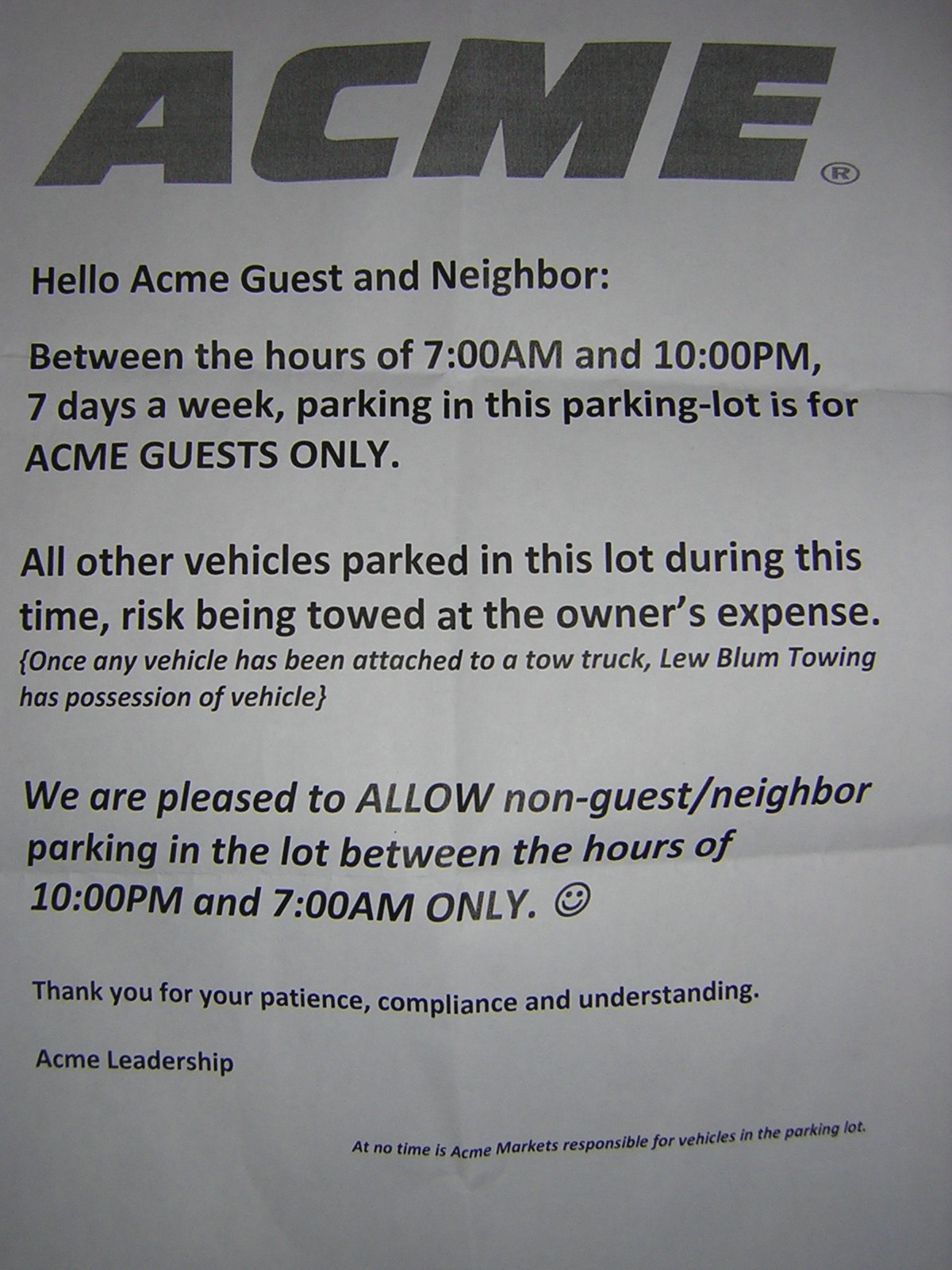
Anyway, this part of South Philly is famous for its tight parking, particularly at night, so a while ago the Acme quietly started letting people park in the lot overnight. Well, one thing has led to another; when I visited the lot at 10 a.m. this morning, a Sunday, the lot was nearly full, and a very substantial portion of the cars had the above flyer under a windshield wiper. It gently suggests that the freebie only works from 10 p.m. to 7 a.m.

You could see this coming a mile away. Free parking spaces attract cars the way a dead horse attracts flies. And the cars are about as good at following instructions as the flies are.

As I argued last year, this should be a paid lot, similar to the one next to the Eastern State Penitentiary in Fairmount.

That's step one. Step two is to redevelop this site along the lines of the Piazza in Northern Liberties -- a series of perimeter buildings around a center square. Build the new Acme first, over on Passyunk where it has always belonged. Then demolish the existing store and complete the redevelopment of the site.

The area above the new store should be given over to parking, just as happens on South Street, over the old SuperFresh (now an Acme) and the Whole Foods next door.

The paid lot, and the follow-on garage, would not attract people looking for free parking, but it would give people who couldn't find free parking a place to go. When you're tired enough, and frustrated enough, you're happy to have even a paid place to park, so you can go home and go to sleep. Also it would be a good resource for the many restaurants in the neighborhood.

See also Once There Was a Prison, Off-Street Parking at the Italian Market - Current Conditions.

Wednesday, November 18, 2015

Richardson Dilworth, an Urbanist for the Ages

I was born and grew up in New York City. I didn't move to Philadelphia until I was in my thirties. Aside from Benjamin Franklin and Grace Kelly, I think the first Philadelphian I heard of was Edmund Bacon (father of Kevin). And the second was Richardson Dilworth.

But I confess I didn't know very much about Dilworth until I sat down and read Peter Binzen's excellent 2014 biography, Richardson Dilworth, Last of the Bare-Knuckled Aristocrats. I didn't know he'd been a 19-year-old Marine rifleman at the battle of Belleau Wood in World War I, or that he'd won the Silver Star on Guadalcanal in World War II, or that he'd struggled with alcohol for most of his life.

And what a life it was. Born to wealth, educated at Yale and Yale Law School, a successful law career, then four jobs with the City of Philadelphia -- treasurer, district attorney, mayor, and president of the Philadelphia Board of Education.

And what a cast of characters. Moses Annenberg, one of Dilworth's most important law clients. Jack Kelly, Olympic oarsman and father of Grace. Albert M. Greenfield, Gus Amsterdam, Bernard Watson.

Sam Dash, later famous as counsel for the Senate Watergate Committee, worked for Dilworth. So did William T. Coleman, later U.S. Secretary of Transportation, and A. Leon Higginbotham Jr., later chief judge of the U.S. Court of Appeals for the Third Circuit.

A bold and innovative reformer with a calculated temper and a remarkably disarming sense of humor, Dilworth's breakthrough moment came in 1951, when he teamed with Joe Clark to oust a Republican political machine that had run Philadelphia for 67 years. Clark became mayor; Dilworth became district attorney, and then succeeded Clark as mayor.

As district attorney, Dilworth did something that would be worthy of note even today. He insisted on fair trials. As one observer put it, "He wanted to make sure justice was done and if mistakes were made to admit them." (P. 116.)

U.S. Senator Joseph McCarthy tangled with Dilworth in 1953. McCarthy was busy hunting for communists in the government, and Alger Hiss had been convicted of perjury. Dilworth reportedly said that 1,000 Alger Hisses hurt less than one McCarthy. McCarthy challenged Dilworth to a televised debate, and at the debate Dilworth defended his statement. "We can put traitors in jail," Dilworth said to McCarthy, "but demagogues remain too long above and beyond the processes of the law." (P. 119.)

Elected mayor in 1955, Dilworth turned out to be an urbanist for the ages. His work with Ed Bacon -- particularly the revival of Society Hill -- is well known. Other stories, less well known, place him at the center of debates that are going on today.

Parking in South Philly was a problem even in 1961, when, as Binzen puts it, "the mayor proposed requiring residents to pay for overnight parking spaces in front of their houses. The proceeds of the $40-a-year licenses" -- about $320 in today's dollars -- "were to be earmarked for building off-street parking lots.  Such a plan worked in Milwaukee, but Dilworth's scheme got nowhere. When he confronted his critics at a stormy public meeting, rock throwers targeted the building. A city councilman, Tom Foglietta, was cut by flying glass." (P. 140.)

Dilworth also wanted to ban cars in the center of the city. Writes Binzen, "His concept was to create a restricted area that would comprise some 400 blocks, from 8th Street west to the Schuylkill River and from Spring Garden Street south to Lombard and South Streets." (P. 151.)

After leaving the mayor's office, Dilworth became involved in a project to develop high-speed rail service between Boston and Washington. President Kennedy encouraged his work, but Kennedy's successor, Lyndon Johnson of Texas, was an entirely different proposition. When he finally got to meet with Johnson, Dilworth says, "It was very clear that he just couldn't be less interested. He just sat there wondering what the hell we were talking about. All he could envision was where he lived. And he would either get a helicopter or an airplane or else get in that enormous Lincoln and drive on a straight road to Austin at 95 miles an hour. So who needed or wanted a train?" (Pp. 155-156.)

Well, we do.

Wednesday, October 28, 2015

Love Park Redesign: Why Are There Still Five Traffic Lanes on 16th Street?


I am a great fan of the Love Park redesign. Final plans were presented in a public meeting at the Free Library on Monday, October 26. I do have one improvement opportunity. It relates to the park's footprint.

At the meeting, Deputy Parks Commissioner Mark Focht related that, in addition to the removal of the slip lane at the southwest corner of the park, the southern sidewalk has been extended approximately eight feet to the south. This is a wonderful thing.

On the west side of the park, however, the treatment of the street remains as it currently is, with a total of five traffic lanes jostling northward. Removing one lane would not increase congestion, but it would calm traffic, particularly at the northwest corner of the park, where 16th street intersects with Arch and the Benjamin Franklin Parkway. This is probably the park's gnarliest street corner, which is saying a lot.

It's worth remembering that, up to Chestnut street, 16th has only two traffic lanes. It then bulges out over the next two blocks, eventually reaching five lanes as it passes by the park. Then, in the next block, up by the Cret Cafe, it's back to three lanes.

On 16th street adjacent to the park, the right-hand lane of the five is a turn-only lane that feeds the entrance to the Love Park garage, on the north side of the park. Because of the configuration of Arch Street, the only other thing you can do if you turn right at that corner is go back down 15th street. Why would someone going up 16th street want to go back down 15th street? Maybe you left your cell phone at home.

Finally, removing a traffic lane would allow the park to expand. Love Park is not a large place, and the extra space would be useful.

Addendum:
On the evening of Thursday, October 29, I went out and observed the right-turn only lane on 16th street, as it intersects with Arch. I watched for 15 minutes, from 5:08 to 5:23 p.m.

Seven cars and one SugarHouse Casino bus turned right during those 15 minutes. Multiplying by four gives a rate of 32 vehicles per hour, during the evening rush. Much of the time I watched, the lane was completely empty.

There are times -- for instance, the morning rush -- when we could expect more traffic in this lane. But of course there would be less traffic in the other lanes. 16th street is basically a get outta town street.

We really can live without that right-turn only lane. Time to extend Love Park to the west.

See also Love Park Underground, Extend the Diagonal, Turning JFK Boulevard into an Extension of Love Park.