Sunday, March 17, 2019

On a Slow Boat to China

Dolce far niente

20th & Manning on a quiet summer day.

"On a Slow Boat to China" is the title of an old Bing Crosby song, where two lovers are dreaming about a protracted getaway. Nowadays the phrase has a more quotidian meaning, and people normally use the briefer phrase slow-walk, as in "Let's slow-walk this project."

"Slow-walk" strikes me as a rather dry, bureaucratic locution, perhaps with a slight odor of death and decay. The Bing Crosby phrase is, to my mind, richer and full of life. I hadn't been aware of the romantic overtones, but I think you can feel them. I'm comforted by my thought that the new bike lanes for Spruce and Pine are standing shoulder to shoulder at the rail of a ship in the South Seas, enjoying the peace and moonlight together.

And going nowhere fast.

Why Does the Slow-Walk Matter?
Currently Philadelphia finds itself in the midst of an effort to reimagine its public spaces - including, notably, its streets. There are two key issues here: bicycling and car parking. There are other important issues, but if these two issues are not adequately addressed, the whole effort is doomed to failure.

Vision Zero
Recently I attended the annual Vision Zero conference, held this year on the campus of Temple University. The conference celebrated several important victories, including state authorization for automated speed cameras on Roosevelt Boulevard. This was a significant and hard-won achievement, and I don't mean to take anything away from it when I mention that we still have some unfinished business in Harrisburg.

There is, for instance, the issue of letting local police officers use radar guns to catch speeders. Currently in Pennsylvania, only state troopers are allowed to do this. For 50 years, municipalities have been asking for the law to be changed, to no effect. Pennsylvania is the only one of the 50 states that does not allow local police forces to use radar guns.

Mayor Kenney delivered the closing remarks of the conference, mentioning, among other things, the recent, dramatic increase in the city's budget for repaving streets. He also said, "We want you to continue to give us a hard time." Well, mayor, here you go.

An adequate repaving budget is of course absolutely necessary, but it is not sufficient to take this city where it needs to go. In terms of  business strategy, you're at the LODO stage - lights on, doors open. You have streets, but you haven't yet figured out what to do with them. For instance, do you want to devote one-third or two-thirds of a street to long-term storage of cars? Or are there other, more valuable uses for that land?

Parking
In general, when it comes to parking, Philadelphia is woefully behind the curve. I serve on the parking committee of a little city at the Jersey shore, Asbury Park, which is light years ahead of Philly. As one example, in February of this year, Asbury shifted its metered parking from pay by numbered spot to pay by license plate. It has also moved its residential parking permits from hang tags on the car mirror to license plate recognition. And you can buy your residential permit online. The Philadelphia Parking Authority has some low-hanging fruit available here.

Let's take a look for a moment at Center City Philadelphia. The congestion is legendary, both in the traffic lanes and in the parking lanes. (The two are related.) What many people don't understand is there are plenty of parking spots in Center City. They're just off the street. In the most recent survey of Center City garages, in 2015, the peak occupancy rate was 73.9 percent. A much better number for peak occupancy would be 85 percent.

Why is it a better number? Because it would free up space on the street. As I mentioned in 2014, "You could take all the cars parked at meters in Center City and sweep them into the garages, and you'd only get the garages to 85 occupancy."

How do we move parked cars to garages and reduce the pressure on our streets? There are three prongs to this trident.

Dynamic meter pricing.
The idea of charging a market price for parking in a city's downtown, and varying that price as demand varies during the course of the day, on different days of the week, and in different seasons of the year, is simply no longer a new idea. It's not mysterious, and the methods used to implement it are no longer to be considered rocket science.

Dynamic pricing had its Broadway debut in San Francisco a decade ago, with the help of a federal grant. (For more, see Parking in San Francisco.) Since then it has spread across the country; Asbury Park has been doing dynamic pricing for years. Philly really needs to wake up and smell the coffee.

Turn parking spots into loading zones.
However, I think I've actually given up waiting for City Council to start charging market rates for curb parking in Center City. So here's an option. Convert regular parking spaces into loading zones, which are in fact desperately needed. Again, our approach to what is now the parking lane (or lanes) should be: What is the highest and best use of this space?

Yes, such a move would mean that motorists might well have to park in a garage when they would prefer to park on the street, and they will undoubtedly mention that thought to their elected representatives. On the other side is the fact that delivery vehicles are regularly blocking traffic lanes and frequently making Center City almost impassable. Not because the delivery drivers are bad people, but because there's no place else for them to stop.

I'd do Chestnut Street first. Much of the parking lane on Chestnut Street in Center City is already given over to loading zones - but only until 10 a.m., when they generally revert to being regular two-hour parking spots. As I mentioned last year, "Not coincidentally, the phenomenon of delivery trucks unloading in the bus lane explodes right after 10 a.m. It seems only logical to extend the time of the loading zones further into the day. I do think this simple and incremental move would help a lot."

Vacancy tax for garages.
Commercial garage prices also need to come down. You'd think that operators would be dissatisfied with a 74 percent peak occupancy, but it's possible that they're making more money at that price point than they would if they lowered prices and increased their occupancy. There are times when public policy and private profit don't both optimize at the same point. (Who knew? For more on this, see Professor Shoup's Parking Book.)

So how do we encourage garage operators to fill their garages, and meet an obvious public policy goal? As I put it in 2014, "Price controls have a habit of backfiring. But you could tax empty parking spots in garages. For the first 15 percent, the tax could be zero. Below 85 percent peak occupancy, the tax would be greater than zero. Just a thought."

As far as I can tell, nobody has ever put a vacancy tax on commercial garages. Vacancy taxes on residential properties, however, seem to be becoming something of an item. Paris has had one since 2015, and New York City may soon be getting a "pied-a-terre" tax. 

Bikes
People who should know better continue to denigrate bicycling. Peter Walker of The Guardian recently wrote a book titled How Cycling Can Save the World, and he wasn't kidding. If you really care about getting people around in cities, and not killing people in traffic crashes, and saving the planet, and generally improving the happiness and well-being of the people, then you should care about bicycling.

To succeed in Philly, bicycling needs a network of protected bike lanes. This would likely quintuple the number of people riding bikes, and basically change the whole story of what goes on on our streets.

Not too many years ago it looked like things were headed in that direction, but after a good start the bike network got mired down, and progress in recent years has been excruciatingly slow.

The poster child for slow-walking is the proposed upgrade to the Pine-Spruce pair of bike lanes, which are the backbone of the city's network of bicycle lanes. They were originally installed in 2009, and were due (overdue) for restriping when a proposal surfaced to upgrade the lanes by adding flex posts. I won't rehearse the years of wrangling that have ensued. And I'm not going to tell you how I feel about this process.

Instead, I'm going to look on the bright side. It is actually possible that the lanes will be redone this year. What could possibly go wrong? Well, I'm mindful of what happened down by the South Street bridge, on 27th Street and South Street. The lanes there were restriped; they were also supposed to get flex posts, but somehow that didn't happen.

I've heard a number of stories about how all that came to be. I've decided not to repeat any of them. I just hope we don't get a replay up on Pine and Spruce.

Leadership
I won't deny that parking and bicycling are difficult political issues in Philadelphia - inflammatory, even. Still, I think it's worth pointing out that these issues simply are not hard on the level of policy or on the level of urban design and traffic engineering. And the solutions are not expensive.

What I think we lack is leadership. This shortcoming manifests itself in several ways.

In parking we generally get distraction - proposals that are popular and often amusing, but which consume way too much oxygen and prevent us from solving the underlying problems.

There was the parking amnesty, a bandaid if ever there was one. And the proposal to increase the minimum requirements for off-street parking in new construction, at a time when virtually the whole rest of the nation is moving toward zero parking minimums. I'll stop there.

As for bikes, it's the slow-walk that's the derailleur. People who oppose bikes don't seem to have any cogent, or even coherent, arguments left. So now it's the slow-walk.

But guess what? There are elections this year - the primary in May and the general in November, and perhaps some of the actors in our little drama will Shuffle Off to Buffalo. (Also the title of a romantic song, this time about a honeymoon in Niagara Falls.)

16th and Market. Is the light really green?

See also At Least It Makes People Laugh, Intermittently Terrifying,  It's the Road Design, Stupid, The Supreme Court and Parking, Taming Chestnut Street, Why Are European and American Bicycling So Different?

Friday, February 8, 2019

The Correct Strategy: Fight

Siege Tactics: Isolate and Diminish

Benito Mussolini near the end of his career.

I'm a peacemaker at heart; I like compromise. Now is not the time.

We need to recognize the times we are in, and make appropriate adjustments to our expectations and behavior.

There is no compromising with Trump. And we need to stop trying to find ways to help the Republicans clean up the mess they have created. After Hoover, Nixon, and now Trump, I'm done with them.

Trump hasn't been the same since Hope Hicks quit. He's lost Kelly and Mattis and Cohn - you may not like them but they were grownups. If he loses the kids, he's got nothing but Melania, and I don't think she's very fond of him.

My sense is that Mueller has the goods on his sons, his daughter, and his son-in-law. I don't see why we should trade them for a presidential resignation. The more he's isolated, the weaker he is. Take them all down, in good order.

I think it's up to the Republicans to figure out what to do with the president. When Democrats try to find a compromise for the good of the country, what they're really doing is enabling the Republicans. Democrats should stay in their lane and keep doing everything they can do to isolate and diminish the president, who is in fact helping greatly in this work.

Yes, there's going to be a great deal of damage. There already has been. And the die-hards have been with us since South Carolina was founded by wealthy slave-holders from Barbados. I want their power diminished as much as possible. But more importantly I want the persuadable middle to finally process the concept that fascism is a really bad idea that doesn't end well.

Trump is looking puffy and disoriented, and he frequently just doesn't make sense. The guy is falling apart. Keep hammering him, and don't let him get up off the floor.

The president is under siege.  Keep him there until his goose is cooked.

See also An Inflection Point, Fascism, Bannon and Co. Aren't Very Good at Being Evil,  What Can Pierre Laval Tell Us About Donald Trump?

Tuesday, February 5, 2019

Submerged Narratives

What Happens When They Surface?

General store interior, Moundville, Alabama. Walker Evans/FSA, 1936. 

I remember being told this story years ago, by someone I was inclined to believe. A little old lady (please don't shoot me - that's what the guy said), possibly in Kentucky or Tennessee (it was a long time ago and I'm not sure), ran a story in the newsletter she produced for her church. The story said that the Procter & Gamble logo - a circular image of the Man in the Moon and thirteen stars - was actually a sign that P&G worshipped the devil. P&G started to receive phone calls, and was understandably alarmed. Lawyers and investigators went nuts trying to run the story down, and eventually found the little old lady, who said she had received the information from a trusted source and was mortified to learn that it was inaccurate. Meanwhile the story had been copied from church newsletter to church newsletter and had taken on a life of its own.

I have no idea whether this story is accurate, but the rumor did start in the 1980s, and it was remarkably persistent. Eventually P&G saw no option but to get rid of the logo.  (Here's a 1985 story on the early days of the rumor, from the New York Times.)

All of this, you will note, took place before the rise of the Internet. Indeed, the medium of communication was paper. There was a second coming of the rumor, on the Amway voice mail system, which led to an award, not against Amway, but against several former Amway distributors, in 2007.  (Here's a Times story from 2007.)

My point here is twofold. First, there have always been submerged narratives. Second, electronics amplifies these narratives, but it does not invent them.

So the next time some techie stands on a platform and tells you all is new, don't believe it. All they have is a bigger megaphone. And that doesn't make you smarter. It just makes you louder.

I don't suppose anybody cares too much about the death of the P&G logo - although it was a nice piece of graphic art - but the lesson is that even submerged narratives can do a bunch of damage.

For some time now, historians have been looking into these submerged narratives. It turns out there are a lot of them. Some of them surface, and even confront the controlling narrative of the time. But others remain quietly insignificant for the world at large.

The Cheese and the Worms
Here's a submerged narrative from the sixteenth century.

Domenico Scandella, aka Menocchio, was born in 1532 in the Italian region of Friuli, which extends from the Adriatic to the Alps a bit northeast of Venice. Menocchio lived almost his whole life in a little town at the foot of the Alps called Montereale, where he worked mainly as a miller and served as mayor in 1581.

I find myself thinking of Menocchio as the crazy uncle who comes to Thanksgiving dinner and shares his fantasies with the rest of the family, of course presenting them all as incontrovertible fact.

It being the sixteenth century, Menocchio's main subject of discourse was religion, and his masterpiece of speculative theology is now known as The Cheese and the Worms. Carlo Ginzburg uses the phrase as the title of his biography of Menocchio, which was originally published in Italian in 1976.

Ginzburg recalls sitting in an archive in Udine, which is not too far from Montereale, during the summer of 1962, going through records of old trials, and coming across a reference to a man who maintained that "the world had its origin in putrefaction" (p. xi - citations are to the 1980 English edition). He made a note; other research intervened; but eventually he got back to Menocchio and wrote his story.

Menocchio had been telling friends and acquaintances about his ideas for years, and eventually word got back to the Inquisition. He was denounced for heresy in 1583; in 1584 he was arrested, imprisoned, and put on trial.

Think of these proceedings as Menocchio's Thanksgiving dinner. With the Inquisitors, instead of family and friends.

He let it all hang out. "The world had its origin in putrefaction?" Happy to explain, your honor. "I have said that, in my opinion, all was chaos, that is, earth, air, water, and fire were mixed together; and out of that bulk a mass formed - just as cheese is made out of milk - and worms appeared in it, and these were the angels." And one of the angels is God. (Pp. 5-6).

Things then become a bit more conventional, with Lucifer taking a fall and God creating Adam and Eve.

The Inquisitors had been asking witnesses whether Menocchio spoke "in earnest or in jest," and whether he was of sound mind. The answers came back that he spoke in earnest, and he was not mad. One of Menocchio's eleven children, Ziannuto, tried to keep the off-ramp open. He put out the word that his father was "mad" or "possessed." He also hired his dad a lawyer. (Pp. 6-7.)

For his part, Menocchio just asked for the cranberry sauce and forged ahead. He had unkind words for the Virgin Mary and the clergy, and he rejected all the sacraments except communion, where he insisted that Christ was not present in the wafer, but rather the Holy Spirit (pp. 4, 5, 9-11).

Menocchio even suggested that lawyers in court should speak in the vernacular, and not in Latin, so that the common folk could follow the proceedings (p. 9).

Not surprisingly, the Inquisitors found Menocchio guilty of heresy. He was sentenced to life in prison.  In 1586, his sentence was commuted; he was allowed to go home to Montereale and told to speak no more of his many ideas (pp. 91, 93, 95).

And it appears that, for a number of years, he did just that. Eventually, however, he started talking again, and the Inquisitors got wind of it. He was rearrested in 1599 and declared a "relapsus" (pp. 103, 110).

It was not a good time to be a relapsed heretic. In fact, it could get you killed. There was some back-and-forth in Menocchio's case, but in the end the pope himself sent word that Menocchio must die. And that's what happened (pp. 127-128).

Why Kill Menocchio?
With his death, Menocchio slipped from obscurity to oblivion, where he remained for nearly 400 years, until Carlo Ginzburg told his story. I wouldn't say that Menocchio has now achieved the fame of a rock star, but last year, in 2018, the movie Menocchio appeared. So, a biography that's forty years old and still in print, and now a biopic. Not too shabby.

Reading his story from the vantage point of the 21st century, I found myself asking, "Why did they bother to kill this crazy old coot?" I suspect some of my readers may have been harboring similar thoughts for the last several paragraphs. I think, upon reflection, that the answer is two-fold.

First, Menocchio was definitely a heretic. Let's just talk about The Cheese and the Worms, and leave the other stuff on the side.

Have a look at the Apostles' Creed, one of the basic statements of Christian faith. Here are the first seven words: "I believe in God the Father Almighty." Seven words in, and Menocchio is already on shaky ground. Add the next five words - "maker of heaven and earth" - and he's toast.

At the center of Menocchio's downfall, Ginzburg places "the refusal to attribute the creation of the world to the divinity" (p. 56).

Second, we need to remember that, at this time, the Roman Catholic Church was fighting for its life. Let's take a moment and review some highlights from European History 101. In 1517, the Protestant Reformation began when Martin Luther published his 95 theses. Eventually, much of northern Europe, still considering itself Christian, declined to recognize the authority of the pope in Rome. Rome responded with the Counter-Reformation, largely engineered during the Council of Trent, which lasted from 1545 to 1563. The Wars of Religion, as they are called, culminated with the Thirty Years War (1618-1648), which devastated Germany in particular, killing as much as one-third of its population. After this catastrophe, religious animosity continued, but outright bloodshed declined.

So Menocchio propounded his ideas at an inauspicious time. Thought control through the Inquisition was already well established. And it wasn't just for obscure Friulian millers. Giordano Bruno was one of the most interesting intellectuals of his generation, and he also faced the Inquisition at roughly the same time as Menocchio.

Although Giordano Bruno supported the novel view of Copernicus that the earth revolved around the sun, it seems that the Inquisition was primarily interested in more standard deviations about the nature of the Trinity, the divinity of Christ, the doctrine of transubstantiation, and similar issues. He was found guilty and  burned at the stake in Rome in 1600.

And then came Galileo, who also supported the Copernican system, publishing a book on the subject in 1632. This time the Inquisitors were not amused, and in 1633 they forced him to recant. He spent the rest of his life under house arrest.

So much has changed between Galileo's time and ours. And I do think it's hard, from the vantage point of the 21st century, for us to place ourselves back in that time. Perhaps it helps to trace some of the changes as they came along. In this regard, I think it's useful to jump the Atlantic and look at some things that went on in the American colonies in the seventeenth century.

Let's first look at the Puritans in Massachusetts, who got their start a few years before Galileo's trial. The Puritans weren't interested in people whose religious views differed from theirs. Rhode Island was founded by Roger Williams, who was expelled from Massachusetts because he thought for himself. One writer calls early Massachusetts "a theocracy that brooked no dissent, religious or political."

Over the course of the seventeenth century, though, tolerance did get a foothold in the colonies. This was particularly true in William Penn's Pennsylvania, founded in 1681. Penn welcomed settlers of all faiths, not just his fellow Quakers. And they came - Huguenots, Mennonites, Amish, Catholics, Lutherans, and Jews. Anyone familiar with the history of Pennsylvania recognizes that the ideal of tolerance was not always matched by reality, but the fact that the ideal existed was a significant break from the European past.

Flash forward a hundred years to the U.S. Constitution and its First Amendment, where there is the notion that the new federal government "shall make no law respecting an establishment of religion, or prohibiting the free exercise thereof." Lurking under this rather legalistic language, I think I detect a new idea - the idea that we should stop slaughtering one another over theology.

The amendment goes on to protect freedom of speech, and of the press, "and the right of the people peaceably to assemble, and to petition the Government for a redress of grievances."

Menocchio would not have recognized this new world. Menocchio had a lot of grievances (he was like the American colonists in this regard - have a look at the Declaration of Independence) and he longed for nothing so much as a hearing.  As he told the Inquisitors, "I said that if I had permission to go before the pope, or a king, or a prince who would listen to me, I would have a lot of things to say; and if he had me killed afterwards, I would not care." (P. 9.)

Free speech, freedom of religion, and a government that listens to the people. Okay.

Pierre Clergue, the Lusty Priest
A basic problem with the old order was that the church had, from the time of Constantine the Great, become a part of the government, and its ears had become attuned to the voices of power and increasingly deaf to the voices of the people.

It has been observed that, as secular power increases, spiritual authority tends to decrease. This creates an empty niche for people who wish to present themselves as the new spiritual authority.

To see how this plays out on the ground, let's parachute into the fourteenth century, to a little village on the northern edge of the Pyrenees called Montaillou, and have a look at the village priest, named Pierre Clergue.

Montaillou is the title of a book by Emmanuel Le Roy Ladurie. It was published in French in 1975 and in English in 1978, and provides a portrait of this little town between 1294 and 1324, relying on remarkably rich records of the Inquisition.

Montaillou, located at an elevation of around 1,300 meters, was a farming and sheepherding settlement that in the early fourteenth century had a population of around 200 or 250. The Clergues were one of the most important families in the area. They were prosperous peasants, and they had also cornered effectively all the official power in the town. Pierre, as the village priest, was the religious authority, conducting services, hearing confession, and collecting tithes, which are taxes owed to the church. (The penalty for not paying your tithes was excommunication.) His brother had the title of bayle, which made him the chief civil officer, collecting taxes and enforcing the law. Together, the two brothers had a very nice little version of Tammany Hall. They pretty much controlled the town and the town's relations with the outside world, and Pierre was definitely the senior partner. (See chapter 3.)

Pierre also had an eye for the ladies. On page 155, Le Roy Ladurie lists twelve of his mistresses whom we know by name. Among them was a young cousin, Grazide Rives, who later married Pierre Lizier. "At that time," she told the Inquisition, "I was a virgin. I think I was fourteen or fifteen years old. He deflowered me in the barn [borde] in which we kept the straw." (P. 158.) Another conquest was Esclarmonde Clergue, Pierre's sister-in-law. (Leviticus 18:16 suggests in strong terms that a man should not have sex with his sister-in-law.)

Pierre also had a long affair with a local noblewoman, Beatrice de Planissoles. Beatrice told the Inquisition that they practiced a form of birth control that she perceived to be effective. There was an herb, which was wrapped in a tiny piece of linen. "And he had a long cord which he used to put round my neck while we made love; and this thing or herb at the end of the cord used to hang down between my breasts," as she told the Inquisition (p. 173). And he would insert the herb in her vagina before they had sex. And if they were ever concerned that the herb had gone astray - in moments of passion, such things have been known to happen - she could always tug on the cord, put the herb in his hands, and he could replace it.

Effective or not, it was a nice game. Pierre clearly enjoyed entertaining Beatrice. At one point, they were both in the village of Prades d'Aillon, and he prepared a bed for them in the church so they could spend the night there. "Oh! Oh! How can we do such a thing in the church of St. Peter?" she protested (p. 309). Very 1960s.

They had interesting conversations. On the subject of incest, something of a personal interest for Pierre, he had this to say: "When the world began brothers knew their sisters carnally, but when many brothers had one or two pretty sisters, each brother wanted to have her or them. Hence many murders." And so sex between brothers and sisters was forbidden (p. 52). I suppose we should give Pierre high marks for originality, but it probably would have been safer not to go there.

Pierre was a powerful man and an accomplished seducer. Normally, friendly persuasion would work, but if it didn't, as Le Roy Ladurie puts it, "he might say to a woman, either you sleep with me or I'll see that you are denounced to the Inquisition in Carcassonne." (P. 67.)

Denounce her for what, you ask. Well, it turns out that many of the people in Montaillou were adherents of the Cathar, or Albigensian, heresy. This was essentially a reboot of the third century Manichean heresy. Without getting into too much detail, the Cathars believed that evil existed independently of good, which implied that God was not almighty.

The Cathars didn't view themselves as heretics, but rather heroic Christians pursuing a better path within the church. There were two kinds of Cathars - a small elite known as perfecti and the larger group of followers, called credentes. The perfecti at this time were shadowy figures moving from place to place, ministering to their flocks, but rarely staying in any one spot for long. The credentes, on the other hand, pretty much blended in with the regular Catholics. They practiced baptism and went to confession and mass. They also had an underground side, hiding perfecti in their houses, giving them alms, and guiding them to the next safe house. But to an outsider, life in Montaillou would have looked normal and Catholic. (Pp. viii, 265, 310-311, 325.)

However, the church took a dim view of Cathars, and a threat of denunciation to the Inquisition would have been a powerful motivator to compel compliance with whatever Pierre Clergue wanted.

One of the most interesting parts of all this, to me, was that Pierre Clergue was himself a Cathar heretic. It took the Inquisitors a very long time to figure this out, but Pierre eventually wound up in the famous jail in Carcassonne, where he died.

Simon de Montfort, Trouncer in Chief
There's even another layer beyond this, though. The church had been fighting for a century to eliminate the Cathars. They should have been gone, but the flame of heresy had not been extinguished. It had been greatly diminished; it had gone to the mountains, and gone underground, but it had not been completely destroyed. Montaillou was the last center in France of the Cathar heresy. (Pp. vii-ix, xii, 231.)

Let's dial back from 1320 to the year 1200. Cathars were all over southern France, and not just up in the Pyrenees. They were in the lowlands, and in the big towns, and in the chateaux of the nobility.

There's a liminal space between being submerged and being fully on the surface. Swimmers know this space when they float on their backs on a summer day, and gaze up at the sky. Submariners in World War II called it "decks awash."

I think of the Cathars in, say, Toulouse in 1200 as being decks awash. If you looked, you could see them, but they weren't particularly demanding your attention. Frankly, they'd already taken over, and they were doing just fine where they were.

The church saw the Cathars, and it launched a preaching campaign. Things didn't go very well. In 1204 there was even a great debate, in Carcassonne, between Catholic and Cathar clergymen, with a large audience in attendance. Things still didn't go very well. (Zoe Oldenbourg's Massacre at Montsegur, published in English in 1961, is still my favorite history of the Albigensian Crusade. The Carcassonne debate is on page 91.)

In August 1205 reinforcements arrived in the form of a young Spaniard, the future St. Dominic. He really put his heart into it, but in the end it wasn't enough.

The church moved on to enforcement. In 1208, Pope Innocent III called for a crusade to suppress heresy in southern France. In July 1209 an army of crusaders showed up in front of the town of Beziers and, through a stroke of good luck, captured it quickly. The crusaders then killed all the inhabitants. On that day it didn't matter whether you were a loyal Christian or a Cathar heretic. If you were in Beziers, you died.

Terror works. The resistance largely collapsed. The crusaders did lay siege to Carcassonne, which surrendered after a few days.

In their own minds, at least, the crusaders had achieved their goal of conquest. The question now was how to manage the occupation. Several senior nobles, including the duke of Burgundy, were asked to stay behind and lead the effort. They all declined. Did they sense the looming quagmire? Perhaps.

Terror works up to a point. It creates fear and perhaps temporary compliance. But it also winds a spring of anger, which is only waiting for its moment.

In the end, the job went to Simon de Montfort, a lesser noble who nonetheless had substantial lands near Paris and was an experienced soldier who had served in the Fourth Crusade. Most of the crusaders went home, leaving Simon with only a small permanent force at his disposal. In the coming years it would be supplemented from time to time by fresh detachments of crusaders, whose presence was always temporary.

Simon was a capable soldier, but he lacked troops, and so he relied on terror as he played what was in effect a rather large game of whack-a-mole. Towns and castles would submit to him and swear an oath of loyalty. He would leave to deal with another insubordinate castellan, and rebellion would rise in his rear.

To Simon it may have looked like anarchy, but it wasn't. It was the feudal system doing what it was best at - resisting an outside invader. Of course, the system had been designed to deal with Visigoths and Vikings and Vandals, and not the pope and the king of France.

At any rate, Simon was good at his job; in 1216 the king of France rewarded him with the title Lord of Languedoc. Then one day in June 1218 Simon was fighting, once again, outside the walls of Toulouse. As Oldenbourg relates, Simon's brother, Guy de Montfort, "was wounded by an arrow fired from the ramparts. As Simon hurried across to him, lamenting loudly, he was struck on the head by a stone from a stone-gun, which (the Chanson tells us) was served and fired by women and young girls. 'A stone flew straight to its proper mark, and smote Count Simon upon his helm of steel, in such wise that his eyeballs, brains, teeth, skull and jawbone all flew into pieces, and he fell down upon the ground stark dead, blackened and bloody.'" (P. 198.)

The war continued, with the king of France playing an increasingly prominent role. In 1271, Languedoc became a direct dependency of the French crown.

Even before the start of the crusade, the Cathars had been using an old fort at the edge of the Pyrenees as their headquarters. Montsegur was a small place perched atop a remarkably steep pinnacle of rock. As life in the lowlands became increasingly perilous for the Cathars, Montsegur grew in importance as a refuge and stronghold. In 1243 the crusaders launched a siege of this almost, but not quite, impregnable position. The siege lasted nine months, until March 1244; when the defenders finally agreed to give up, they were given good terms, but the 200 or so perfecti in the fort had to die. It was, by all reports, quite a bonfire.

I think we can call Montsegur the end of major combat operations, although massacres and roundups continued for a very long time. In 1308 the Inquisition came to Montaillou, arrested almost all the adult and adolescent residents, and carted them off to jail in Carcassone. Some were released fairly quickly; others stayed longer. I do wonder how the children and sheep did without any grownups around.  (Montaillou, pp. 63-64.)

During the course of this long conflict you can see feudalism gradually crumbling, along with early stirrings of the centralized French nation-state. What we do not see, from the start of the Crusade in 1209, is any sustained effort to win the hearts and minds of the people. Instead we had the Inquisition. People were encouraged to abandon their heretical beliefs and return to the Catholic faith, and if they did so they were allowed to live. If they refused to recant (as almost all the perfecti refused), or if they relapsed (as Menocchio did), they would normally be killed.

The church had mounted a campaign of persuasion before the start of hostilities, with earnest preachers such as St. Dominic doing their best. But after the war began, even the Dominicans found themselves going on a war footing. In 1233, a few years after Dominic's death, the pope put the Dominicans in charge of the Inquisition.

I'm inclined to think that the Inquisition was one of the great institutional innovations of the high middle ages, comparable to the rise of the universities, but with very different effect.

As Oldenbourg puts it, "Other later epochs were to experience the pressure of similar police-state terrorization; but it is the Dominican Inquisition which must take credit for having actually invented the system. Once the trail had been blazed, there were plenty of imitators ready to follow them along it and perfect their methods: though it would seem that, apart from purely technical improvements, there was very little left for them to discover." (Pp. 308-309.)

What Do We Know about Alternate Narratives ?
Alternate narratives serve a purpose. They explain stuff. Take the Procter & Gamble rumor, at the beginning of this story. Maybe the little old lady just asked herself, "Why does such a boring company have such an interesting logo?"

I made this up, of course. Maybe she thought this, and maybe not.

On the other hand, I don't know whether she actually existed. Having a little old lady as your protagonist personalizes the story in a pleasant way, and the story itself provides a zany but engaging answer to a question that she may never have asked. Other narratives, like a competitor planting disinformation, aren't nearly so much fun. How easy it is to slip through a door into a world where belief is more important than fact, and conjecture can rapidly harden into received wisdom.

What can we learn from Menocchio? For me, the key thing about him was how grounded he was in the material world - things he could see and touch. His analogy of the cheese and the worms is, to me, very telling. Menocchio was literate; he had access to books, and he read them. But his key insight came from his daily life.

He thought he had witnessed the spontaneous generation of life, so he had no problem building his story of the creation of the world on a foundation of old cheese.

The humble maggot has fooled many people over the years. The egg that produces a maggot is very small. Maggots do seem to come out of nowhere, but they don't. (They do go on to become flies, which then plant more of the tiny eggs.)

Joseph Leidy, a scientist who lived in nineteenth-century Philadelphia, spent a considerable amount of his time trying to convince people that they had not witnessed the spontaneous generation of life. He seemed to find this business of batting down incorrect conclusions a bit frustrating, but he soldiered dutifully on, answering letter after letter as politely as he could. (See The Last Man Who Knew Everything.)

On to the Cathars and the independent existence of evil. Christians have been wrestling with the problem of evil for several millennia now. St. Augustine's thought was that evil is simply the absence of good - a state of disorganization, if you will.

I confess to considerable sympathy for St. Augustine's point of view. Most of the evil I have seen has come through the slow grinding of bureaucratic processes, where many people touch an issue, and arguably good intentions, deformed by other arguably good intentions, can lead to poor outcomes.

I've led a sheltered life. Let's go back to Montaillou in 1310 - a shepherd stands in a snow-dappled alpine meadow, staring at an angry she-wolf who is clearly willing to kill him to get at the sheep he's guarding. Does he care much about the hungry wolf pups at home in the burrow? Or is he more worried about the fact that all he has in his hands is a shepherd's crook? If he had the time and inclination to analyze the wolf's motives, would he see a state of disorganization or evil incarnate?

I think people need narratives that relate to their lived experience. When the controlling narrative fails to provide that, alternate narratives will emerge.

Tolerance, Anyone?
So how should we deal with all these competing narratives? One thing I'm pretty certain of is that suppression is a bad idea. If you've got a century to spend, and you're willing to seriously damage the institutions that you're trying to defend, you may be able to declare victory at some point. That's what happened with the Albigensian Crusade.

Or you could try tolerance. America is, of course, the land of alternate narratives. Many people came here because they were being persecuted for their ideas in their home countries. Others simply bring with them the ideas and culture of a place that is very different from the United States. And then there were the hippies in the 1960s who just decided to think for themselves. Or was it the marijuana talking?

It's America. We don't all have to believe the same thing or view the world the same way. But we do need to respect the other guy's right to do the same thing. It seems a bit odd to have to say this in the United States, but the way things have been going lately, I feel obliged to mention it.

We actually do have a controlling narrative. It's enshrined in our Constitution and the Declaration of Independence. Let me translate, freely. Respect the competing narratives. Fight over facts. Do not impose your beliefs on others who do not share your beliefs.

Social Media
We do have a problem with our social media. I think the problem is manageable, and frankly it's not new. Communications have been gaining in reach and speed since the invention of the printing press. The idea of removing the middleman is also not new. Around the time Gutenberg was printing his bibles, Martin Luther was suggesting that Christians did not need a large clerical bureaucracy to mediate between God and the individual. You could just get down on your knees and dial up the deity directly.  Now, that was a big deal.

I think the basic problem with the social media, as currently constituted, is their tolerance for anonymous authors, or false identities, which amounts to the same thing.

Aristotle, in his book on rhetoric, said that there were three main elements of a speech: ethos, pathos, and logos. Logos is logical argument, pathos is the appeal to emotion, and ethos is the identity and character of the speaker.

On social media, we need to know who is talking to us. Have a look at these two statements:

"Hi, my name is Ivan. I'm a colonel in the KGB. Hillary Clinton is bad. Donald Trump is good!"

"Hi. I'm Dorothy, a church-going, God-fearing little old lady in Kansas. Hillary Clinton is bad. Donald Trump is good!"

In our current situation, Ivan may be the only one telling the truth. Or maybe he's lying too.

I think the social media require other reforms as well, but I think knowing the speaker is basic.

See also How Do We Put This Back Together?

Thursday, January 3, 2019

The Curious History of the Minimum Wage

This is an excerpt from a longer story that I did in 2015 about Thomas Piketty's book Capital in the Twenty-First Century. To see the full story, click here.

Wheat harvest, Ohio. Ben Shahn/FSA, 1938.

The Emperor's New Clothes: The Minimum Wage

One of the great values of Piketty's book are the moments when, as in Hans Christian Andersen's story, the emperor is leading a parade through town with no clothes on -- and these moments just flow seamlessly from the data. A good example is the minimum wage. Piketty tells the story of the minimum wage in two countries: France and the United States.

France first got the minimum wage in 1950, but for nearly two decades it stagnated, falling "farther and farther behind the average wage." (P. 289.) Then along came the upheaval of May 1968, a time of massive protests that started with university students and spread out from there.

(1968 was a watershed year in a number of countries around the world, including the United States. There's a very good book on it all: Mark Kurlansky's 1968: The Year that Rocked the World [2004]. The France chapter begins on page 209.)

(Okay, I can't resist. One of the lead protesters was Daniel Cohn-Bendit. Known as Dany the Red, he once said, "Je suis Marxiste tendance Groucho," or roughly, "I am a Marxist of the Groucho persuasion.")

At any rate, a main result of the events of 1968 in France was that the minimum wage, long stagnant, took off like a rocket. Between 1968 and 1983 it increased by more than 130 percent. (P. 289.)

Around 1980, the winds of politics changed. Margaret Thatcher became prime minister of Great Britain in 1979; Ronald Reagan was elected president of the United States in 1980; and shortly thereafter Gordon Gekko declared that "Greed is good." As opposed to being one of the seven deadly sins.

In France, the Socialists had returned to power in 1981, but the winds were too strong for them, and in 1982-1983 the government took a "turn toward austerity." Says Piketty, "The break was as sharp as that of 1968, but in the other direction." The minimum wage did continue to increase, but at a relatively low rate. (Pp. 289-290, 308-309.)

If you graph all this, the curve is flat until 1968, sharply up until the early 1980s, and then moderately up until the present.

Meanwhile, what's going on in the United States? The minimum wage got started in the 1930's and increased steadily until its peak in 1969, Richard Nixon's first year as president. Since then it has not kept up with inflation, although there have been occasional upward bumps. (P. 309.)

As Piketty puts it, "The United States used the minimum wage to increase lower-end wages in the 1950s and 1960s but abandoned this tool in the 1970s. In France, it was exactly the opposite: the minimum wage was frozen in the 1950s and 1960s but was used much more often in the 1970s. Figure 9.1 illustrates this striking contrast." (P. 310.)

Figure 9.1 is on page 309 of the book, but it is also in the online Technical Appendix; you can look at it by clicking here.

So what should we make of all this? Here's Piketty's rather professorial take: "To an even greater extent than other markets, the labor market is not a mathematical abstraction whose workings are entirely determined by natural and immutable mechanisms .... labor market regulations depend on each society's perceptions and norms of social justice and are intimately related to each country's social, political, and cultural history." (Pp. 308, 310.)

I am now going to, very freely, translate Mr. Piketty: Within certain broad limits, the minimum wage is not about economics; it is about politics. Fight for $15!

Sunday, December 16, 2018

How Do We Put This Back Together?

Lilliana Mason Says It Doesn't Look Good

Migrant mother, California. Dorothea Lange/FSA, 1936.

I've been living with this picture for a very long time. A lot of people have. It is one of the most famous pictures to come out of the Farm Security Administration's photo project during the 1930's. Florence Thompson, the subject of this portrait, was born in the old Indian Territory of Oklahoma to Cherokee parents in 1903. She survived the Great Depression and died in 1983.

The image is famous because the face says it all: What comes next?

I can't believe it, but we're actually facing another one of those times. And, frankly, things don't look very good.

Recently my son suggested I read a book by one of his college chums, Lilliana Mason, who is now a professor at the University of Maryland, College Park. And so I read the book, Uncivil Agreement: How Politics Became Our Identity (University of Chicago Press, 2018), and I almost wish I hadn't. (Earlier this year she also published an op-ed in the New York Times. To see it, click here.) The book analyzes the stovepipes that we Americans have frozen ourselves into, and answers some questions that I have had for some time. The answers are not encouraging.

But first some background.

What's Been Going On
For several decades now, many smart people have been wondering about the Republican base. Their leadership kept pulling the old bait-and-switch trick on them - offer one thing, then deliver another. And in the next election, the same people would go to the polls and vote again for the Republicans.

Under Trump, the ground has shifted somewhat, but the basic dynamic remains the same. A very small group of people at the top are trying to turn their base, and the whole country, into a herd of peons, ruled by a small and increasingly closed elite.

The idea of a middle-class society, the idea of social mobility, the idea of a career open to talent - all these are to be replaced by an economic, political, and social profile similar to that of medieval France or a modern banana republic.

So why  does the Republican base keep voting for this program? Why the visceral hatred for Obamacare, even as they sign up in droves? Why do they vote so enthusiastically against their own self-interest? Why do they vote for their own degradation?

The Answer
According to Mason, the basic answer is very simple. And I must say she has convinced me. Mason suggests that many, many people in America see life as a football game. The main goal, and really the only goal, is to win. People want their team to win.

Mason starts her story back in the time after World War II, when researchers performed a number of experiments that had disturbing results.

Robbers Cave
Flashback to the summer of 1954 and the Robbers Cave State Park in Latimer County, Oklahoma. Social psychologist Muzafer Sherif is holding a special summer camp for 22 fifth-graders. All are from Oklahoma City, but none of them know any of the others. All are white, protestant, middle-class boys, and beyond that they have been screened to be psychologically as close to identical as possible.

Sherif and his coworkers divide the boys into two teams of equal size, and, for the first week of the three-week camp session, they are kept apart. In fact, they don't even know of the other team's existence.

In the second week the two teams, called the Eagles and the Rattlers, are brought together for a baseball game, and the trash talk starts immediately. Things go downhill from there, with raids on the other team's cabin. Fist fights start to break out, and boys start to collect good throwing rocks.

As Mason puts it, "By the end of the second week, twenty-two highly similar boys who had met only two weeks before had formed two nearly warring tribes, with only the gentle nudge of isolation and competition to encourage them." (Mason, page 2.)

In the final days of camp, the researchers tried to reverse this process with a number of what we would now call team-building exercises - in this case, trying to get two teams to act as one. Among other things, the researchers shut off the water supply to the camp, and all the children had to work together to figure out what was wrong and restore the water supply. "After these exercises, the boys remained partial to their own teams, but they did agree to ride home in the same bus at the end of camp. Prior to the exercises, both teams had refused to share a bus with the others." (Mason, p. 134.)

Lord of the Flies
If you're thinking that the Robbers Cave experiment sounds a lot like a scientific version of Lord of the Flies, you are not alone. However, it seems unlikely that there was any cross-influence. Lord of the Flies was published in 1954, the same year the Robbers Cave experiment took place. They are contemporary, and both clearly living in the shadow of World War II, but I'm prepared to think they came to similar places by different paths.

Ingroups and Outgroups
"Humans are hardwired to cling to social groups," as Mason puts it (p. 9). In the 1960s, social psychologist Henri Tajfel decided to test this concept. In one experiment, he made up two notional groups; the experimental subject was assigned to one of the groups. However, there was no conflict between groups, no difference in values. And there were no actual people in the groups. Except for the subject, who had been assigned to one of the nonexistent groups. How non-confrontational can you get?

The subject was then given a choice on how to allocate money between the two groups. Either both groups could receive the maximum amount, or the subject's group (the ingroup) could receive less than the maximum and the other group (the outgroup) would receive even less than the ingroup. Again and again, in many variations of this experiment, the subject chose the second alternative. Winning was more important than prosperity.

Civilization Is Not a Zero-Sum Game
One of the purposes of civilization is to tame some of these instincts. This of course involves the leaders of a society actually being interested in preserving civilization.

It's easy enough to point out flaws in the demagogue's world. For starters, life is not like a football game. Football is a zero-sum game, with one winner and one loser. +1 -1 = 0. Civilized life is largely composed of non-zero-sum games. +1 +1 = 2.

Here's an example. I have no idea how to change the oil in my car. I take it to my dealership, which employs a small army of mechanics. One of them changes the oil. I pay the cashier. So my car has fresh oil, and the dealership has a little more money than it did before I showed up. You don't exactly have the drama of a Superbowl, but I prefer it when oil changes are not exciting.

The Last 30 Years
Unfortunately, over the last 30 years or so, the idea of looking for win-wins, as they are sometimes called, has been displaced in our political life by the search for conflict. And we have found it.

Mason chronicles this process with about 100 pages of impressive original research. Her statistical analysis of data primarily from the American National Election Studies, which have been analyzing presidential elections since 1948, confirms our rising ire and progressive retreat into tribal groups.

Sorting
At the base of this process is a phenomenon that Mason calls sorting. She notes that we all have a variety of identities. Membership in a political party is only one of these identities. Race and ethnicity, sex, religion, favorite sports, smoker/non-smoker, pre-existing medical condition - it's a very long list.

What happens when all of the people in a group share most or all of their identities? It's not pretty.

As Mason puts it (p. 19), "Imagine how much more intense the Robbers Cave conflict would have been had the Rattlers all been Catholic, northern, and white, while the Eagles were Protestants, southern, and black."

This intensity, based on the sorting of identities between the two groups, reinforces the focus on winning. Fast-forward to American politics today: "All of the political arguments over taxes, welfare, abortion, compassion, responsibility, and the ACA are built on a base of automatic and primal feelings that compel partisans to believe that their group is right, regardless of the content of the discussion." (P. 50.)

Winning becomes everything; the issues themselves become relatively trivial.

Misleading Polls
Naturally, in such an environment, polling on particular issues can become quite misleading. Take the legislative fiasco that occurred in the wake of the 2012 Sandy Hook shootings. It looked for a while like some meaningful gun control reforms would get through the Congress. One poll showed "83 percent of Democrats and 81 percent of Republicans personally supported a law expanding background checks." (P. 54.) And then - nothing happened.

Writes Mason (also p. 54), "when it came to the moment of public partisan competition, party victory trumped preferred policy for many Republicans. Party affiliation today means that a partisan cares a great deal about one party being the winner. Policy results come second."

What Comes Next?
As I noted at the outset, Mason is not sanguine about finding a way out of this mess. Neither am I.

Those who follow demographic trends - or just walk down a street in a city like Philadelphia - can easily see that it's not a white Christian country. Frankly it never was. Florence Thompson, pictured at the top of this story, was not Scotch-Irish. She was Cherokee.

But that doesn't mean that we will not be ruled by a closed oligarchy of white Christian men.

The idea that the country's wealthy business interests will desert the Republicans and possibly (aping Ross Perot) try to start a third party is, to my mind, unrealistic. The business interests in Nazi Germany and Fascist Italy adapted pretty readily to Hitler and Mussolini (at least in the beginning), and the same already seems to be happening here.

I did come up with two glimmers of hope. I traded a number of very cordial emails with Professor Mason, and I asked her about these potential rays of light.

First, the Democrats ran hard on healthcare in the midterm elections, and it seems the issue contributed to their success. I asked Professor Mason whether she thought this might be a sign of returning civilization, or whether it was simply a matter of the Dems using healthcare (an extremely emotional issue) to mobilize their base.

Her response: "My most recent thoughts are actually pointing toward policy-based campaigning working better for Dems than Reps. Because the average policy attitudes of the American electorate are liberal (but a majority call themselves conservative), policy-based appeals should work well for Dems. The GOP, on the other hand, is incentivized to fall back onto identity-based appeals because their policies are less popular."

Here's my other possible point of light. I think the great move to the suburbs after World War II was a disaster on many levels, not least because it tended to isolate people from others who weren't just like them. (Mason talks a bit about the suburbs on pages 41-42.) Now, however, many people are moving back to the city and even rubbing elbows with people (gasp) who aren't just like them. And, as the recent election showed, even the suburbs around Philadelphia are changing.

Professor Mason threw some cold water on this one: "Re-urbanization might be a double-edged sword. On one hand, it does generate more community-oriented influences. On the other hand, it further centralizes Democratic voters in smaller and more dense geographical areas. This makes the 'natural' GOP advantage in the Senate and electoral college even bigger."

Is there anything out there that can be big enough, and come soon enough, to head off our move to a two-class society, with a very small elite at the top, a large group of powerless poor people at the bottom, and no middle class in the middle? I don't know.

Just before the recent election, Mason gave a very interesting interview to WNYC. To listen to it, click here.

See also Fascism, Life on the Farm, Mr. Piketty's Book, Rugged Individualism From Daniel Boone to Barack Obama, Unsustainable Income Inequality.

Sunday, December 2, 2018

Christ Church Park Redesign

Here's What I Think

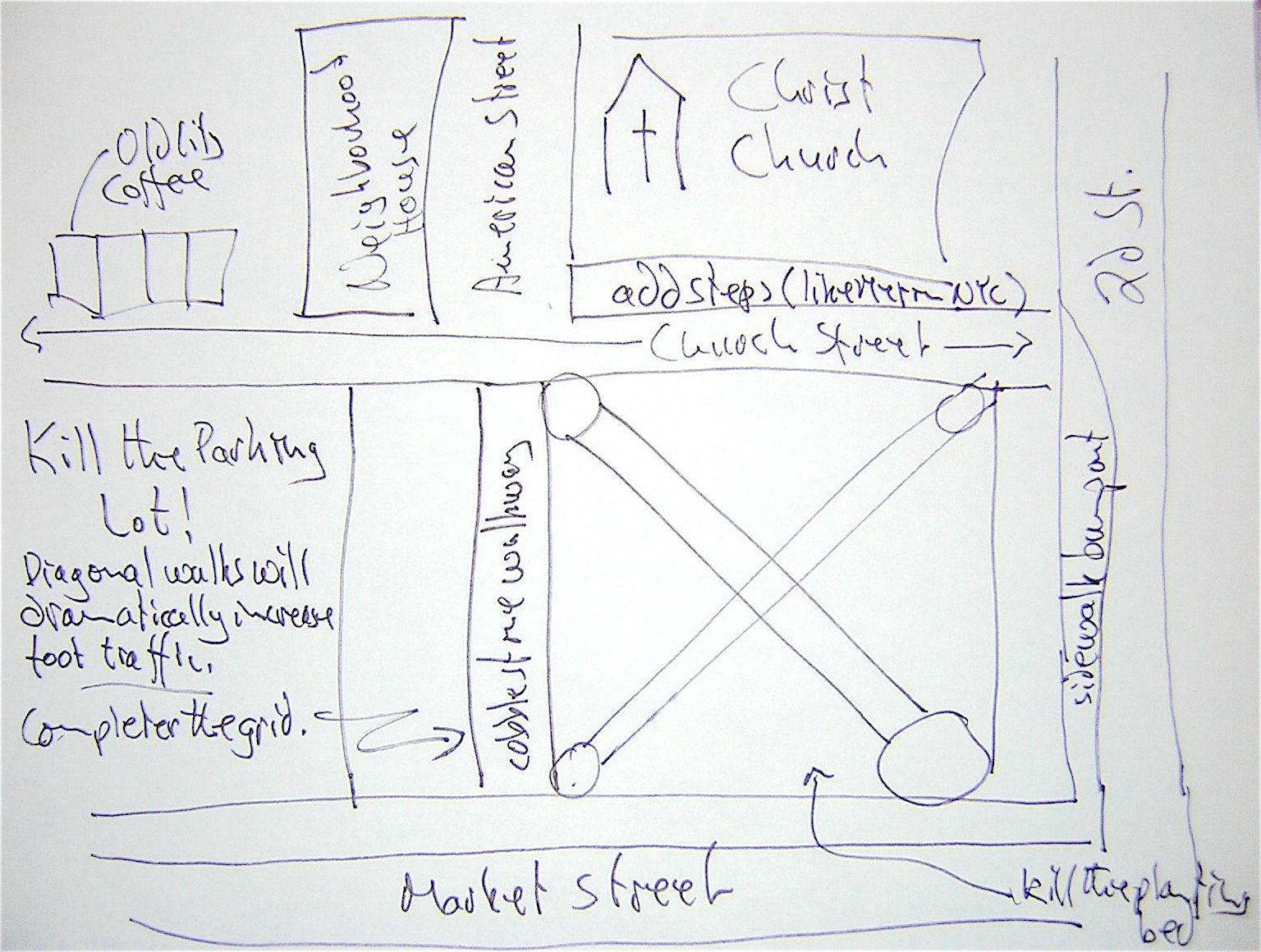
X marks the spot.

Great meeting November 27 at Christ Church's Neighborhood House, on the redesign of Christ Church Park. The design team has been busy - a previous neighborhood meeting in July, also at the Neighborhood House; an open-air design workshop on Church Street, directly next to the park, in August; an online survey; research on other parks both in Philadelphia and elsewhere; and of course observation of the park itself.

At the most recent meeting the team went over all this activity and then presented a series of four design options, each taking a different approach but aiming at the same goals of increasing the park's usage and its usefulness to the community.

The Parking Lot
There was a bit of tip-toeing around what should be done with the elephant in the room - a parking lot that sits discreetly behind a red brick wall at the west side of the park. One of the presenters noted that turning the parking lot into part of the park would increase the size of the park by 50 percent. However, the National Park Service has stated from the beginning - very nicely - that the parking lot is out of scope for this project.

The presenters did discuss expanding the park in a tentative way that I hope didn't offend anyone, and they offered drawings of lesser takings from the parking lot that would improve the sightlines into the center of the block.

I say what I'm about to say with a twinge of regret, because I do think this is a model parking lot - it essentially disappears, in a nice way, behind a red brick wall. I wish every parking lot in Philadelphia looked this good. Very few of them do.

However, having given the matter some thought, I strongly support turning the parking lot into park land, for several reasons. First, this is a small lot in a crucial location that should be devoted to active people and not sleeping cars. Second, these drivers have alternatives in very large garages at the mall and on Second south of Chestnut. Third, turning the lot into parkland would provide a lot more room for people to enjoy themselves outdoors right in the center of Old City. Fourth, it would open up the block in a dramatic way that would let people see, before they stepped into the park from Market or Second, the potential for further walking adventures beyond the park, to the north and the west. Currently the rather complex web of streets within this block is not particularly visible until you get through the park and hit Church Street - the main drag, but hardly the only option for an interesting walk.

I hope the National Park Service will reconsider its position.

Diagonal Walkways
The presenters showed us drawings for four main options. I liked pieces of each of them, and pulled them together into what I suppose we could call option five - the rather clumsy drawing at the top of this story.

First, I think the park needs two strong diagonal paths, from the southwest to the northeast, and from the southeast to the northwest. These will be good for the park itself, and for the whole neighborhood. The survey came up with a figure of 20 percent of respondents who never go to the park. This is a terrible number, and the way to fix it is to allow people walking - residents, workers, tourists - to use the park as a shortcut to their destination.

There seems to be a lingering idea that a park should be solely an oasis for quiet contemplation, and that foot traffic shuffling through would be a distraction for those who have come to meditate. If you look at Washington or Rittenhouse Square, you'll see that they both have strong diagonal paths. And if you stand at the northeast gate of Rittenhouse Square, at 18th and Walnut, around 8:30 on a Tuesday morning, you'll just about get run over by the people walking through the park on their way to the office. This is not a conflict with other uses, it is a complement.

In The Death and Life of Great American Cities (1961, pp. 96-97), Jane Jacobs analyzed Rittenhouse Square in detail and came to the conclusion that the square's secret to its success was the variety of users who appear in the park over the course of the day.

Jeff Speck, in his book Walkable City (2012), likes to talk about the importance of bringing back the useful walk - walking to the office, or walking to pick up groceries, possibly at several different stores (say, in Rittenhouse, coffee at La Colombe, bananas, clementines, and arugula at Sue's, and cheese and maybe soppressata at Di Bruno's).  Walking should not be simply a leisure activity. It can also be a useful way to get around.

I think people - particularly our leaders - have trouble with this idea, just as they seem to have trouble seeing a bicycle as anything other than a leisure-time toy. The pattern of bicycle commuting and utility bicycling throughout the day is firmly established in certain parts of Philadelphia. And certainly it's not a secret at this point. I just think a lot of people have trouble processing the information, let alone acting on it.

And I think I know why. Jarrett Walker, who is consulting on the redesign of Philadelphia's bus network, has an interesting blog post on elite projection. This is simply the idea that the well-to-do and influential people in our society imagine that everyone else is just like them, or wants to be just like them. As he points out, many, many problems flow from this lack of vision.

Anyway, the strong diagonals should be very good at getting people into the park, and they should also encourage people to see how permeable this block is. And this block is only part of a larger, currently unintegrated, circulation pattern that, if it ever gets hooked together, would allow people to get around entirely on byways and, with the exception of crosswalks, avoid the highways. This system of walkways and alleys is prepared to run from the mall on Fifth Street down to Front Street, and from the Arch Street Meeting House to Old St. Joseph's Church, below Walnut.

Opening Up to Market Street
Coming back to the park itself, let's have a look at proposals for the perimeter of the park, starting with the south side, by Market Street. The actual park is at present set well back from Market, with much of the additional space taken up by a planting bed. I personally think the original designers of the park saw this as a mashalling yard for tourists. You can stand at the fence and gaze at Christ Church on the other side of the park's large lawn, maybe take a picture. Then you can walk through one of the park's two gates, which stands inconspicuously at the west edge of the park, next to the brick wall for the parking lot. You can then walk up a brick path to the gate at the north side of the park and, if you want, cross the Belgian block of Church Street and enter the church.

So the whole park, on its most heavily trafficked side, is essentially hiding. Time to open things up a bit. There are a number of interesting proposals about how to do this, but I do think one thing is quite clear. This park needs a gate at the corner of Second and Market. Which by the way is only a few steps from the Second Street stop of the Market-Frankford line, and less than half a block from stops for six different bus routes (5, 17, 21, 33, 42, 48).

Unless you're moving a piano, you really don't need to drive to Old City. But however you get there, the corner of Second and Market is the natural front door for Christ Church park. At present there is no gate on this corner.

Sidewalk Bumpout on Second Street
The design team also suggested bumping out the sidewalk on Second Street, roughly from Church Street down to Market. Engineers have been consulted, and we are assured that this can be done without materially affecting the flow of motor vehicles down Second Street.

Steps for Sitting on the North Side of Church Street
The design team also recommends adding steps to the north side of Church Street. You could use these steps to walk up to the church's grade level, which is a bit higher than the surrounding area, or you could use them to sit on; this happens quite a lot on the steps of the Metropolitan Museum in New York City. I think the steps the design team proposes would work well.

The team is also proposing a lower wall on the north side of the actual park. These two changes would serve to meld the Church and its yard, Church Street, and the park itself into a more organic whole.

Back to the Parking Lot
Okay, back to the west side of the park. Another advantage of removing the parking lot is that it allows you to move the current north-south walkway further to the west, so it's on line with American Street to the north. There was a lovely rendering of this new walkway, paved now in cobblestones instead of brick, and looking for all the world like an eighteenth century Philadelphia street, shaded by the mature trees that are already present in the parking lot.

This new alignment for the walkway allows people to see from Market Street that the block has an interior north-south street, and from the park they will also be able to see Church Street running east to west, and intersecting at the northwest corner of the park.  That's not the whole internal grid on this block, but I think it's enough to create an invitation to explore. 

About Those Pink Stickers
At the end of the meeting, printouts of the four design options were put on tables, and the members of the audience, who had each previously been provided with several small stickers, some green and some pink, were asked to show their approval of particular design elements by placing a green sticker on things they liked, and a pink sticker on things they didn't like. I placed my stickers, chatted with a number of people, and at the end of the session I walked around and had a look at where the various stickers had descended.

On the plans that still had the parking lot at least partially intact, the lot looked like a leopard with pink spots.


Parking lot gate. Unlock the value.

See also The Invitation, The Future of Christ Church Park, Permeable Blocks.

Sunday, November 25, 2018

Getting From Here to There

Transit First in Philadelphia

Bus station, Marion, Ohio. Ben Shahn/FSA, 1938. 

I finally got around to reading SEPTA's recent report on redesigning Philadelphia's bus network, and I'm very glad I did. The Philadelphia Bus Network Choices Report was introduced to the world in June of this year. If you'd like to read the report, click here.

When it came out, Network Choices received insightful coverage from Jason Laughlin of the Inquirer (click here) and Jim Saksa of PlanPhilly (click here).

The report was prepared by consultants Jarrett Walker + Associates. This well-known firm also consulted on the redesign of Houston's bus network, which was rolled out in 2015.

What struck me most about the Walker report was that, at its base, it was a short course in geometry, as applied to transportation in cities.

The Geometry of Cars
Since the arrival of cars a little over a century ago (the Ford Model T was introduced in 1908), there has been a strong tendency to concentrate on cars for all of our transportation needs. This approach has had support from the car industry and its allies. Unfortunately, when it comes to cities, the push for an essentially monomodal transportation system based on the private automobile runs up against the laws of geometry. (See Network Choices, page 9.)

Cars are big. It takes a lot of space for cars to transport people. This is a problem, because the purpose of cities is to bring people together, and the effect of cars is to push them apart.

We can see this effect at work in Center City Philadelphia, where the Vine Street Expressway is essentially a moat dividing William Penn's original city from points north. Market Street and JFK Boulevard are too wide for pedestrians to be comfortable, and so the interesting stores tend to show up on the side streets and Walnut and Chestnut to the south, which are human scale.

Cars are also very convenient. They can get you anywhere there's a road, something that trains on tracks and buses on fixed routes do not do. There are valid reasons why people have loved cars since they were invented, and it is a simple fact that cars are not going away.

However, it seems fair to suggest that we are currently over-reliant on cars. Unlike some other parts of the country, Philadelphia has a functioning multimodal transportation system, with a variety of rail transit and a large bus network; many parts of the city are very walkable, and certain sections are heavily bicycled, despite the utter inadequacy of the city's network of bike lanes. Still, you only need to look at a street like Chestnut in Center City to see that there are too many cars, both moving and parked, and they are taking up too much space.

How do we cut down on the number of cars being used every day in this city? People tend to focus on commuters, many of whom either come from or are going to places that are inaccessible by anything but a car. Fortunately, there is a silver lining. Many of the car trips in Philadelphia are actually quite short - under two miles. And in many cases these trips could be done easily, and possibly more pleasantly, by walking, biking, or taking the bus.

Unfortunately, all of these modes have been neglected, and if you want them to fulfill their potential, they all need to be upgraded. When it comes to buses, this means we need to rethink the network.

The Geometry of a Bus Network
The older parts of Philadelphia were laid out on a grid, and the bus network in those areas generally follows the grid. In the newer parts of town, where street layouts often feel very suburban, the bus network is more radial.

The Walker firm really likes the grid, because the grid dovetails with the firm's basic design approach of short, straight routes, high frequency, and good connections. Free transfers are crucial to the success of this approach, which involves a lot of hopping on and off buses, but because of the high frequency it does not involve a lot of waiting time.

Let's have a look at South Philly. This is basically grid heaven, but that does not mean there are no improvement opportunities. It turns out that the east-west routes have comparatively wide spacing (they're generally about half a mile apart), while the north-south routes are spaced about a quarter mile apart (Network Choices, p. 73).

The north-south routes are too close together and basically try to steal passengers from one another. Who wins? The most frequent routes. Poor little Route 2, for instance, is stuck between the much more frequent Broad Street Line (aka the subway) to the east, and, to the west, Route 17. As the report puts it, "The pattern of boarding activity and route productivity is clearly showing that many people prefer to walk to higher frequency service." (P. 73.)

Route 47M
South Philly's overcrowding of north-south streets reaches its apogee with route 47M on 9th Street. To quote the report, "This is a highly specialized route that primarily serves the Italian Market on 9th Street. Until 1993, SEPTA operated all Route 47 buses via 9th Street, but the busy Italian Market meant that many buses were stuck in traffic during their trip through South Philadelphia. In May 1993, northbound Route 47 was shifted to 7th Street to improve speed and reliability. But the 47M was also added to maintain service on 9th Street.

"Route 47M operates northbound only and is effectively using one bus from the northbound 47 every 20 minutes to run through the Italian Market on 9th Street. This is done so that people going to the market  do not have to walk two blocks from 7th Street to 9th Street.

"This kind of response to specialized demands takes frequency from the most productive north-south route to reduce walking distance for a few people." And guess what. Hardly anybody gets off the 47M at the Italian Market. "Most people riding Route 47M get off at Market Street." (P. 84.)

I can hear the howls of protest already, as the keepers of South Philly's many "peculiar institutions" (such as parking in the crosswalk) rise up in agitated opposition. But if you're robbing Route 47 of significant frequency so that people don't need to walk two blocks to the Italian Market, and then virtually nobody is getting off at the Italian Market, perhaps sweet reason will win out in the end. Who knows. One insight the Walker report offers, which I happen to agree with, is that "the point of transit is to provide an alternative to driving, not an alternative to walking." (P. 93.)

Chestnut Street
In addition to looking at the big-picture geometry of routes, the Walker people also spent time going through their tool-box of hyperlocal solutions to specific problems. They clearly took a close look at Chestnut Street in Center City, a transit nightmare that I've been writing about for a while, and they've come up with a bunch of deft, often very minor, adjustments that I think could have very positive effects. (See page 46.)

Mayor Kenney has already started the ball rolling on Chestnut Street. In September he introduced a package of steps to increase enforcement of existing traffic regulations on the most heavily congested parts of Chestnut, which lie just east and west of Broad. And this program has had some effect.

However, the increased enforcement is temporary, and even now it's not solving the whole problem. Random people parking in the bus lane has declined substantially, but Fed Ex, UPS, and the post office still stop when and where they choose. And of course Uber and Lyft stop wherever their next passenger is standing.

I've suggested before that a big part of the solution lies in the third lane on Chestnut Street - the parking lane. Much of this lane is given over to to loading zones in the early morning, but at 10 a.m. those spots generally revert to being regular two-hour parking spots. Not coincidentally, the phenomenon of delivery trucks unloading in the bus lane explodes right after 10 a.m. It seems only logical to extend the time of the loading zones further into the day. I do think this simple and incremental move would help a lot.

That still leaves the problem of drivers filling the bus lane, which is on the right side of the street, while they try to turn right and go south on a numbered street. The right turn from the bus lane was never an ideal design, and I actually recall that when this first went in, the right turn from Chestnut onto 17th was prohibited. There was a big sign indicating No Right Turn. Basically, everybody ignored it, and after a while the sign quietly went away.

Drivers do queue regularly to make the turn on 15th and 17th, which I have observed personally. A lot. I'm told this also happens elsewhere. The issue is twofold. First, pedestrians walking along on the south side of Chestnut are often crossing 15th and 17th in great numbers, blocking the drivers who want to turn right. Second, cars headed south on 15th and 17th frequently back up into the intersection and even beyond, to the north. What can I say? It's a busy area.

The basic problem for a bus driver is that the bus stop is at the corner, just before the intersection. If turning cars back up at all, the bus can't get to the stop. The Walker folks suggest a number of changes that would likely make things, not perfect, but I think much better.

First, what would happen if we just moved the stop to the far side of the intersection? Then the bus driver could swing out into the left lane, drive around the queue, and stop at the stop.

Alternatively, we could simply eliminate the bus stop at intersections where cars turn right - in other words, space the bus stops every other block, placing them at intersections where there is only a left-hand turn.

But, but, you splutter. Take a deep breath. Stops in Philly are much closer together than they are in other comparable cities. The typical Philadelphia block is about 450 feet long, so stopping every other block would give you 900 feet between stops, putting Philly on a par with Boston (p. 93).

And often a bus rider would not have to walk any further than at present. Take the William Penn House on the 1900 block of Chestnut. It's located in the midblock, so a resident currently has a choice of two stops half a block from the apartment building's front entrance on Chestnut Street. Removing one of those stops would still leave you with the same half-block walk to a bus stop.

Implementation: All at Once or Bit by Bit?
So, should we redesign the network over a couple of years, and then implement the changes all at once? Or should we put the improvements in gradually, as they become available?

I'd do both. My thought on the 47M is that eliminating it is pretty much a no-brainer, but I've seen this community in action. I'd wait on the 47M and roll it up into a much bigger ball with things like Route 2, just west of Broad. This would encourage people to take a broader view.

On the other hand I'd do Chestnut Street now, especially since it's already started and may fail if we don't keep going. I'd even do it in several slices - expand the hours of the loading zones in the parking lane, and then later deal with the bus stops and the right-turning traffic.

The problems on Chestnut Street are widely recognized in the community, which doesn't mean that the changes will lack opposition. However, Chestnut Street is low-hanging fruit, and it might be possible to convince a City Council member or two that the results are almost certain to be very positive and the blowback transitory.

Also, it wouldn't hurt to get some successful pilot projects out there fairly early. They could show people that these changes actually do work, right here in Philadelphia, and possibly increase public confidence in the overall project.

Bus station, Marion, Ohio. Ben Shahn/FSA, 1938. 

See also Unblocking the Bus Lane on Chestnut, Taming Chestnut Street, Cars and Bikes - the Back Story, About that Parking Lot in South Philly.

About the photographer. Ben Shahn is best known as a painter, but he made a number of trips for the Farm Security Administration's photo unit, and to my mind produced work that is among the best in the whole collection, where he is up against some astounding talent, including Walker Evans, Dorothea Lange, Gordon Parks, and Russell Lee.