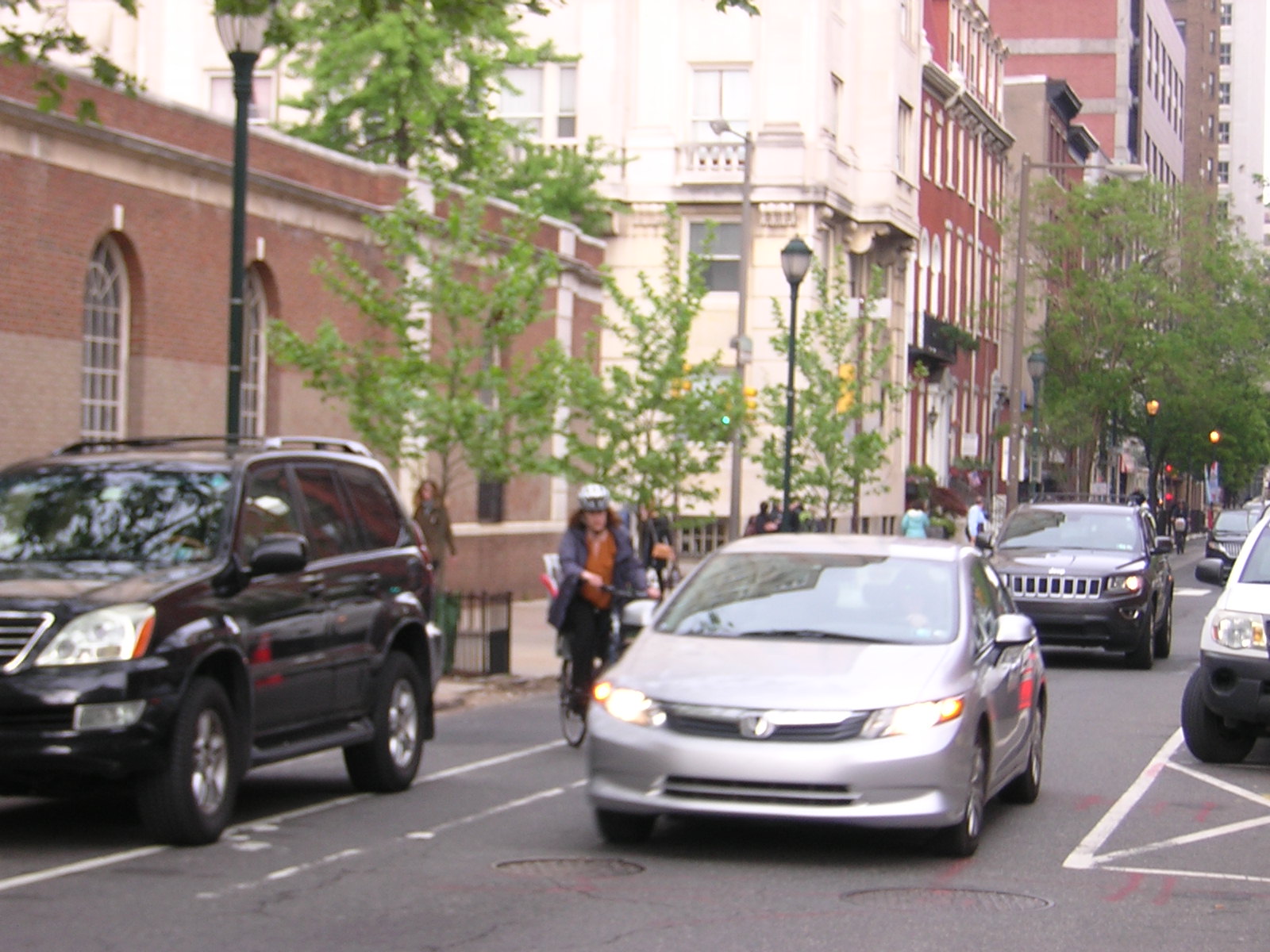
Showing posts with label Buffered Bike Lanes. Show all posts

Wednesday, January 18, 2017

Parking on a Rainy Day

Yet another kerfuffle over bike lanes. A recent philly.com story focused on the 800 block of Pine - specifically the south side of the street. The north side is occupied by Pennsylvania Hospital, founded by Benjamin Franklin in 1751, and the nation's first hospital. My daughter, Alicia, was born there. As far as I know, it is not a participant in this controversy.

In the philly.com story, a resident of the south side expresses concerns about the protected bike lanes proposed for Pine and Spruce. My initial reaction was a trifle acerbic, undermining a promise I've made to Alicia to try to stay positive. So I decided to do something useful yesterday morning. I walked down to 8th and Pine and took pictures.

The proposed upgrade to the existing bike lanes on Pine and Spruce has already provoked a good bit of argument, including discussions at two meetings of the Washington Square West Civic Association. And it seems there will be yet more meetings.

Opponents complain of the hardship of not being able to park at the curb directly in front of their houses. If you listen to this argument in isolation, you may find yourself feeling some sympathy. After all, people need access to their houses. But when you look at the context, I submit that the picture changes.

One of the big things that people tend to overlook is rear access. I've already discussed access issues on Pine and Spruce west of Broad (see Flex Posts on Pine and Spruce and More on the Pine and Spruce Bike Lanes).  Let's have a look at rear access on the 800 block of Pine.


This is a view into the interior of the block from 8th Street. You can see that the buildings facing Pine (on the right) and Addison (on the left) are well provided with off-street parking. The access to this rather rather handsome lot is by a large curb cut on Pine, shown below. Vive la France.


While we're on Pine, here is a look at the existing bike lane.


A basic purpose of protected bike lanes is to keep trucks and cars from parking in the bike lane and blocking it, which of course renders it useless to bicyclists. Some would argue worse than useless, because the bicyclist then needs to leave the bike lane and merge with the moving cars and trucks in the motor-vehicle lane.

Okay, let's go to Addison and look at the kind of rear access available up near 9th Street.


The buildings at this end of the block are bigger, and some of the parking lots aren't as pretty. But some are quite lovely.


Here's another one that's not terrible.


Finally, in the mid-block, actual garages predominate.


There's basically enough off-street parking on this block to sink a battleship. I fail to see the hardship of asking residents to park in their off-street spots, instead of parking at the curb on Pine, where their presence does create a substantial hardship for bicyclists.

Well, you say, the people don't want to park at the curb very long, maybe 15 minutes. Surely not that many bicyclists would be inconvenienced.

The bike traffic numbers indicate otherwise. Even in the middle of the day, there are a lot of bikes whizzing around the streets of Center City. Last June 20, between 2:30 and 3:30 in the afternoon, I counted bikes at 16th and Spruce. On average there was one every 30 seconds. (See Intraday Biking.)

So if you parked in the bike lane there for 15 minutes, you'd have 30 bicyclists scrambling around you. An inconvenience ratio of 30 to 1. And in rush hour the number of bicyclists would be much higher.

To come back to the 800 block of Pine, here's what I think. If we can't put a protected bike lane on this block, we're not going to be able to put one anywhere in Center City. And I greatly fear that is going to be the outcome of the process we are currently enduring.

Mayor Kenney may indeed deliver his promised 30 miles of protected bike lanes. But will they be where the bicyclists need them, and where current and potential bike traffic demand them?

See also Vision Zero in Philadelphia.

Tuesday, July 26, 2016

Zombie Arguments in Bike Safety

Zombie says overtaking crashes are very rare, 
so why build bike lanes? Turns out 40% of fatal 
car-bike crashes are rear-enders. 

Recently I posted a story about Tom Palermo, his death, and the subsequent construction of parking protected bike lanes on Roland Avenue in Baltimore, where Tom died.

Shortly before the new bike lanes went in, there was a contentious community meeting attended by City officials. After the meeting, the officials confirmed that they would proceed with construction of the bike lanes, and they responded to a number of issues that had been raised.

Among the FAQs from the Baltimore DOT (on page 9) was this: "Since rear end crashes are rare for bicyclists, how is the change to cycle track protected by parked cars justified? Please provide statistics and references."

This argument has been around for a while, and it refuses to die. I'm not quite sure how you kill a zombie argument. I'm pretty sure you don't drive a stake through its heart - that's for vampires.

At first, I was going to let this go. After all, the Baltimore officials did a reasonably good job of rebutting it, and it would have been easy enough to let things lie. However, one of the lessons I took away from the story of Tom Palermo's death and the subsequent bike lane controversy was that "specious arguments must be rebutted in detail."

So maybe you can kill a zombie argument by talking it to death. Or burying it in facts.

The FAQs from the Baltimore DOT referred to a data sheet from the National Highway Traffic Safety Administration, which focused on fatal bicycle accidents and found that in 2013 "non-intersection" crashes accounted for 57 percent of fatal bicycle crashes.

It's possible to take this further. In 2014 the League of American Bicyclists put out a report on a study it had conducted, independent of the federal statistics. For a period of 12 months, it researched in detail every fatal traffic crash involving a bicyclist that it could find on the internet, documenting 628 crashes. The results were, as the report put it, "eye-opening":

"We learned, for example, that a much higher percentage of fatal crashes than expected were 'hit from behind' incidents." Of crashes with reported collision types, 40 percent were rear-end collisions.

Rarity Is a Matter of Perspective
So why do people think 40 percent of deaths is rare? Because rarity depends on perspective. In absolute terms, death on a bicycle is rare.

Currently this particular way of meeting your maker is running around 700 a year. The National Highway Traffic Safety Administration reports that 726 bicyclists died in car-bike crashes in 2014.

Meanwhile, total deaths from traffic accidents involving motor vehicles were 32,675. Even pedestrians died more than bicyclists - 4,884.

And then you can add in all the non-fatal crashes. Good numbers here are hard to find because the reporting criteria vary widely among reporting agencies, but here is one indication of the non-fatal mayhem on our highways: 39.2 percent of spinal cord injuries in the United States result from motor vehicle crashes.

And of course we could add crashes that don't involve cars. Bikes crash into other bikes, pedestrians, immovable objects, the ground. Such crashes are rarely fatal, but they can result in serious injury.

Small Compared to What?
So, yes, in absolute terms, not a lot of people die in bicycle accidents. But the rate at which they die is another issue entirely.

John Pucher and Lewis Dijkstra published an article in Transportation Quarterly in 2000 on this subject. They found that, per kilometer traveled, bicyclists in the United States are 11 times more likely to die than motorists. Pedestrians are 36 times more likely to die than motorists, on a per kilometer basis. On a per trip basis, pedestrians and bicyclists are about three times more likely to die than motorists. Think about this the next time you venture out to the grocery store. (See my previous post Death as an Acceptable Outcome.)

A car is the safest place to be on the street. There's a lot of vehicular mayhem, but the vast majority of miles that Americans travel, and trips that they take, are by car, so the shockingly high mortality rates for walkers and bikers get masked. As Pucher and Dijkstra put it, "the dangers of walking and cycling in America are not just perceived, they are real."

The Terror Factor
The idea of being rear-ended by a car while you're riding your bike down the street holds a very special kind of terror. Such an event is very likely to kill you, and you can't in most cases prepare or react, because you don't know it's going to happen. You're utterly powerless. You have no control or even influence in this situation. (Here's a story on a crash in Kalamazoo, Michigan, in June. Five bicyclists died, and four were injured. It was a group ride. The driver has been charged with second degree murder and operating while intoxicated causing death, among other things.)

There are bicyclists who live with this icy thought every time they get in the saddle. What's more, I think it's why many moms won't let their kids ride bikes in the street anymore. They don't care so much that Johnny may fall and skin his knee. It's death from out of the blue that keeps kids inside, playing video games and getting fat.

And if the driver isn't drunk and doesn't leave the scene, he or she is unlikely to get more than a slap on the wrist. It's basically a free kill. Homicide without consequences. At least for the perpetrator.

We need to rethink this. We need to think of protected bike lanes as anti-terror devices.

Wednesday, June 22, 2016

Intraday Biking


The things I carried.

The history of bicycling in the United States has been overwhelmingly recreational. (See Why Are European and American Bicycling So Different?) In recent years, though, bicyclists in Philadelphia and a number of other American cities have started to ride their bikes to work in considerable numbers - not the kind of numbers we see in the Netherlands or Denmark or Germany, but still noteworthy.

The thing that was missing was people going around town in between commuter hours. The Europeans use the term utilitarian bicycling, which can include commuting but also the little trips. Dropping kids off at school, or preschool. Going to the grocery store. Going to a meeting at someone else's office.

I'm primarily a recreational bicyclist myself, but I've also taken to riding Indego bikes to the Reading Terminal Market and to the Whole Foods on South Street. These are just far enough away from home that I don't always feel like walking.

Recently I've had the impression that there were more bikes on the streets of Philly in the middle of the day. I'm not sure they're all running errands like me. Some are in spandex and look like they may be out to Fairmount Park and beyond for a training ride. Others look like students and professors on their way to class. And others look like they may be commuting to jobs that start later than 9 a.m. - stores maybe, or restaurants.

Let's borrow a term from the stock market and call it intraday biking.

The Counts
As I said, I've had an impression. But what's that worth? So I decided to get some numbers.

My first stop was Rival Bros, the coffee shop at 24th and Lombard. I wanted to see what traffic was like at the deadest times. I made a leap of faith and picked 2:30-3:30 in the afternoon - after lunch, before the rush. This was on Wednesday, June 15.

It was pretty quiet. Westbound, in the bike lane on Lombard, there were 31 bikes in the hour (19 males, 12 females). Southbound on 24th there were 14 bicyclists (9 males, 4 females, one child riding with a grownup).

In all these counts I logged people as they exited the intersection. There was quite a bit of turning, and it would probably be nice to capture that information. Something for next time.

This was the quietest hour that I saw. On average, there was a bicyclist floating though the intersection every 80 seconds.

I went back to Rival on the morning of Friday, June 17. (You should try the Derringer, which I think is called a cortado elsewhere.) Between 9:30 and 10:30 a.m. there were 65 bicyclists, or more than one a minute. Westbound there were 59 (38 males, 21 females). Southbound there were 6 (5 males, one female).

Next I went to Plenty, at 16th and Spruce. (I can't resist the chocolate croissants.) Between 9:20 and 10:20 a.m. on Monday, June 20, there were 152 bicyclists through the intersection, 116 males and 36 females, or approximately one every 25 seconds. Westbound, in the bike lane on Spruce, there were 93 (70 male, 23 female). Northbound on 16th there were 59 (46 male, 13 female).

On the afternoon of June 20, sitting in my sidewalk chair at Plenty, I saw 113 bicycles gliding through the intersection, or approximately one every 30 seconds. This count ran from 2:30 to 3:30. The weather was sunny, with a temperature of 93 degrees. Westbound there were 83 cyclists (61 male, 22 female). Northbound there were 30 (19 male, 11 female).

What the Numbers Mean
These numbers say a few things to me.

First, biking is an all-day phenom, at least in parts of Center City. I'm not sure people have noticed it yet. Bikes are small and quiet, and easy to miss if you're not looking for them.

Second, there was only one child. This is probably an unfair observation; the locations I picked are parts of major commuter routes where there won't necessarily be a lot of children. But still, there was only one child.

Third, only 29 percent of the riders were female.

Women and children are markers for perceived safety. What I was looking at, I think, are the "strong and fearless" and the "enthused and confident." Maybe 10 percent of the population. Half the population is what we call "interested but concerned." I don't think they've showed up yet.

They haven't showed up because they don't think it's safe. Want them to show up?  Build protected bike lanes. That's what they did in Europe, and it works.

Rival Bros, after the coffee is done.

See also Flex Posts on Pine and Spruce; More on the Pine and Spruce Bike Lanes; Looking and Not Seeing, Listening and Not Hearing.

Thursday, May 19, 2016

More on the Pine and Spruce Bike Lanes

Welcome to Pine Street.
In Flex Posts on Pine and Spruce I defended the proposed upgrade of the bike lanes on those streets from buffered (a painted buffer zone on the pavement) to protected (flex posts added to the buffer zone).

Mindful that people do need to drop off groceries and perform similar chores, I proposed adding two loading zones to the parking lane in each block, across the street from the bike lane. Several people I have spoken to have dismissed this proposal out of hand, saying the local residents will never accept it. Presumably the only sufficiently convenient solution is to continue to allow residents to pull up in the bike lane in front of their front door.

So I went for another walk - actually several walks - and scribbled in my notebook and thought.

Let me start by concentrating on CCRAville, the area west of Broad that I am most familiar with.

People seem to think they currently have the right to stop in any bike lane in CCRAville to unload groceries, children, perhaps an aged and infirm grandmother. However, the bike lane side of the 14, 15, 16, and 1700 blocks of Pine is currently placarded as no stopping. Likewise the 1400 and 1800 blocks of Spruce. And for good measure the bike lane on 22nd street is no stopping from South to Market, except for a brief no parking zone near the Greenfield School.

No stopping means no stopping.

How can the City be so heartless? Well, there are options to parking in the bike lane. They may be a bit further from your front door, but they may also be safer - not just for bicyclists, but for you, your children, your grandmother.

Many of the buildings on the south side of Pine and the north side of Spruce (where the bike lanes are) have rear access. The poster children for this are the 15, 17, and 1800 blocks of Pine (backing on Waverly) and the 14, 17, 18, and 1900 blocks of Spruce (backing on Bach Place and Manning).

On many other blocks at least some of the buildings have rear access - for instance the 1900 and 2000 blocks of Pine.

Other blocks are more difficult to categorize. The 1400 block of Pine, for instance, contains Symphony House and Peirce College. In addition to fronting on Pine, Peirce has access from Waverly, 15th, and Carlisle. Symphony House fronts on Broad and has a loading dock on Pine.

These buildings would not be inconvenienced by a protected bicycle lane on Pine, but a protected lane would reduce the number of stories like the one that follows here.

A Story
One weekend morning, probably a year ago, my wife and I were driving down Pine to the grocery store. There was a bicyclist in the bike lane a bit ahead of us. And then, as we approached Broad, a car with Florida plates roared up behind the bicyclist and proceeded to follow him very closely and abuse him verbally.

We all stopped for a red light at Broad. I lowered my passenger window and told the motorist that he was driving in a bicycle lane. He did not take my comment well.

The light changed and we all went forward across Broad. The Florida motorist continued in the bicycle lane and turned on 12th.

Little Streets
Back to the west side of Broad. I previously mentioned Carlisle street, which runs north-south in the block between Broad and 15th. There are a lot of these little north-south streets in the neighborhood. They get very little traffic, and they strike me as good places for a motorist to pull over - safer, frankly, than the hurly-burly of Pine and Spruce.

On Pine, heading west from Broad (the bike lane ends at 22nd), you have Carlisle, Hicks, Smedley, Chadwick (which hits a stub of Cypress that runs to 17th by Tenth Presbyterian), Bouvier, Uber, Capital, and Van Pelt.

Coming back down Spruce from 22nd, you have Van Pelt again, then Smedley and Hicks.

There are also a whole bunch of mews - walkways that run behind buildings. I have one on my block. It extends, with interruptions, the full length of the block. I and others have spent a good amount of time over the years pruning the vegetation and raking and sweeping the beautiful stone pavers placed there by a long-gone generation.

Many of the mews in the neighborhood appear disused and neglected. Maybe people should have another look.

One more extraneous comment. As I walk around the neighborhood I still see a good bit of razor wire. The technology for security and surveillance has improved dramatically, and the razor wire makes a bad impression on the tourists.

East of Broad
Let's go back east of Broad for a quick look. The 1300 block of Pine is no stopping, as is about half of the 1300 block of Spruce. Then you get to the bike lane on 13th street, which is no stopping from Locust north beyond Chestnut, about halfway to Market. This commercial corridor is also well supplied with loading zones.

Here's an idea. I think the basic problem with protected bike lanes is that they're new - well, new to Philadelphia. People have trouble visualizing how they will work. So let's show them how it works. Right on 13th street. All you need to do is put in the flex posts. Literally. And let the demonstration project provide proof of concept for all to see.

Let's do it right now. Not in 2018. Right now.

Rear access on 2300 block of Spruce, from Manning.
About the manhole cover at the beginning of this story: For a very long time I thought that concrete manhole covers had only been an emergency measure during World War II. Clearly I was wrong. Thomas P. Greger received U.S. Patent No. 536,621 on April 2, 1895. If you'd like to read the patent, click here.

Thursday, May 5, 2016

Flex Posts on Pine and Spruce

1600 block of Spruce street. Bike lane at left.
There is a proposal to turn the bike lanes on Pine and Spruce streets into protected bike lanes. This means that, in addition to the current (more or less) painted buffer zone between the bicycles and the cars, there will be a series of flex posts. These are plastic posts, usually orange, that you can now see in a number of areas around Philadelphia, perhaps most visibly on the Walnut Street bridge. The barrier they create is almost entirely visual and psychological. If a car hits them, they bend over. I used to call them wibble-wobble sticks, but my daughter tells me that is no longer accepted terminology.

(The posts on the Walnut Street bridge are white. They'd probably get hit less if they were orange, or yellow, or lime green. But I digress.)

I've now heard a number of well-meaning concerns about putting the flex posts in on Pine and Spruce. Most of these concerns, I believe, are related to an understandable reluctance to change the way things are. Cars currently use the bike lanes as loading zones. Moving vans use the bike lanes as loading zones. And houses of worship use the lanes on the weekends as parking spaces for persons attending services.

No stopping zone. Pine street bike lane.
My basic thought is that people need to take a step back and think about the street as a whole. There are currently three lanes - a parking lane, a traffic lane, and a bike lane.

The Parking Lane Is the Problem
I don't think the bike lane is the problem. I think the parking lane is the problem.

This thought crystalized when I read Jon Broh's comments in a recent Stu Bykofsky column. Jon is the current head of the Wash West civic, and his concern was for the merchants on Pine Street, who are apparently quite vocal about demanding that their customers have easy access to their stores by car.

Fine. The problem with access is not the bike lane. It is the fact that virtually all the spaces in the parking lane are given over to long-term storage of cars, and virtually no loading zones are available in the parking lane to provide the access that the merchants desire.

We need to think hard about balancing storage versus access at the curb. Currently in Wash West and CCRAville, there is no balance.

We also need to go back to Jeremy Bentham's thinking about the greatest good for the greatest number. In late 2014 and early 2015, Mike Axler and I conducted a survey of parking in CCRAville - the area west of Broad Street - and we came up with some surprising findings. The people parking on the street in CCRAville are a small minority. At least 87 percent of households in CCRAville do not park a car on the street. And yet we all suffer from the lack of access.

I haven't studied Wash West or Society Hill, but I'm inclined to think the numbers there would be similar.

Access on Pine and Spruce is part of a larger issue of access in many parts of the city. Recently the Crosstown Coalition, a group of 20+ civic organizations, conducted a parking survey. Of local businesses responding to the survey, 82 percent reported that delivery people and contractors had to park illegally. I do have a problem with a parking system that forces people to break the law just to do their jobs.

A piece of the solution to this larger problem is providing more loading zones. On Pine and Spruce I think two loading zones per block would do great good. I would put these spots at the front and the end of each block, because those are the easiest spaces to get in and out of.

I haven't made a study of this, but I have spent quite a lot of time on Pine and Spruce, in a car, on a bike, and on foot. My observation is that there are rarely more than one or two cars parked in the bike lane on each block. My proposal for two loading spots per block would clear the bike lane and not harm the motorists.

Large moving vans always pose a challenge. The city does allow residents to placard existing parking spots to make space for moving vans. And if the people parked in those spots don't move their cars, the cars can be towed.

As for the church and synagogue parking, I really think there is plenty of available curb space without blocking bike lanes. The houses of worship simply need to shift some cars to new locations. And perhaps some of those locations, dare I say it, could be off-street. Many of the garages in the affected neighborhoods have a significant number of vacancies on weekend mornings.

Why Should Anybody Care?
You may ask, Why should we ask non-bicyclists to go to all this trouble to accommodate bicyclists? The answer is this: With car-free, protected bike lanes on Pine and Spruce, the bike counts there could easily quintuple.

Right now, what we have out there are the "strong and fearless" and the "confident and enthusiastic." These groups total maybe 10-15 percent of the population. 60 percent of the population are called "interested but concerned." They're not going to come out if they're constantly having to merge into moving traffic to avoid cars parked in the bike lane.

On a personal note, I find that I'm slipping from the confident and enthusiastic category to the interested but concerned. I like to ride an Indego bike over to the Reading Terminal Market, but the constant lane-shifting is getting to me. I've had enough unpleasant experiences with oblivious or entitled drivers that I now often simply dismount and walk on the sidewalk around the parked car.

I think people who ride bikes will easily understand what I'm saying, but I've struggled a bit to find a way to explain it to non-bicyclists. Here's an attempt - it's not an exact analogy, but perhaps it's good food for thought. Think about the last time you were on the access lane to an Interstate highway, trying to get into the right traffic lane. The cars already in the right traffic lane are going 65 miles per hour or more. You need to accelerate to that speed and slip into a gap between two cars.

Not only are you relying on the courtesy of the motorists already in the traffic lane, you're having trouble seeing them, because your view to the rear is partially obstructed by the structure of your car.

Now imagine performing a slower version of that merge every two minutes for your entire trip, craning your neck to try to see what's behind you while also making sure you don't run into the parked car that's directly in front of you.

Change is difficult. However, I ask motorists and residents - and particularly those attending our local houses of worship - to engage in an act of empathy. Some small adjustments on their part could make a huge difference for bicycling in this city. And it's not just about the bicyclists. If the city is going to reach its goals for Vision Zero and clean air, among other things, it needs a lot more bikes on the road, riding safely.

And my boat is so small.
See also Parking: Storage v. Access, The Supreme Court and Parking, Why Are European and American Bicycling So Different?