Wednesday, January 22, 2025

Can Open Streets Go Year-Round?

Pretty Nearly.

Open Streets: West Walnut did so well in September that it came back for encore performances on December 8 and 15. 

And yes, Virginia, there was even a Santa Claus planted directly in the middle of Walnut Street.
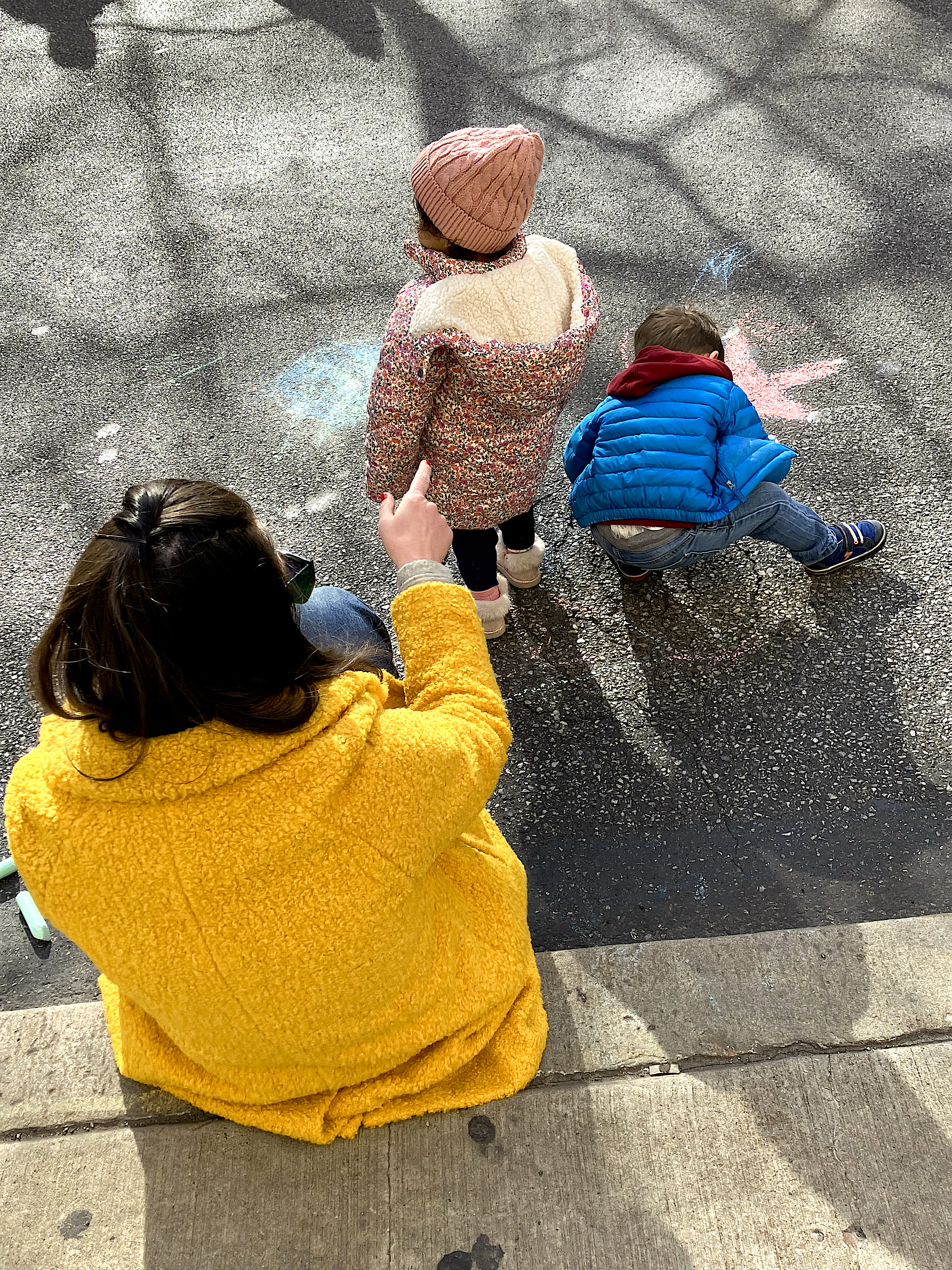

And there was chalk.


Here are some children not playing chess but playing with chess pieces and having a lively time.


As was a smaller child who happily found her own way to play beanbag.  


As is normal at Christmas time, the engine behind the celebration was commerce. Will the people come out? Definitely. Will they go into the stores and buy stuff? It seems so, but we need to wait for the numbers.


Meanwhile, on 18th street, we have people watching TV. They had been watching Frosty the Snowman, but now they appear to be enjoying a break with some wallpaper. Later, I'm told, there was a broadcast of the Eagles-Steelers game. The Steelers lost 27-13. 


And here we have one of the area's major attractions, the beer garden that stands on the remains of three nineteenth century buildings that were looted and burned during the George Floyd disturbances in 2020. The beer garden appears to be quite successful all the time, but the Open Streets were definitely special.

Violence was not far away this year. On the afternoon of Friday, December 13, a gunfight broke out at Philadelphia's Christmas Village, near the ice skating rink in Dilworth Park, next to City Hall, leaving three people wounded, one shot in the face.

Another, more distant reminder of the fragility of civilization came on December 20, when a man drove a BMW SUV into the crowds at the Christmas Market in Magdeburg, Germany, killing five people, including a nine-year-old child, and injuring at least 235 others.

The police presence at the December Open Streets: West Walnut was decidedly more muted than it had been in September. Large police vehicles had blocked vehicular access to the open streets in September; in December they were replaced by smaller vehicles belonging to the Center City District, which actually managed to look friendly. As I've often said, security should be effective and unobtrusive. But too often what we get is obtrusive and ineffective. I think the Center City District is headed in a good direction.

Nevertheless, there were still quite a few cops standing around. They generally looked bored but alert, a good frame of mind for sentry duty. One of the things they were watching with some care was a group of remarkably non-intimidating people walking a circular, or perhaps oval, picket line in front of Starbucks.

As a paid-up member of the Democratic Socialists of America, I was well aware of the ongoing strikes against Starbucks and Amazon, and after I finished taking the strikers' picture, I joined the picket line and walked the circle for a bit.

See also Open Streets: West Walnut, The Lady on Stilts.

Wednesday, January 15, 2025

I Found a Picture on a Wall

Not Far from my Home

January 1, 2025.


There is a large garage in Center City Philadelphia, just a few blocks south of City Hall on Broad street, the main north-south street in William Penn's 1682 plan. The garage has closed and is awaiting redevelopment. It is less than a block from the Kimmel Center, home of the Philadelphia Orchestra, and several other theatrical venues are nearby, but this is hardly the only garage in the immediate vicinity, and all of Center City has been shedding underutilized garage space at an impressive rate, usually replacing parking stalls with condos.

Aside from the empty garage, this is a very nice neighborhood. 

However, Philadelphia has difficulty sustaining its performance from beginning to end. There is a strange affection for the squalid, and it's never hard, even in the best neighborhoods, to walk a few feet and revisit our recent history as a dying town. The French call this syndrome nostalgie de la boue.


November 14, 2024.


The side wall of the garage, on Pine street, has adopted a relatively clean, but still louche, persona as a place for posters of all kinds. As with the Lennon Wall in Prague, there is jockeying for limited space. Posters get overlain, and there is a certain amount of ripping and tearing that seems to come with the territory. 

The poster above, like many others, was pasted up in multiple copies. Several copies of this one were torn carefully from the wall. This is unusual. I can't tell you if this was done by people unhappy with the poster, or people who were so happy with it that they wanted to take a copy home. In Philadelphia, both motives are possible. 

I suspect there is a deeper meaning to all this, but I'm afraid my sonar is unable fathom these particular Lower Depths. 

December 31, 2024.


Friday, January 10, 2025

The Lady on Stilts

Third Street Had a Good Idea


I was slightly off my game on December 7, possibly because it was Pearl Harbor day, which is an emotional day for me. Anyway, what you see here is slightly off my usual polish, which nods to chaos but in the end finds a certain equilibrium. Or at least tries.

On the other hand, maybe I was right for the day. Old City closed a block of Third north of Market on that Saturday, and had an Open Street. The star was the lady on stilts.


But there wasn't a whole lot to back her up. I was only there for an hour, roughly from three to four, but there simply wasn't a lot of programming beyond the lady on stilts.

There was a brass band, but for the time I was there the players just stood around. A little music would have been nice. 

And there could have been some additions to the dramatis personae. A juggler or two would have been okay. There were quite a few kids to be amused, not to mention adults in a wide variety of ages.


Really, putting on a street fair can draw on well over a half millennium of practice. Just pick what you want (three-card monte may be a bad idea); then mix and match.

I'll be interested to see whether local merchants saw the desired boost in foot traffic. The windows I looked through showed spaces well populated with people who appeared to be in a good mood. But, as New York mayor Bloomberg used to say, "In God we trust. Everyone else, bring data."


Below: All this painting on the street has nothing to do with the holidays. The City is starting a major rebuild of this stretch of Market, with the intention of making it more pedestrian friendly. Before we dig, we must draw. Third and Market. 


Betsy Ross House (below) was just around the corner on Arch, and definitely on its game.


See also Open Streets: West Walnut.

Friday, January 3, 2025

Sweeping the Bike Lane

This Is Not a Fake Picture

1700 block of Pine.

I seem to recall, in community meetings nearly a decade ago, people questioned the existence of street sweeping machines that were small enough to fit in a bike lane. And frankly, I'd never seen one before January 2, when I took this picture.

So bike lane sweeping machines are real. The picture is not a fake. I am not a bot.

Still, I have always been impressed with the inventiveness of the anti-bicycle crew. Back in 2016, Randy LoBasso wrote a story for the Metro detailing some of the fact-free gossip swirling around bike lanes in Philly. His focus was on a community meeting in Wash West to discuss proposed upgrades for the Pine-Spruce bike lanes. I think the meeting left us all with a sense of stalemate.

The next year, 2017, Emily Fredricks was killed in Wash West, at 11th and Spruce, and in 2019 the Pine-Spruce bike lanes were upgraded to their current state.

Memorial gathering for Emily Fredricks.
"For now we see through a glass, darkly ..."
I Corinthians 13:12


We have definitely made progress since 2016, but the underlying opposition among various parts of the community remains a constant. The basic tactics are the same: throw a lot of chaff in the air, and do your best to distract people from the fundamental issue: parking in the bike lane cripples the bike lane.

Nowadays, opponents of bike lanes frequently start their argument by stating that they are in favor of bicycling. Often they say they are bicyclists themselves. They just don't want to have a properly functioning network of bicycle lanes in Philadelphia, because that would interfere with their ability to drive their cars and park those cars wherever they damn well please. 

Of course, they don't say that last bit out loud. Instead they spray the room from a grab-bag of bandaids - how about speed bumps? A decent tool, doesn't address the underlying issue. I could go on - but enough.

The opponents of bike lanes are persistent, and they need to be watched. But we have made progress - just look at that sweeping machine at the top of this story - and I think we will make more progress this year.

"But when that which is perfect is come, then that which is in part shall be done away." I Cor. 13:10 

See also The Traffic at J'aime; Flex Posts on Pine and Spruce; Once More Unto the Breach, Dear Friends; The State of Play on Pine-Spruce; Mayor Parker Signs No Stopping Bill.

Wednesday, January 1, 2025

Unleashing the Oligarchs

Where Will It End?

Marie Antoinette gets around. Asbury Park boardwalk.


People are grasping for historical parallels to help them think about what the second Trump administration might look like. The 1920s, 1890s. The 1850s, with the slavemasters ascendant and Roger Taney declaring in the Dred Scott Supreme Court case that blacks are inferior human beings.

All these priors are good. But I have one more. Time: around 1790. Location: in a different country - France. This is when Marie Antoinette, the queen of France, did not say "Let them eat cake." But she might as well have. Marie and her husband, Louis XVI, and pretty much the entire French ruling class, had been giving clueless arrogance a bad name for a very long time.

Marie and Louis do remind me of the oligarchs who are coming into power in the second Trump administration, which Timothy Snyder has dubbed Trumpomuskovia. 

I think the oligarchs, and their ringleader Trump, will make the fatal mistake of overreach. They are definitely primed for it. The reality they live in - the bubble, if you will - is a place that brings them comfort and power on a silver platter. Their earwigs and flatterers are quick to praise anything they do as an act of genius, explaining to lower-class people such as journalists that a stupid, impulsive, lurching mistake is actually a masterful piece of political jiu-jitsu, or perhaps just a brilliant bargaining chip that will cause the opposition to give the oligarch what he really wants, and be grateful that the worst has not happened.

There are wealthy and apparently intelligent people on Wall Street, and in many other places, who don't believe that Trump will actually deport millions of people, both undocumented aliens and American citizens whose sin was standing in the wrong place at the wrong time.

I think Trump will try. I also think he will fail. He may avoid ruffling the feathers of industrial farmers in largely rural red states by attacking blue cities in blue states. I'm a fan of the movie Casablanca, where Humphrey Bogart tells Major Strasser that there are parts of New York City that he would advise the major not to invade. 

Or look at what happened in the airports in 2017, when the first Muslim ban went in. Lawyers flooded the zone and gummed up everything in sight. It was beautiful, in a messy way. 

Cities are gooey, with occasional patches of quicksand. Going in is easy. Getting out again is another thing.

Or take the tariffs. People say he won't do the tariffs. That would be a good thing, but a fail for Trump. And if he does pass them, they will be a disaster. A brilliant disaster, of course, and exactly what Trump wanted. Tell that to Herbert Hoover. (For information on the infamous Smoot-Hawley tariff act of 1930, click here.)

Trump and his oligarchs will try to do these things, and others, and - I think this will be their downfall - they will continue to squeeze the middle-class lemon until the pips squeak. 

As I said, I think their fatal flaw is overreach. I don't, however, think the response will be at all like what happened in the French Revolution, with people rising up in the streets of Paris. I personally think the troubles will begin in the world of finance, as they did in 2007-2009 and on many prior occasions. And I think this is Trump's weakest point. He and his motley crew don't understand the issues, aren't interested in learning, and will be unable to cope. I think they will panic.

This is, of course, what happened during the Covid pandemic.

I'm hopeful that what comes next will not be terribly violent. There are examples of bloodless revolutions. The one closest to home is what Franklin Roosevelt did after his election in 1932. But my favorite is the 1989 fall of the wall in Berlin, followed by the reunification of Germany. And East Germany, a country for four decades, ceased to exist.

I think we are headed into a period of major reconstruction, and not the one that the Project 2025 people have outlined. Instead I see positive change. This needs to start with our Constitution, which is clearly broken and needs to be fixed. We also need to reform the Supreme Court and purge the grafters and perjurists. But I don't think that is the end. We certainly need to reexamine the role of oligarchs in our national life, and while we're at it I think we need to have a close look at the American corporation, which may have evolved to the point where it is doing more evil than good. Certain companies and perhaps even whole industries might be called upon to explain what their value added is. I'm thinking particularly of the health insurance industry, where I worked for sixteen years. (Paul Krugman plays with the idea "that at this point private health insurance is, in large part, a parasitical racket.")

This will all be quite scary for many people. But I for one am very hopeful for the future. Scared to death, but hopeful.

Greetings from Asbury Park. Or, if you prefer,
Darkness on the Edge of Town.


See also Quagmire, What a Cold Civil War Feels Like, What's Wrong with a Nice Little Recession?

Wednesday, December 11, 2024

Painting with Light

The Trees Are Very Happy


The evening before Thanksgiving found me with family, walking around the Brooklyn Botanic Garden in the dark. There was a light show. It was called Lightscape. And I think it was the best light show I have ever seen.


I don't say this lightly. I've enjoyed the light shows at Longwood gardens. They are utterly charming and use a classical French garden very sensitively. And then one year they added a walk through the woods, which I thought took the whole experience to a new level. Call it a walk on the wild side.

But that's where Brooklyn starts. It's an artist-driven show. There is a synoptic power bringing the individual efforts together, and also sequencing an experience that starts with happy discovery and moves to - shall we say happy shock - and then through some quieter and subtly seducing sections, all leading you finally to the exit and the real world. Which, after what you've just been through, is also something of a shock.


I think it's fair to say that the invention of electricity changed the way we all see light. Before that we had sunlight (particularly on a sunny day) and we had night, which could be dark in ways that many now living have never experienced. Imagine a moonless, overcast night with absolutely no electric lights - not even the flashlight on your iPhone. Against that black velvet background, there were torchlight parades, and eventually whale-oil lanterns, and then gaslight. But the switch to electricity took things to a new level.


And very quickly electricity transformed entertainment. The 1893 World's Columbian Exposition in Chicago extended its hours deep into the evening by bathing the exposition grounds in electric light, in the process consuming three times as much electricity as all the rest of Chicago. (For more, see City of Lights.)

Coney Island was quick to pick up the gauntlet, bathing its already fanciful structures in artificial light and drawing admirers (and detractors) from quite literally around the world. (For more, see Night Lights at Coney Island.)


And then of course we had the lights of Times Square, where neon showed what it could do in the service of Mammon. I haven't smoked a Camel cigarette in more than half a century, but I am still drawn to the garish charm of Times Square.

What happened to me in Brooklyn, though, was something deeper and more meaningful. I was dealing directly with actual artists, who in turn were telling me things that could not be put into words. 

To quote Arnold Schwarzenegger, I'll be back.


For a story in the New Yorker from 2023, click here.

See also City of Lights, Night Lights at Coney Island, Lighting Rittenhouse.


Wednesday, December 4, 2024

Mayor Parker Signs No Stopping Bill

Also Changes Taney Street to LeCount

Mayor Parker signs the no stopping bill.

Philadelphia, Dec. 4: Mayor Cherelle Parker had a busy lunch hour in the Mayor's Reception Room in City Hall. She signed a bill making it illegal to stop a motor vehicle in any bike lane throughout the city, and she signed a bill changing the name of Taney street to LeCount street. 

Council President Kenyatta Johnson was in attendance at the signing ceremony, along with several members of City Council. 

LeCount Street

Roger Taney was chief justice of the United States before the Civil War, and he wrote the infamous Dred Scott decision declaring that blacks are inferior human beings. I have not been able to find anyone who can explain to me why this street was named for Taney in the first place. He seems to have had virtually no connection to Philadelphia.

Caroline LeCount was an early warrior for civil rights, helping her fiance Octavius Valentine Catto to desegregate Philadelphia's streetcars. Catto was shot to death during an election in 1871. LeCount was the first black woman in Philadelphia to pass the teaching exam; later she became principal of a school that, in time, was named after Catto. She retired in 1911. 

No Stopping

The mayor explained the importance of putting the no stopping signs up along the bike lanes on Pine and Spruce at the same time that the planned loadings zones are added to those blocks, noting that otherwise the existing loading traffic would have no place to go. This installation will happen in the spring; the installation of concrete protective barriers will come along later, but I'm confident that it will come. There seemed to be widespread recognition that, while the no stopping signs will significantly cut down on incursions into the bike lanes, those lanes will not actually be safe until the concrete barriers are installed.

I'm prepared to call it a good day.

See also The State of Play on Pine-Spruce; Loading Zones Are the Key.