Tuesday, April 26, 2022

When Is the Next Bus Coming?

Glad You Asked!


The other day I was walking by the bus shelter at 18th and Chestnut and my eye was caught by something I hadn't seen before. There on the panel with the big electronic ad, just above the ad, there was - a bus arrival clock. (Sometimes called a countdown clock.)

These things have been around for a while - I remember seeing them in Paris more than a decade ago - but seeing one in Philly was a very pleasant surprise.

It turns out that the arrival clock at 18th and Chestnut is not alone. The ever-reliable BillyPenn tells me that Philly is getting sixty of them - and that's just for starters.

(To see the BillyPenn story, click here.) 

See also Getting From Here to There, Transit Memories.

Thursday, April 14, 2022

Clawing Back Some Mindspace

Defecting from Car Worship


A few weeks ago I was sitting in a local pharmacy, waiting for yet another Covid booster. It was a nice place, quite informal, and I found myself listening to the chatter of the people behind the counter. 

They were talking about "floaters," who in this context are employees of the larger company who float along like a stray coconut from island to island in a large chain of islands, or archipelago of stores. They fill in whenever there is a gap - perhaps someone is still on the water in his fishing boat, wrestling with a very large tuna who just won't quit. Or perhaps someone had to go to the dentist.

After a while the conversation came to focus on one floater in particular. Let's call him Fred. 

Fred, it turns out, was famous as the floater who never stopped talking. One of the people behind the counter - let's call him Joe - recalled a time when Fred talked for an hour straight about the high price of gasoline in New Jersey and the high price of parking in Philadelphia. Around the one-hour point Joe said that he didn't drive and didn't own a car. Joe then asked the other two workers who were there behind the counter whether they drove or owned a car, and they said no. Then Joe turned to Fred and told him that his audience was entirely uninterested in the high price of gas in New Jersey and the high price of parking in Philadelphia, and requested a change of subject.

As I left the pharmacy, feeling slightly light-headed, I found that my vicarious ride along the Gulf Stream had gotten me to thinking. I don't know about you, but there are days when I actually forget that I own a car. It's a nice car, and I'm quite fond of it, and, because of the state of our transportation system, I can't do without it.

But I don't fetishize it. I haven't looked at cars that way since I was a teenager. 

I think I just assumed there were a lot of people like me. And perhaps there are, at least in Philadelphia. And I guess that Fred thinks that everyone in America is just like him. And perhaps he's more right than I am.

But when Fred was declaiming for an hour, 75 percent of the people in his little group behind the counter didn't own cars, didn't drive, and didn't care about the price of gas. That put me in new territory - the idea that people aren't interested in the price of gas. It had never occurred to me that such people existed.

Maybe cars are starting to lose their stranglehold on the American imagination. At least in some places.

With the fall of the Soviet Union, movie studios floundered around looking for a new class of awful, evil, terrible villains. What will the studios do when the car chase doesn't rivet the audience?

I guess there's a downside to everything.


See also Looking and Not Seeing, Listening and Not HearingThe Space-Time Continuum.

Monday, April 4, 2022

Tillie's Family Tree

An Exploration in Old Postcards


Here's a picture of Tillie, Asbury Park's mascot, hanging out at the Wonder Bar on Ocean Avenue, just across the street from the boardwalk. There he is, somewhat absurd, smiling I think benevolently, and wearing the collar and cravat of an Edwardian gentleman. The Atlantic Ocean is the proverbial stone's throw away.

Wonder Bar Tillie is, as far as I can tell, an exact replica of the legendary Palace Tillie, minus the flaking paint. Palace Tillie graced the exterior of Palace Amusements, which was torn down in 2004. 

Palace Tillie survived the demolition and is still with us. He currently resides in a box just north of Convention Hall, in a corral next to the boardwalk that is used to store trash and certain motor vehicles out of sight. He is sitting about one block from Wonder Bar Tillie. 

Here is a picture of Palace Tillie in his beige box.


The other beige box holds some other murals salvaged from Palace Amusements just before the wrecking ball struck. Which box contains which art? I don't know.

Palace Tillie was not Asbury Park's first Tillie, but let's hold off on that for a minute. I want to have a look at Tillie's family tree.

Coney Island, the Ancestral Home

This involves going to Tillie's ancestral home in Coney Island, where we can see what I believe to be Tillie's oldest ancestor. I call him Ur Tillie.


Our research also involves learning about old postcards. The picture above comes from the postcard below.


For years I've enjoyed browsing through bins of old postcards at flea markets and antique shops, but I had no conception of their rather complicated history. And I had never seen a postcard like the one above.

It turns out that the golden age of postcards was before World War I. Two dates stand out: 1898, when postage for picture postcards dropped from two cents to one; and 1907, when the new divided back allowed senders to write a message on the left side of the back, leaving the right side for the address and the stamp. Until then messages were not allowed on the back. (For more postcard history, see this article from the Smithsonian Institution.) 

So how old is the postcard above? Note the open space on the right side of the picture, which would normally have been taken up by a very brief message (remember: no writing on the other side until 1907). This card does not appear to have been used for correspondence. The handwriting in the open space - "Coney Island" and "1906" -  appears to belong to various cataloguers.

This particular postcard resides at the Brooklyn Public Library, where the online cataloguers have properly dated it "1906?" The printed words on the postcard note that the picture shows the entrance to Steeplechase Park, which George C. Tilyou opened in 1897. It burned down in 1907. I'd say all we know, based on the history of the postal regulations and the history of the building, is that the photo dates from somewhere between 1897 and 1907. 

It might be possible to narrow that range by consulting other documentation, like publisher's catalogs. But I'm willing to be humble and accept a dating with a ten-year window.

Let's have a look at Ur Tillie himself. He probably answers more readily to the name Funny Face - at least that is the formal name borne by all the later incarnations of this personage in Coney Island.

Let's start off by conceding the obvious: This is a very odd face. The Cheshire Cat smile debuts here with a violence assisted by the fact that we're looking at a three-dimensional mask rather than a two-dimensional mural painting. The bulging eyes actually compete with the smile, again assisted by the 3-D effect. The ears are enormous, and the head floats in space - there is no collar, no cravat.

Our Tillie is a lot more lovable than Ur Tillie, but the the lines of paternity strike me as clear.

Even before the fire, it's apparent that Funny Face had progressed well beyond Ur Tillie. Here's a shot of a Steeplechase ticket to ride, which Wikimedia Commons dates to 1905.

The face here seems more definitely human. The smile, while still preposterous, seems a bit more organic. The eyes have stopped fighting and accepted that they are not the main attraction. The ears are still very large. And the ensemble is now anchored on a collar and a necktie. You'll note there's also just a sliver of the shoulders of a high-button jacket. Our modern Tillie normally goes with just the collar and tie.

After the Steeplechase burned in 1907 the proprietor, George C. Tilyou, rebuilt on a new plan, producing the result immortalized in the color postcard below.  


You can see the enormous Funny Face in the center of the glass facade. I call him Tillie's Dad. 

Renditions of Funny Face on such things as admissions tickets varied over time, but all the variations shared an angularity that contrasts with the roundness of Palace Tillie's features.

Steeplechase II opened in 1908 and lasted until 1966, when Fred Trump, Donald's father, knocked it down. Fred died in 1999; he was, and is, widely hated in Coney Island. People have simply failed to see the humor in his evil clown act. 

For more on the Steeplechase demolition, see Jim Crow Was a Failed State.  As occasionally happens with my articles, the Jim Crow story covers a sizable list of topics that may at first seem unrelated; the Coney Island stuff is at the beginning.

I'm taking the Steeplechase dates from Charles Denson, Coney Island: Lost and Found (2002) pp. 32-35, 136-140. Denson writes for a general audience and does not include footnotes, but he is deeply knowledgeable and a careful writer. 

Tillie the First

Okay, let's move on to Tillie the First. The Asbury Park Museum recently had a show in the lobby of the Berkeley Oceanfront Hotel. I knew that George Tilyou had opened a branch of his Steeplechase - call it a cadet line - in Asbury Park, but I didn't know when, and the museum kindly informed me in the show that the date was 1914 (coincidentally, the same year that Tilyou died). 

Here's a postcard showing the Asbury Park Steeplechase, and you can see what I call Tillie the First smiling down from the facade.


Tillie the First seems downright friendly to me. His head is rounder, his ears are smaller, and his smile is not quite so spectacularly wide. I think we're well on our way to Palace Tillie here.

Atlantic City

It turns out that Tillie has a cousin in Atlantic City. Here he is.


I know very little about AC's Steeplechase Pier. The UPI news service tells us that Tilyou set it up in 1899, and I am inclined to think that this Funny Face is an older cousin for Asbury Park's Steeplechase Tillie. He certainly looks older - the large ears and the extraordinarily large mouth strike me as less evolved than the Asbury rendition. And the collar is distinctly overdone. However, he does seem much friendlier than anything in Coney Island. 

Tentacles from Mickey Mouse to Batman

Tillie seems to have quite a few linkages or parallel developments in the wider culture that might deserve further exploration. In addition to Lewis Carroll's Cheshire Cat, Walt Disney's Mickey Mouse comes promptly to mind. Tillie's evolution to roundness is paralleled by Mickey, who in Steamboat Willie (1928) looks decidedly like a rodent, at least from the neck up. By the time of the Sorcerer's Apprentice (a part of the 1940 Fantasia) Mickey's head had become rounder and his nose shorter.

I also think Mad magazine's Alfred E. Neuman seems to bear some resemblance to Tillie. Talk about a round head. Of course, Mr. Neuman is famous for his missing front tooth, something that you will never see with Tillie.

And then there's this: What happens if you take Funny Face and, instead of making him rounder, you accent the existing angularity? I think you might wind up with Batman's Joker. 

The immediate inspiration for the Joker was apparently a character played by Conrad Veidt in the 1928 movie The Man Who Laughs. The publicity still looks remarkably like an angular follow-on to Funny Face. Veidt, who played Major Strasser in Casablanca, definitely had the necessary angular features. 

The movie is based on Victor Hugo's 1869 novel L'Homme qui rit

Brooklyn's current Luna Park, which opened in 2010, has adopted Funny Face from Steeplechase Park and moved the image in an angular direction. I think the new image is well done and kinda scary. (The current park is not to be confused with the original Luna Park, 1903-1946. See Denson, Coney Island, pp. 36-37.) 

Finally, the name Funny Face. There's a 1957 movie of that name, starring Fred Astaire and Audrey Hepburn. It's based loosely on a 1927 musical from George and Ira Gershwin, and from the plot summaries I fail to see any connection whatsoever with the Coney Island Funny Face. 

Palace Amusements

I thought I'd end with a 1978 shot of Palace Amusements in Asbury Park, which was Tillie's home for many years. The water in the foreground is Wesley Lake, which separates Asbury from Ocean Grove.


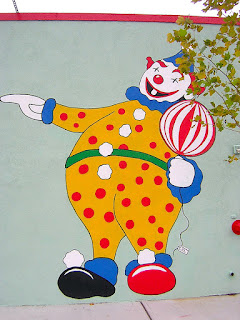
Just one more. The clown below is on the north side of the Wonder Bar. I think he may also be a refugee from the Palace.  If you look carefully at the right side of the picture above, I think you can see him. Wonder Bar Clown is facing left, and Palace Clown is facing right, but I think he's the same guy.


See also City of Lights, Tillie Goes Biking.

Thursday, March 24, 2022

We're Actually Winning

Cars Can Be Civilized

Bike lanes didn't do it. Streeteries did.

A few days ago my wife and I walked to Parc, on Rittenhouse Square, for dinner. It was a beautiful late afternoon, warm and sunny, almost no wind.

We sat on Locust Street near 18th, at one of the open-air tables next to the building's wall, and had a lovely meal. I had a nice view of the park in the late afternoon sun, and Lois had a nice view of the long array of people extending down Locust Street, sitting outside and having a good time.

After a while I noticed something. I had a good view of the intersection at 18th and Locust, right next to the square, and because I do this automatically these days, I had one eye on the moving vehicles. 

And then I had two eyes on. Something had happened to me. I wasn't scared. I looked at the cars and trucks and buses as they rolled up 18th or turned and went down Locust, and I was not intimidated.

All these drivers were proceeding slowly and carefully. The flow of traffic was smooth, and the transit times were clearly not deterring a robust traffic flow.

And I wasn't feeling afraid. I'd been told many times that speed was the crucial factor in taming the traffic, but looking back I don't think I had really believed it until that moment.

I thought of a few improvement opportunities. Switching from gasoline to electricity, for instance. And removing the dumpster from in front of the Curtis Institute. It's just possible that both of these things will happen, each in its own time.

We can actually live with cars in our cities. We just need to tame them.

I have seen the future, and it works.

See also Checking in With Outdoor Dining, The Space-Time Continuum.

Monday, March 7, 2022

Angry and Ridiculous

A Man for Our Time

Milord la Chamarre, outside, 1993.


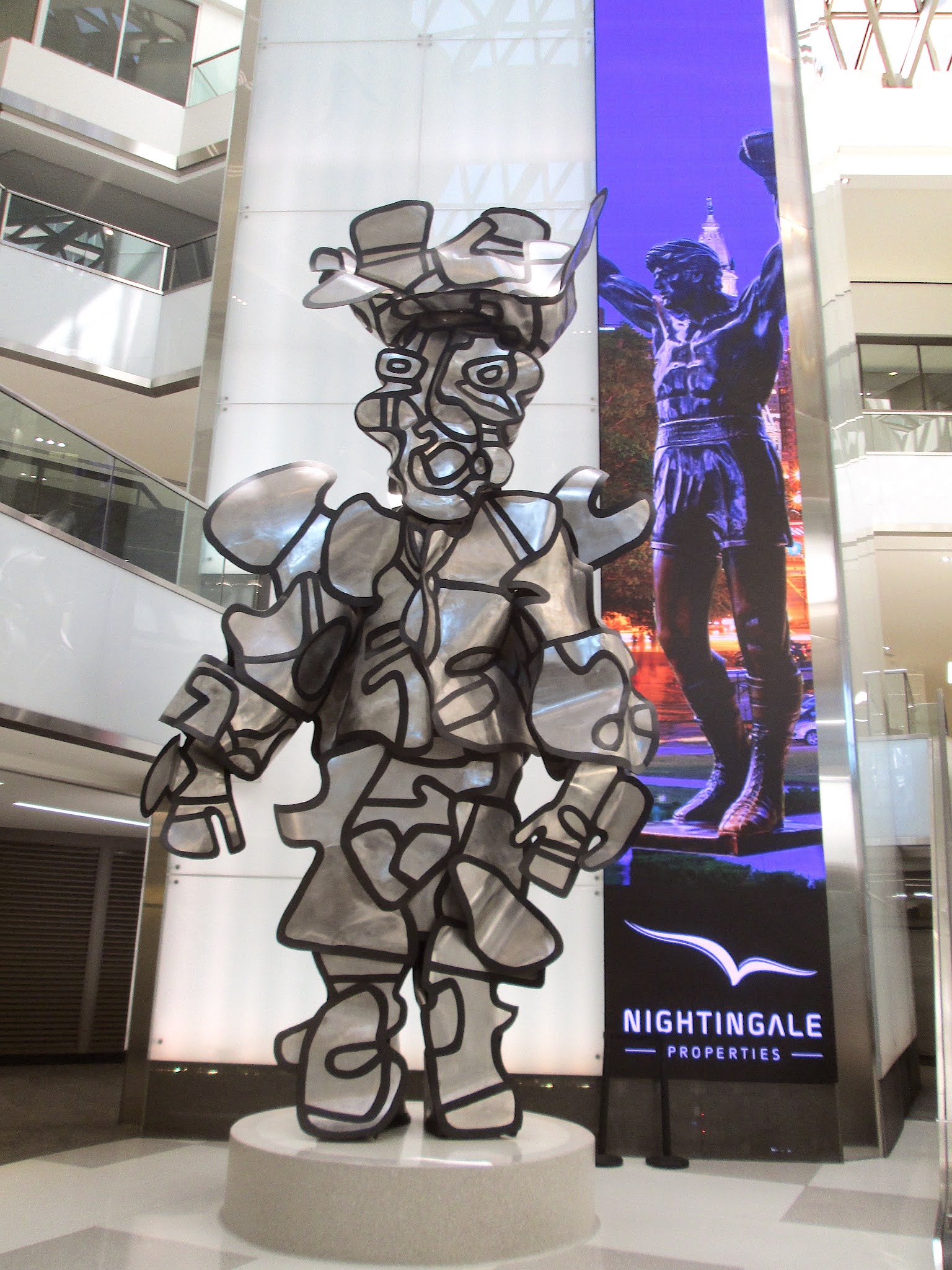
Years ago a kindly and well-informed docent at the Philadelphia Museum of Art explained cubism to me. Basically, she said, cubism disarticulated the surfaces of a cube and rearranged them in a novel fashion, and I think you can see that in Jean Dubuffet's Milord la Chamarre. Body parts have been separated, flattened and sometimes crumpled, and then (tentatively) reattached. I sometimes think he looks like he's in the initial stages of exploding. Sometimes I think he's just about to fall apart. And sometimes I think he's just angry.

I was not prepared for my first encounter with Milord la Chamarre. The first Dubuffet sculpture I remember seeing was in New York City, in front of the Chase Manhattan Bank headquarters near Wall Street. It's called Four Trees, it was installed in 1972, and I thought it looked like a group of gigantic, marshmallowy mushrooms. It made me happy just to look at it.  

When I first saw Mr. Milord, he was glaring off into space, or perhaps glaring down at me. He was standing on an elevated platform attached to an exterior wall of the Centre Square development, across the street from Philadelphia's City Hall. 

He looked odd. And he looked angry. I found it unsettling to be in his presence.

The Peripatetic Mr. Milord

It turns out that I have not been alone in finding him a bit unnerving. 

Milord la Chamarre was first installed on New York City's Park Avenue, in front of the Seagram building, in 1974. One observer told the Times that it looked a "giant version of the Tin Man in the 'Wizard of Oz.'" Another said he looked like "the Frankenstein monster in a suit of armor."  

Philadelphia developer Jack Wolgin thought the statue looked like a Mummer, so he brought Mr. Milord home and set him up in the Centre Square atrium in 1976. He was moved outside, where I first saw him, in 1990, and then back inside in 2019. (There's still a plaque outside, which helpfully summarizes some of his travels.)


A lot of Philadelphians just call him the Mummer. I think it's a valid way of looking at him, although I sincerely doubt that Jean Dubuffet ever saw a Mummer, or had one puke on his shoes.

Here he is, back inside the atrium.


Mr. Milord is 24 feet tall and weighs 5,000 pounds. He's made out of stainless steel and was fabricated by Lippincott, Inc. 

And he's still angry.


Right shoulder. A complicated bit.


Left hand. I think this is the only part of the statue that makes me feel comfortable. I don't know why. And no, I have no way to relate this hand to human anatomy.


Here's a detail of the lower right leg. This plate, just above the foot, reminds me of a soccer shin guard. If you think it's armor, call it a greave. Note the rivets. (They're in the black.)


What Does Chamarre Mean? 

So what was Dubuffet intending when he created Mr. Milord? I think we can learn a bit more about the artist's thinking if we have a look at the word chamarre. Usually Milord La Chamarre is translated as My Lord of the Fancy Vest. I looked in my French dictionaries, and found the verb chamarrer, which means "to bedizen." Bedizen, in turn, means to dress or adorn with gaudy finery. 

I did eventually find the noun chamarre online, where it has several meanings. One is embroidery. (This was in the French-language division of Wiktionary-land. To follow along, click here.) 

Both noun and verb derive from the Spanish noun zamarra, which is a sheepskin coat worn by Spanish shepherds. 

So how does a working-man's coat in Spain (admittedly a very warm coat) father a French word for gaudy adornment? I don't know. Is our statue a milord - that is, a nobleman - in a suit of armor or perhaps a fancy vest? Or is he a blue-collar Mummer? I don't know. I've decided he's both - or all three, depending on how you're counting.

In any event, there he is, gaudily dressed, clearly malevolent under the comedy, striding forward as if he owns the place.

Art Brut 

Where does the anger come from?

Dubuffet was one of the spark plugs behind the Art Brut movement, which got its start in the late 1940s. In the words of the Tate, "Art brut is a French term that translates as 'raw art', invented by the French artist Jean Dubuffet to describe art such as graffiti or naïve art which is made outside the academic tradition of fine art." The Tate adds that, in addition to graffiti, art brut includes "the work of the insane, prisoners, children, and primitive artists." It was "the raw expression of a vision or emotions, untramelled by convention." Dubuffet tried "to incorporate these qualities into his own art." 

I have decided that Four Trees is channeling children and Mr. Milord is channeling crazy people.

But, in addition to the anger, there is a brittle quality, a fragility. The way his body has been assembled, he appears to be in imminent danger of collapse, possibly held together only by his anger.

To see how Dubuffet pulls this off, we need to look at something called the Hourloupe Cycle.

The Hourloupe Cycle 

When you look at Mr. Milord or the Four Trees, it's hard not to notice the black outlines of the various segments. And then I find myself thinking of Keith Haring. Haring has a mural in the Point Breeze section of Philadelphia. Here's a photo of We the Youth (1987, restored 2013). 


(For a story and pictures by Mural Arts Philadelphia, click here.)

It turns out that Mr. Milord and the Four Trees, in addition to being influenced by Art Brut, also came along in the middle of what is called Dubuffet's Hourloupe Cycle. (Just so you know, the word hourloupe doesn't seem to have any meaning.)

I think that a basic idea behind hourloupe was radical simplification. Dubuffet wanted his hand to connect directly with - something - without the intervention of his conscious brain. Here again, as with Art Brut, Dubuffet, a sophisticated Frenchman to his fingertips, was attempting to escape the clutches of the French Academy.

The National Gallery of Australia reports that the hourloupe cycle "was inspired by doodles that Dubuffet made with a ballpoint pen while talking on the telephone in July 1962." 

His hourloupe studies began with drawings and paintings, but in due course he started exploring his ideas in three dimensions, and eventually we get to Mr. Milord. 

So if parts of Mr. Milord look like crumpled paper to you, I wouldn't disagree. And if you think some of his armor plates may have gotten started as post-it notes, I'd tell you that Post-It notes weren't introduced until 1980, and then I would agree with you on the general proposition, maybe with Elmer's glue or - better - pushpins that eventually get turned into rivets. Just guessing.

Disintegration

It is worth remembering that Dubuffet was French and not American. Let's have a look at some of what France went through while he watched. First there was World War II, an experience of defeat, occupation, and eventual liberation by foreign powers. Then France had not one but two Vietnams. The first was actually in Indochina. The second was in Algeria, and it brought down the Fourth Republic. Then, in May 1968, students began their famous revolt, many others joined in, the government and the economy came to a halt, and it seemed briefly that the new Fifth Republic might fall in turn. (It didn't.) And, shortly thereafter, Dubuffet created Mr. Milord. I think this statue is basically about the ever-present possibility of disintegration, and what that might look like. 

Angry and ridiculous.

So what can we Americans learn from Mr. Milord? I think we are rounding out a long historical circle that began in the middle of the last century, with the Civil Rights movement and the Vietnam War and Watergate (for me the turning point was the Tet offensive in 1968). Will we fulfill the promise of the Declaration of Independence and the Constitution as amended, or will we continue down the path to a military state under autocratic rule, similar to eighteenth-century Prussia? These issues were raised pointedly at mid-century, and I think we will see the answers in the relatively near future.

As I suggested earlier, I think Milord la Chamarre, with all his aggressive fragility, speaks to our time. Will he destroy everything around him, or will he finish disintegrating first? I think it's an open question.

Closing with a shot of Claes Oldenburg's 1976 Clothespin sculpture, which stands outside at Centre Square, perhaps 100 feet from Mr. Milord.

1993.


Special thanks to Chris Murtha for guiding me to sources I would not otherwise have found. Needless to say, we will not blame him for the many zany opinions I have expressed in this story. 

See also What the Greeks Knew, Little Karl, The 800-Pound Gorilla in the Oval Office.

Friday, March 4, 2022

The People Screaming Were White

Hall of Mirrors in South Philly

Outdoor dining, Asbury Park.


Professor Elijah Anderson has written a book about Center City Philadelphia entitled The Cosmopolitan Canopy (2011). He points to the Reading Terminal Market and Rittenhouse Square, in particular, as places where all people are welcome, and where just about everybody tries to be nice to one another. This attitude of welcome and mutual kindness contrasts with many other parts of the city, which are best analyzed as urban villages, where residents are clannish and deeply suspicious of outsiders. You don't need to be a gated community to be a closed community, or at least one that tries hard to be so.

I found myself mulling these thoughts as I attended yet another meeting on the future of Washington Avenue in South Philadelphia. At the Christian Street Y, Tuesday, March 1, 6:30 p.m. I got there at 6 in an attempt to make sure I got a  seat, and it was a good thing that I did so. The meeting was in the gym, a large space, but there were remarkably few chairs set out for the audience. The vast majority of attendees stood.

The show began with Mike Carroll, the deputy managing director in charge of the Office of Transportation, Infrastructure, and Sustainability (Otis); he ran through the final final design for the remaking of this street. He was standing at the front, behind a desk, with the presentation slides on the wall behind him and a large microphone in his hand. 

Mike's an accomplished speaker with a good baritone voice, but soon I found myself unable to hear him. There were many hecklers in the audience; the one standing behind me and basically shouting into my good ear had a particularly shrill voice. I did try to follow her meaning for a while. As nearly as I could tell, her argument boiled down to this: You didn't consult the neighbors (not true), we're the neighbors (okay, I believe you), we don't want the redesigned road (other people do), so don't do it (it doesn't work quite like that).

This person was unmasked, but had a ready answer for those who queried her on the topic: "Covid is bullshit!" Nearly a million dead, and the coronavirus is bullshit.

As nearly as I could tell, the hecklers were all white. I was sitting among a group of Black neighbors who, like me, had arrived early and gotten seats. I doubt they were particularly happy about the street redesign. I have my own reservations about it. But they weren't yelling. They were sitting quietly and attending to Mike Carroll as best they could.

As I've stated before, I think the current final design, which was reworked from the previous final design, was not brought about by the desire to please the Black residents of Point Breeze. I think it flows from a desire to mollify the owners of businesses located along Washington Avenue. Call them the Auto Repair Oligarchs.

And I think that the business owners, like the Black community in Point Breeze, are urban villagers. They want to have unilateral control over the space they occupy, and they don't like outsiders. Although I think the oligarchs do like the money that comes in from outside.

The Black community in Point Breeze rightly fears gentrification. I think the existing businesses on Washington Avenue fear being replaced by more upscale businesses and large apartment buildings. These processes are already underway, and if the City of Philadelphia were truly interested in slowing the rate of change, there are a number of things it could do, such as helping homeowners in Point Breeze to fix up their homes so they would be less tempted to sell. 

Maintaining Washington Avenue as a barrier between Point Breeze and the neighborhoods to the north may or may not slow the rate of gentrification, but it will certainly encourage the new people moving in to use their cars more and to walk and bicycle less. This is because, right now, you're a lot safer in a car on Washington Avenue than you are either on foot or on a bike.

Towards the end of Cosmopolitan Canopy, Professor Anderson suggests that it would be nice to see the concept move out from Center City and into other parts of Philadelphia. I like that idea quite a lot, and I think the battle on Washington Avenue is basically about an expanding cosmopolitan canopy. This could be rooted in the existing urban villages, if people were willing to live together with mutual respect and kindness. 

Near Independence Hall, Philadelphia, Feb. 27, 2022. 


See also A Turning PointQuo Vadis, Philadelphia? and Do We Secretly Want Ugly Cities and Dangerous Streets?

Monday, February 14, 2022

A Turning Point

How I Became a Democratic Socialist

Asbury Park, 1982.


On Saturday, February 5, Joy Huertas of Philadelphia's Office of Transportation, Infrastructure, and Sustainability posted a charming piece of fiction about Washington Avenue, a dreadful street in South Philly that has been awaiting a remake for nearly a decade. 

In 2020, the City released its "final design decision" for Washington Avenue, calling for a "road diet" to reduce the avenue from five lanes for motor-vehicle traffic to three. 

Then came the calls for more public input. And so began the dance. Whatever proponents of the design did, it was not enough. Surveys, letters of support, community board approvals. Nah. Not the right answer. 

Finally, City officials huddled with groups of residents in Point Breeze and Grays Ferry to gather further information. They then decided that there was significant opposition to the three-lane design. (It appears that these meeting did not violate Pennsylvania's open meetings law, aka the Sunshine Act.) 

So the City dropped the "final design decision" - the product of seven years of work - and is now mulling two significantly weaker designs, with a final final decision expected in weeks and construction to take place this year. (For two stories in PlanPhilly, click here and here.) 

What struck me, in all this recent activity, was that the City was essentially acting as if this project had no history before 2020. 

Just to refresh everyone's memory, this project began in 2013. I went back and reviewed the emails in my "Washington Avenue" folder. They start in 2014. 

I attended two meetings - one in 2014 and one in 2015. The first (October 15, 2014) was at the Bryant Baptist Church on 19th Street a bit south of Washington Avenue, and the second (September 3, 2015) was at the Rock School for Dance Education on Broad at Washington. I have distinct memories of both. I will limit myself to one story. 

At the second meeting we were sitting at round tables, engaging in conversation. A middle-aged Black woman was sitting to my right, and we had a cordial discussion of the issues at hand. It may be a bit difficult to remember today, but back then the focus was on bike lanes. Today the focus is more on the whole street and on dead pedestrians. 

At any rate, I'm a good listener and a genial person, and the lady warmed to me, and at one point leaned a bit in my direction and said, smiling, "Bicyclists are evil." 

I didn't challenge. I just tucked the story away. And now you have it. 

I certainly had no doubt, after the two meetings in 2014 and 2015, that there were Black residents in Point Breeze who were strongly opposed to proposals to redesign Washington Avenue. 

In my opinion, for the City to come back at this late date and say they're shocked, shocked to discover that there is opposition in Point Breeze is disingenuous at best. 

Let me be very clear: I don't think opposition from Point Breeze residents is driving the design decision. Why do I think that? Because I was also present at the Battle of 11th Street, which took place in a community room near the Italian Market in 2019 and was focused on the proposed new, two-way cycle track for a stretch of 11th Street. (To see my report on that evening's meeting, click here.) 

One anecdote I didn't put in the 2019 story: A middle-aged white woman stood up and told the packed room that she had regular fantasies of running bicyclists down with her SUV. 

I thought at the time, and think today, that people who fantasize about committing mass murder should not be allowed to drive policy. And in this case they were not. Despite such vehement opposition from members of the community, the City went ahead and built the cycle track. And guess what? The sky has not fallen. 

Why is the outcome different on Washington Avenue? I will tell you what I think. I think the people in Point Breeze are being cynically used as a smokescreen. As the Wizard of Oz puts it, "Pay no attention to the man behind the curtain." 

And who's behind the curtain? In my opinion, it's the business owners, many of whom treat Washington Avenue as their own private brick yard, loading zone, and parking lot. The old English common law held that the King's highway was not to be treated as a stable yard. This idea has been worn away over the years, but I still think it's valid to suggest, as a general principle, that we should not allow people to unilaterally privatize public property. 

There's a saying that goes back to Ozzie Myers, although he didn't quite say it this way. Over the years it's been slowly smoothed out. Here's the version that's in the Lexicon of Aphorisms: "Money talks, bullshit walks."

This is, of course, not a problem that is unique to the politics of Philadelphia. We see it in Washington every day. And in both parties. 

My thinking on this subject has undergone an evolution over the past decade or so. I used to be more accepting of the power of money in politics. But, really, how far is "money talks, bullshit walks" from Mao's dictum: "Political power grows out of the barrel of a gun." 

I think not far. And so I do prefer the notion that power proceeds from the consent of the governed. (I'm not alone in this. Have a look at the Declaration of Independence.)  So, I believe that an objectively good policy, supported by a very good public approval process, should not be trumped by shadowy forces acting behind closed doors. To use Ozzie's words, bullshit should talk, and money should walk. 

And that is why Washington Avenue has brought me to a turning point. For the last decade I have been devoting myself to reimagining Philadelphia's streets. They could, after all, be so much better. And I am perfectly willing to lose in a fair fight. I have volunteered on eight political campaigns, and my candidate has won twice.  

But Washington Avenue was different for me. I still think we need streets that should be safe, useful, and, if possible, even pleasant for all users. But I no longer think that designing better streets and then undergoing a thorough public review process are enough. I think we need to look at our broken political process and fix it. This involves replacing people and also reforming the way we do things in our political life. 

I don't think either the Republican or the Democratic party is up to this job. And so I plan to spend more time working with the Democratic Socialists of America, aka the Party of Bernie Sanders. 

I actually joined DSA about a year ago. My son suggested it to me. You can be a DSA member and also a registered Democrat.  Much of what the DSA does involves nesting within the Democratic Party and pushing it to do the right thing - something Bernie Sanders has had notable success with in the past few years. Dues are on a sliding scale, and you can sign up online. 

They have a nice magazine, and I got a membership card that says "A better future is possible." It sits on my bureau, and I look at it every day. It's red, of course. 

I haven't done much with DSA over the last year - they reach out on a regular basis and are happy to take no for an answer. But now I think I'm going to be reordering my priorities. I'm tired of being played for a sucker. 

See also Flex Posts on Pine and SpruceAbout That Parking Lot in South PhillyA New World Being BornIt's the Road Design, StupidLooking and Not Seeing, Listening and Not Hearing.