Thursday, March 24, 2022

We're Actually Winning

Cars Can Be Civilized

Bike lanes didn't do it. Streeteries did.

A few days ago my wife and I walked to Parc, on Rittenhouse Square, for dinner. It was a beautiful late afternoon, warm and sunny, almost no wind.

We sat on Locust Street near 18th, at one of the open-air tables next to the building's wall, and had a lovely meal. I had a nice view of the park in the late afternoon sun, and Lois had a nice view of the long array of people extending down Locust Street, sitting outside and having a good time.

After a while I noticed something. I had a good view of the intersection at 18th and Locust, right next to the square, and because I do this automatically these days, I had one eye on the moving vehicles. 

And then I had two eyes on. Something had happened to me. I wasn't scared. I looked at the cars and trucks and buses as they rolled up 18th or turned and went down Locust, and I was not intimidated.

All these drivers were proceeding slowly and carefully. The flow of traffic was smooth, and the transit times were clearly not deterring a robust traffic flow.

And I wasn't feeling afraid. I'd been told many times that speed was the crucial factor in taming the traffic, but looking back I don't think I had really believed it until that moment.

I thought of a few improvement opportunities. Switching from gasoline to electricity, for instance. And removing the dumpster from in front of the Curtis Institute. It's just possible that both of these things will happen, each in its own time.

We can actually live with cars in our cities. We just need to tame them.

I have seen the future, and it works.

See also Checking in With Outdoor Dining, The Space-Time Continuum.

Monday, March 7, 2022

Angry and Ridiculous

A Man for Our Time

Milord la Chamarre, outside, 1993.


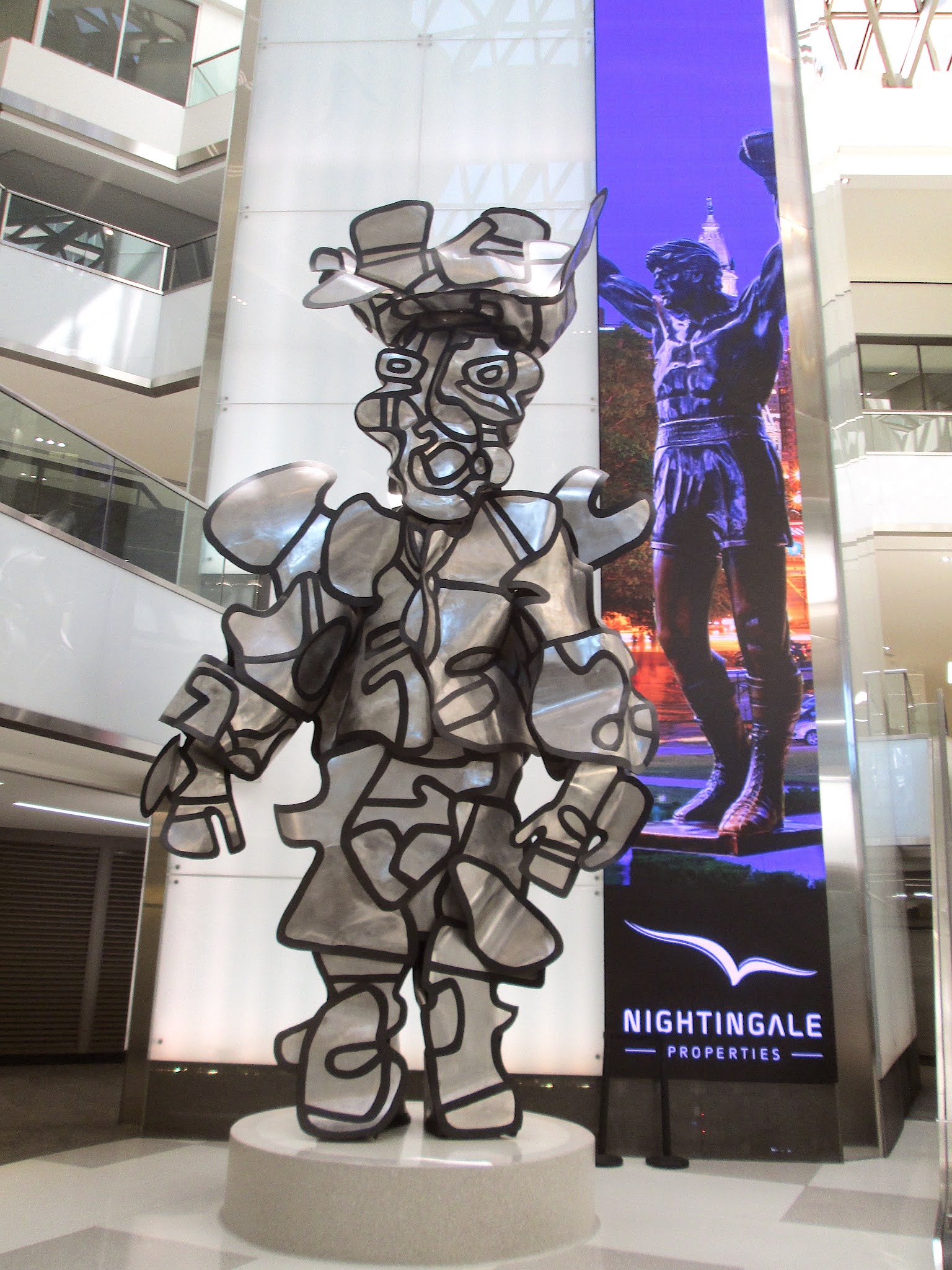
Years ago a kindly and well-informed docent at the Philadelphia Museum of Art explained cubism to me. Basically, she said, cubism disarticulated the surfaces of a cube and rearranged them in a novel fashion, and I think you can see that in Jean Dubuffet's Milord la Chamarre. Body parts have been separated, flattened and sometimes crumpled, and then (tentatively) reattached. I sometimes think he looks like he's in the initial stages of exploding. Sometimes I think he's just about to fall apart. And sometimes I think he's just angry.

I was not prepared for my first encounter with Milord la Chamarre. The first Dubuffet sculpture I remember seeing was in New York City, in front of the Chase Manhattan Bank headquarters near Wall Street. It's called Four Trees, it was installed in 1972, and I thought it looked like a group of gigantic, marshmallowy mushrooms. It made me happy just to look at it.  

When I first saw Mr. Milord, he was glaring off into space, or perhaps glaring down at me. He was standing on an elevated platform attached to an exterior wall of the Centre Square development, across the street from Philadelphia's City Hall. 

He looked odd. And he looked angry. I found it unsettling to be in his presence.

The Peripatetic Mr. Milord

It turns out that I have not been alone in finding him a bit unnerving. 

Milord la Chamarre was first installed on New York City's Park Avenue, in front of the Seagram building, in 1974. One observer told the Times that it looked a "giant version of the Tin Man in the 'Wizard of Oz.'" Another said he looked like "the Frankenstein monster in a suit of armor."  

Philadelphia developer Jack Wolgin thought the statue looked like a Mummer, so he brought Mr. Milord home and set him up in the Centre Square atrium in 1976. He was moved outside, where I first saw him, in 1990, and then back inside in 2019. (There's still a plaque outside, which helpfully summarizes some of his travels.)


A lot of Philadelphians just call him the Mummer. I think it's a valid way of looking at him, although I sincerely doubt that Jean Dubuffet ever saw a Mummer, or had one puke on his shoes.

Here he is, back inside the atrium.


Mr. Milord is 24 feet tall and weighs 5,000 pounds. He's made out of stainless steel and was fabricated by Lippincott, Inc. 

And he's still angry.


Right shoulder. A complicated bit.


Left hand. I think this is the only part of the statue that makes me feel comfortable. I don't know why. And no, I have no way to relate this hand to human anatomy.


Here's a detail of the lower right leg. This plate, just above the foot, reminds me of a soccer shin guard. If you think it's armor, call it a greave. Note the rivets. (They're in the black.)


What Does Chamarre Mean? 

So what was Dubuffet intending when he created Mr. Milord? I think we can learn a bit more about the artist's thinking if we have a look at the word chamarre. Usually Milord La Chamarre is translated as My Lord of the Fancy Vest. I looked in my French dictionaries, and found the verb chamarrer, which means "to bedizen." Bedizen, in turn, means to dress or adorn with gaudy finery. 

I did eventually find the noun chamarre online, where it has several meanings. One is embroidery. (This was in the French-language division of Wiktionary-land. To follow along, click here.) 

Both noun and verb derive from the Spanish noun zamarra, which is a sheepskin coat worn by Spanish shepherds. 

So how does a working-man's coat in Spain (admittedly a very warm coat) father a French word for gaudy adornment? I don't know. Is our statue a milord - that is, a nobleman - in a suit of armor or perhaps a fancy vest? Or is he a blue-collar Mummer? I don't know. I've decided he's both - or all three, depending on how you're counting.

In any event, there he is, gaudily dressed, clearly malevolent under the comedy, striding forward as if he owns the place.

Art Brut 

Where does the anger come from?

Dubuffet was one of the spark plugs behind the Art Brut movement, which got its start in the late 1940s. In the words of the Tate, "Art brut is a French term that translates as 'raw art', invented by the French artist Jean Dubuffet to describe art such as graffiti or naïve art which is made outside the academic tradition of fine art." The Tate adds that, in addition to graffiti, art brut includes "the work of the insane, prisoners, children, and primitive artists." It was "the raw expression of a vision or emotions, untramelled by convention." Dubuffet tried "to incorporate these qualities into his own art." 

I have decided that Four Trees is channeling children and Mr. Milord is channeling crazy people.

But, in addition to the anger, there is a brittle quality, a fragility. The way his body has been assembled, he appears to be in imminent danger of collapse, possibly held together only by his anger.

To see how Dubuffet pulls this off, we need to look at something called the Hourloupe Cycle.

The Hourloupe Cycle 

When you look at Mr. Milord or the Four Trees, it's hard not to notice the black outlines of the various segments. And then I find myself thinking of Keith Haring. Haring has a mural in the Point Breeze section of Philadelphia. Here's a photo of We the Youth (1987, restored 2013). 


(For a story and pictures by Mural Arts Philadelphia, click here.)

It turns out that Mr. Milord and the Four Trees, in addition to being influenced by Art Brut, also came along in the middle of what is called Dubuffet's Hourloupe Cycle. (Just so you know, the word hourloupe doesn't seem to have any meaning.)

I think that a basic idea behind hourloupe was radical simplification. Dubuffet wanted his hand to connect directly with - something - without the intervention of his conscious brain. Here again, as with Art Brut, Dubuffet, a sophisticated Frenchman to his fingertips, was attempting to escape the clutches of the French Academy.

The National Gallery of Australia reports that the hourloupe cycle "was inspired by doodles that Dubuffet made with a ballpoint pen while talking on the telephone in July 1962." 

His hourloupe studies began with drawings and paintings, but in due course he started exploring his ideas in three dimensions, and eventually we get to Mr. Milord. 

So if parts of Mr. Milord look like crumpled paper to you, I wouldn't disagree. And if you think some of his armor plates may have gotten started as post-it notes, I'd tell you that Post-It notes weren't introduced until 1980, and then I would agree with you on the general proposition, maybe with Elmer's glue or - better - pushpins that eventually get turned into rivets. Just guessing.

Disintegration

It is worth remembering that Dubuffet was French and not American. Let's have a look at some of what France went through while he watched. First there was World War II, an experience of defeat, occupation, and eventual liberation by foreign powers. Then France had not one but two Vietnams. The first was actually in Indochina. The second was in Algeria, and it brought down the Fourth Republic. Then, in May 1968, students began their famous revolt, many others joined in, the government and the economy came to a halt, and it seemed briefly that the new Fifth Republic might fall in turn. (It didn't.) And, shortly thereafter, Dubuffet created Mr. Milord. I think this statue is basically about the ever-present possibility of disintegration, and what that might look like. 

Angry and ridiculous.

So what can we Americans learn from Mr. Milord? I think we are rounding out a long historical circle that began in the middle of the last century, with the Civil Rights movement and the Vietnam War and Watergate (for me the turning point was the Tet offensive in 1968). Will we fulfill the promise of the Declaration of Independence and the Constitution as amended, or will we continue down the path to a military state under autocratic rule, similar to eighteenth-century Prussia? These issues were raised pointedly at mid-century, and I think we will see the answers in the relatively near future.

As I suggested earlier, I think Milord la Chamarre, with all his aggressive fragility, speaks to our time. Will he destroy everything around him, or will he finish disintegrating first? I think it's an open question.

Closing with a shot of Claes Oldenburg's 1976 Clothespin sculpture, which stands outside at Centre Square, perhaps 100 feet from Mr. Milord.

1993.


Special thanks to Chris Murtha for guiding me to sources I would not otherwise have found. Needless to say, we will not blame him for the many zany opinions I have expressed in this story. 

See also What the Greeks Knew, Little Karl, The 800-Pound Gorilla in the Oval Office.

Friday, March 4, 2022

The People Screaming Were White

Hall of Mirrors in South Philly

Outdoor dining, Asbury Park.


Professor Elijah Anderson has written a book about Center City Philadelphia entitled The Cosmopolitan Canopy (2011). He points to the Reading Terminal Market and Rittenhouse Square, in particular, as places where all people are welcome, and where just about everybody tries to be nice to one another. This attitude of welcome and mutual kindness contrasts with many other parts of the city, which are best analyzed as urban villages, where residents are clannish and deeply suspicious of outsiders. You don't need to be a gated community to be a closed community, or at least one that tries hard to be so.

I found myself mulling these thoughts as I attended yet another meeting on the future of Washington Avenue in South Philadelphia. At the Christian Street Y, Tuesday, March 1, 6:30 p.m. I got there at 6 in an attempt to make sure I got a  seat, and it was a good thing that I did so. The meeting was in the gym, a large space, but there were remarkably few chairs set out for the audience. The vast majority of attendees stood.

The show began with Mike Carroll, the deputy managing director in charge of the Office of Transportation, Infrastructure, and Sustainability (Otis); he ran through the final final design for the remaking of this street. He was standing at the front, behind a desk, with the presentation slides on the wall behind him and a large microphone in his hand. 

Mike's an accomplished speaker with a good baritone voice, but soon I found myself unable to hear him. There were many hecklers in the audience; the one standing behind me and basically shouting into my good ear had a particularly shrill voice. I did try to follow her meaning for a while. As nearly as I could tell, her argument boiled down to this: You didn't consult the neighbors (not true), we're the neighbors (okay, I believe you), we don't want the redesigned road (other people do), so don't do it (it doesn't work quite like that).

This person was unmasked, but had a ready answer for those who queried her on the topic: "Covid is bullshit!" Nearly a million dead, and the coronavirus is bullshit.

As nearly as I could tell, the hecklers were all white. I was sitting among a group of Black neighbors who, like me, had arrived early and gotten seats. I doubt they were particularly happy about the street redesign. I have my own reservations about it. But they weren't yelling. They were sitting quietly and attending to Mike Carroll as best they could.

As I've stated before, I think the current final design, which was reworked from the previous final design, was not brought about by the desire to please the Black residents of Point Breeze. I think it flows from a desire to mollify the owners of businesses located along Washington Avenue. Call them the Auto Repair Oligarchs.

And I think that the business owners, like the Black community in Point Breeze, are urban villagers. They want to have unilateral control over the space they occupy, and they don't like outsiders. Although I think the oligarchs do like the money that comes in from outside.

The Black community in Point Breeze rightly fears gentrification. I think the existing businesses on Washington Avenue fear being replaced by more upscale businesses and large apartment buildings. These processes are already underway, and if the City of Philadelphia were truly interested in slowing the rate of change, there are a number of things it could do, such as helping homeowners in Point Breeze to fix up their homes so they would be less tempted to sell. 

Maintaining Washington Avenue as a barrier between Point Breeze and the neighborhoods to the north may or may not slow the rate of gentrification, but it will certainly encourage the new people moving in to use their cars more and to walk and bicycle less. This is because, right now, you're a lot safer in a car on Washington Avenue than you are either on foot or on a bike.

Towards the end of Cosmopolitan Canopy, Professor Anderson suggests that it would be nice to see the concept move out from Center City and into other parts of Philadelphia. I like that idea quite a lot, and I think the battle on Washington Avenue is basically about an expanding cosmopolitan canopy. This could be rooted in the existing urban villages, if people were willing to live together with mutual respect and kindness. 

Near Independence Hall, Philadelphia, Feb. 27, 2022. 


See also A Turning PointQuo Vadis, Philadelphia? and Do We Secretly Want Ugly Cities and Dangerous Streets?

Monday, February 14, 2022

A Turning Point

How I Became a Democratic Socialist

Asbury Park, 1982.


On Saturday, February 5, Joy Huertas of Philadelphia's Office of Transportation, Infrastructure, and Sustainability posted a charming piece of fiction about Washington Avenue, a dreadful street in South Philly that has been awaiting a remake for nearly a decade. 

In 2020, the City released its "final design decision" for Washington Avenue, calling for a "road diet" to reduce the avenue from five lanes for motor-vehicle traffic to three. 

Then came the calls for more public input. And so began the dance. Whatever proponents of the design did, it was not enough. Surveys, letters of support, community board approvals. Nah. Not the right answer. 

Finally, City officials huddled with groups of residents in Point Breeze and Grays Ferry to gather further information. They then decided that there was significant opposition to the three-lane design. (It appears that these meeting did not violate Pennsylvania's open meetings law, aka the Sunshine Act.) 

So the City dropped the "final design decision" - the product of seven years of work - and is now mulling two significantly weaker designs, with a final final decision expected in weeks and construction to take place this year. (For two stories in PlanPhilly, click here and here.) 

What struck me, in all this recent activity, was that the City was essentially acting as if this project had no history before 2020. 

Just to refresh everyone's memory, this project began in 2013. I went back and reviewed the emails in my "Washington Avenue" folder. They start in 2014. 

I attended two meetings - one in 2014 and one in 2015. The first (October 15, 2014) was at the Bryant Baptist Church on 19th Street a bit south of Washington Avenue, and the second (September 3, 2015) was at the Rock School for Dance Education on Broad at Washington. I have distinct memories of both. I will limit myself to one story. 

At the second meeting we were sitting at round tables, engaging in conversation. A middle-aged Black woman was sitting to my right, and we had a cordial discussion of the issues at hand. It may be a bit difficult to remember today, but back then the focus was on bike lanes. Today the focus is more on the whole street and on dead pedestrians. 

At any rate, I'm a good listener and a genial person, and the lady warmed to me, and at one point leaned a bit in my direction and said, smiling, "Bicyclists are evil." 

I didn't challenge. I just tucked the story away. And now you have it. 

I certainly had no doubt, after the two meetings in 2014 and 2015, that there were Black residents in Point Breeze who were strongly opposed to proposals to redesign Washington Avenue. 

In my opinion, for the City to come back at this late date and say they're shocked, shocked to discover that there is opposition in Point Breeze is disingenuous at best. 

Let me be very clear: I don't think opposition from Point Breeze residents is driving the design decision. Why do I think that? Because I was also present at the Battle of 11th Street, which took place in a community room near the Italian Market in 2019 and was focused on the proposed new, two-way cycle track for a stretch of 11th Street. (To see my report on that evening's meeting, click here.) 

One anecdote I didn't put in the 2019 story: A middle-aged white woman stood up and told the packed room that she had regular fantasies of running bicyclists down with her SUV. 

I thought at the time, and think today, that people who fantasize about committing mass murder should not be allowed to drive policy. And in this case they were not. Despite such vehement opposition from members of the community, the City went ahead and built the cycle track. And guess what? The sky has not fallen. 

Why is the outcome different on Washington Avenue? I will tell you what I think. I think the people in Point Breeze are being cynically used as a smokescreen. As the Wizard of Oz puts it, "Pay no attention to the man behind the curtain." 

And who's behind the curtain? In my opinion, it's the business owners, many of whom treat Washington Avenue as their own private brick yard, loading zone, and parking lot. The old English common law held that the King's highway was not to be treated as a stable yard. This idea has been worn away over the years, but I still think it's valid to suggest, as a general principle, that we should not allow people to unilaterally privatize public property. 

There's a saying that goes back to Ozzie Myers, although he didn't quite say it this way. Over the years it's been slowly smoothed out. Here's the version that's in the Lexicon of Aphorisms: "Money talks, bullshit walks."

This is, of course, not a problem that is unique to the politics of Philadelphia. We see it in Washington every day. And in both parties. 

My thinking on this subject has undergone an evolution over the past decade or so. I used to be more accepting of the power of money in politics. But, really, how far is "money talks, bullshit walks" from Mao's dictum: "Political power grows out of the barrel of a gun." 

I think not far. And so I do prefer the notion that power proceeds from the consent of the governed. (I'm not alone in this. Have a look at the Declaration of Independence.)  So, I believe that an objectively good policy, supported by a very good public approval process, should not be trumped by shadowy forces acting behind closed doors. To use Ozzie's words, bullshit should talk, and money should walk. 

And that is why Washington Avenue has brought me to a turning point. For the last decade I have been devoting myself to reimagining Philadelphia's streets. They could, after all, be so much better. And I am perfectly willing to lose in a fair fight. I have volunteered on eight political campaigns, and my candidate has won twice.  

But Washington Avenue was different for me. I still think we need streets that should be safe, useful, and, if possible, even pleasant for all users. But I no longer think that designing better streets and then undergoing a thorough public review process are enough. I think we need to look at our broken political process and fix it. This involves replacing people and also reforming the way we do things in our political life. 

I don't think either the Republican or the Democratic party is up to this job. And so I plan to spend more time working with the Democratic Socialists of America, aka the Party of Bernie Sanders. 

I actually joined DSA about a year ago. My son suggested it to me. You can be a DSA member and also a registered Democrat.  Much of what the DSA does involves nesting within the Democratic Party and pushing it to do the right thing - something Bernie Sanders has had notable success with in the past few years. Dues are on a sliding scale, and you can sign up online. 

They have a nice magazine, and I got a membership card that says "A better future is possible." It sits on my bureau, and I look at it every day. It's red, of course. 

I haven't done much with DSA over the last year - they reach out on a regular basis and are happy to take no for an answer. But now I think I'm going to be reordering my priorities. I'm tired of being played for a sucker. 

See also Flex Posts on Pine and SpruceAbout That Parking Lot in South PhillyA New World Being BornIt's the Road Design, StupidLooking and Not Seeing, Listening and Not Hearing.

Friday, February 11, 2022

City of Lights

Asbury Park's Boardwalk Circa 1980

1978.


I do miss the lights. Traveling carnivals still come to Asbury Park and work their magic in Bradley Park, just inland from Convention Hall. But the big permanent rides are gone, and I miss the lights.

There are still a few attractions for children on the boardwalk - a water park, miniature golf, and a pinball museum that has four small rides out front. Last summer my four-year-old grandson was quite fond of the school bus, which moved and made sounds when you fed it three quarters. He was a little bit fond of the train engine. The Batman car and the Flintstones car seemed to attract smaller children. There is also a playground on the beach, not far from the pinball museum.

1981.


It's not the same. Have a look at this Ferris wheel preening in the twilight.

1978.


I find myself entranced, and I can only imagine the effect on children. 

Let's have a look at the carousel house, which is attached to the Casino building. 

1978.


And inside the carousel house. (The carousel was built in 1923 and moved from Asbury Park to Myrtle Beach, South Carolina, in 1992.)

1981.


As nearly as I can tell, the first carnival people who glommed on to the idea of using electric lights to create an evening wonderland were the builders of Luna Park, one of the three big amusement parks that were in the Coney Island entertainment district before World War I. The key man here was Frederic Thompson.

John Kasson traces Thompson's inspiration to the World's Columbian Exposition of 1893 in Chicago, also known as the White City for all its white buildings, This event had a strong and lasting influence on American architecture and urban design, and it also explored the outdoor potential of electric lighting, which was only beginning to displace gaslit street lamps. "At night the splendor of the scene was further enhanced by an unprecedented battery of floodlights, using three times as much electricity as the rest of Chicago." (John F. Kasson, Amusing the Million: Coney Island at the Turn of the Century, 1978, pp. 21, 61-66.) 

1978.


Professor Kasson reports the result in Luna Park: "Borrowing from the example of the White City, Thompson studded Luna with a quarter million electric lights. The same buildings that excited wonder during the day assumed a dazzling new aspect; the strings of lights seemed to sketch an insubstantial, dreamlike scene" (p. 66). 

As competitors refused to be left behind, the lights of Coney Island proliferated, and news of this unique little world soon spread across the globe. Charles Denson argues that, by 1904, Coney Island "was the mechanical amusement center of the world. No longer just a resort, it was a phenomenon that attracted curious high-brow visitors such as Sigmund Freud and Maxim Gorky. Coney's electric skyline was unlike anything ever seen before. Gorky described it as 'shapely towers of miraculous castles, palaces and temples. Golden gossamer threads tremble in the air. They intertwine in transparent, flaming patterns, which flutter and melt away in love with their own beauty mirrored in the waters." (Charles Denson, Coney Island: Lost and Found, 2002, p. 31.) 

Gorky is perhaps best known today as the author of a play called The Lower Depths, which was first produced in 1902.  It was directed by a fellow named Konstantin Stanislavski. Gorky visited Coney Island in 1906 and actually did not approve of the amusements, but the nighttime view clearly knocked his socks off. (To see his essay on Coney Island, entitled "Boredom," click here.) 

1978.


I can't match Gorky for florid prose, but around 1980 I found myself reconnecting with my childhood sense of wonder. Looking again at these pictures forty years later, I find myself reconnecting with two of my younger selves.

There was enchantment on the boardwalk in Asbury Park, all those years ago, and it was a lively place after dark.

1981.


My sense is that Gorky's basic concern about Coney Island was that the amusements were not uplifting - they didn't make you a better person. In this he was right, but out of sync with the audience, which did not want to be uplifted - it wanted the release of amusement, and if the result was childlike wonder, happy shrieks, or raucous laughter, so much the better. The carnies knew their audience well, and they delivered.

1978.


See also What Streets Can Learn From Boardwalks, Tillie Goes Biking.

Tuesday, February 1, 2022

Hans Fallada and the White-Collar Proletariat

The Fantasy of Rugged Individualism

South Philly, 1989.


Recently several members of my family have been reading the German writer Hans Fallada, who died in 1947. I came late to the party, and I'm not quite sure how many of his novels we currently have in our house. Books travel from home to home in our family, as needed.

I've only read two of Fallada's novels, The Drinker (published posthumously in 1950) and Wolf Among Wolves (1937). At some point I may read Every Man Dies Alone (1947) and his most famous novel, Little Man - What Now? (1932).

But I don't think I'm going to do it right away. Frankly, I find reading a Hans Fallada novel exhausting and depressing. I believe this is because his characters are so real, and the situations he puts them in are so demoralizing.

I do strongly recommend Wolf Among Wolves if you want to understand what life was like during the German hyperinflation of the early 1920s. 

In December my son gave me a small book for the holidays - Heinz J. Schueler's Hans Fallada, from 1970. It is a critical analysis of the major themes in Fallada's work, and it tops out at 119 pages, which makes it easily the shortest book connected to Hans Fallada that I will ever read. I would caution an English-language reader that there are extensive quotations in German, which are not translated. They are, however, explained, and you can get the gist of what's going on by just reading the English. 

Personally, I discovered that the German I had in graduate school has just about completely disappeared, but I also noticed that if I'd read the novel under discussion, that helped quite a lot.

I found several spots where I was disagreeing with Schueler. There's a whole chapter on Fallada's portrayal of women, which frankly sounds a bit sexist today; Professor Schueler focuses on the role of women in marriage, saying that their job is to save men from isolation. Well, the book did come out in 1970, and that was another time. But I'm thinking of a woman in Wolf Among Wolves, who freely engages in sex for pleasure and who turns down an offer of marriage from a man she likes, but who is a bit stupid. And she's clearly not all that interested in being one of Fallada's angels of salvation. She's been helping an old lady run a junkyard in Berlin, and it's fairly clear the old lady wants her to take over the business. So all kinds of hints of modernity here, but Schueler doesn't write about them. 

The main focus of Fallada's writing is the plight of the Kleinburger, or lower-middle class man, during the turbulent twenties. Another term for him is Stehkragenprolet, or white-collar proletarian (although Stehkragen really means "stand-up collar" - the kind of stiff collar, often made of celluloid, that middle-class men in those days kept in collar boxes and attached to their shirts each morning.)

This class - the white-collar proletariat - was a critical element in the rise to power of both Mussolini and Hitler, so what Fallada has to say on the subject has relevance today. The two most important things to know are that Fallada saw them as isolated and demoralized. The people below them - the actual proletarians - often had class solidarity and traditions of mutual dependence and help. The people above them had their networks of power. The Kleinburgers believed in the capitalist canard of individualism, or each man on his own, or each against all, or wolf among wolves. 

And that is their fatal flaw. Nobody above them or below them is silly enough to believe they can get by without networks.

It's also what makes the Kleinburgers easy prey for fascists, who give them a place to belong and The Other to fight against.

The flip side of this is what happens when they find their isolation deepening, and their former leaders deny that the little people had simply been doing what their masters told them to do.  

Siege warfare: Isolate and diminish. (See The Correct Strategy: Fight.)

The Other, South Street, 1992.


See also Fascism, On Demagogues, Jim Crow Was a Failed State, The Roots of the RepublicBoos Are Good, Rugged Individualism: From Daniel Boone to Barack Obama.

Monday, January 24, 2022

Tillie Goes Biking

A Migrant from Brooklyn Finds His Legs


Who knew? Tillie has legs! And now he's riding a bike!

Frankly, I hadn't known that Tillie existed below the collar and that oh-so-stylish necktie. At least, stylish for its time.

There he was on a penny-farthing bicycle, which is in fact age appropriate - Tillie is well over 100 years old. (The name penny-farthing comes from old British coins - the penny, or front wheel, being rather large, and the farthing, or rear wheel, being quite small.)

This new version of Tillie - Tillie 2.0? - showed up just before the pandemic, and briefly graced a number of the bicycles that were available in Asbury's bike share program. Sadly, the bike share did not survive the pandemic. The scooter share also went on hiatus for a while, but it's back, and there are scooter-share scooters everywhere. We can only hope Tillie 2.0 and his bike-share bikes will come back as well, some day soon.

It's hard to explain how important Tillie has been for Asbury Park. For many years, through thick and thin, the good times and the bad, Tillie has been our icon. He does have some competition from various references to Bruce Springsteen, usually involving the words Greetings From Asbury Park. Our parade of identity might actually profit from some new recruits - I'm fond of the dolphins who swim on various facades of Convention Hall - but for now Tillie is the smiling face of Asbury Park. 

And so it's probably even harder to explain that Tillie is actually a migrant from Brooklyn - Coney Island, to be precise.

His older cousin, Funny Face, graced Coney Island's Steeplechase Park for many years. George C. Tilyou, owner of the Coney Island park, opened another steeplechase in Asbury Park and decorated it with Tillie, a kinder, gentler version of Funny Face, whom I frankly find a bit scary. 

A large mural rendition of Tillie currently graces the Wonder Bar, where he kindly presides over Yappy Hour, a Happy Hour for dogs and humans (only the humans get alcoholic beverages). The Wonder Bar mural is actually the third incarnation of Tillie as a mural. Tilyou's was the first, and then came the famous mural on Palace Amusements, which was removed from its site when Palace Amusements was demolished; it then spent nearly two decades hanging out at the city's sewage treatment plant, and in 2021 was transferred to a storage site just north of Convention Hall.

Here's a picture of Wonder Bar Tillie.

Presiding over Yappy Hour at the Wonder Bar.


Yappy Hour explained.


Commerce in Convention Hall.


Tillie, king of souvenirs.


Tillie at Palace Amusements. Note the utility wires.


Tillie as a towel, with a t-shirt thrown in.


Iconographic options on Convention Hall. There are more.


Tillie everywhere: The side of the bike basket.