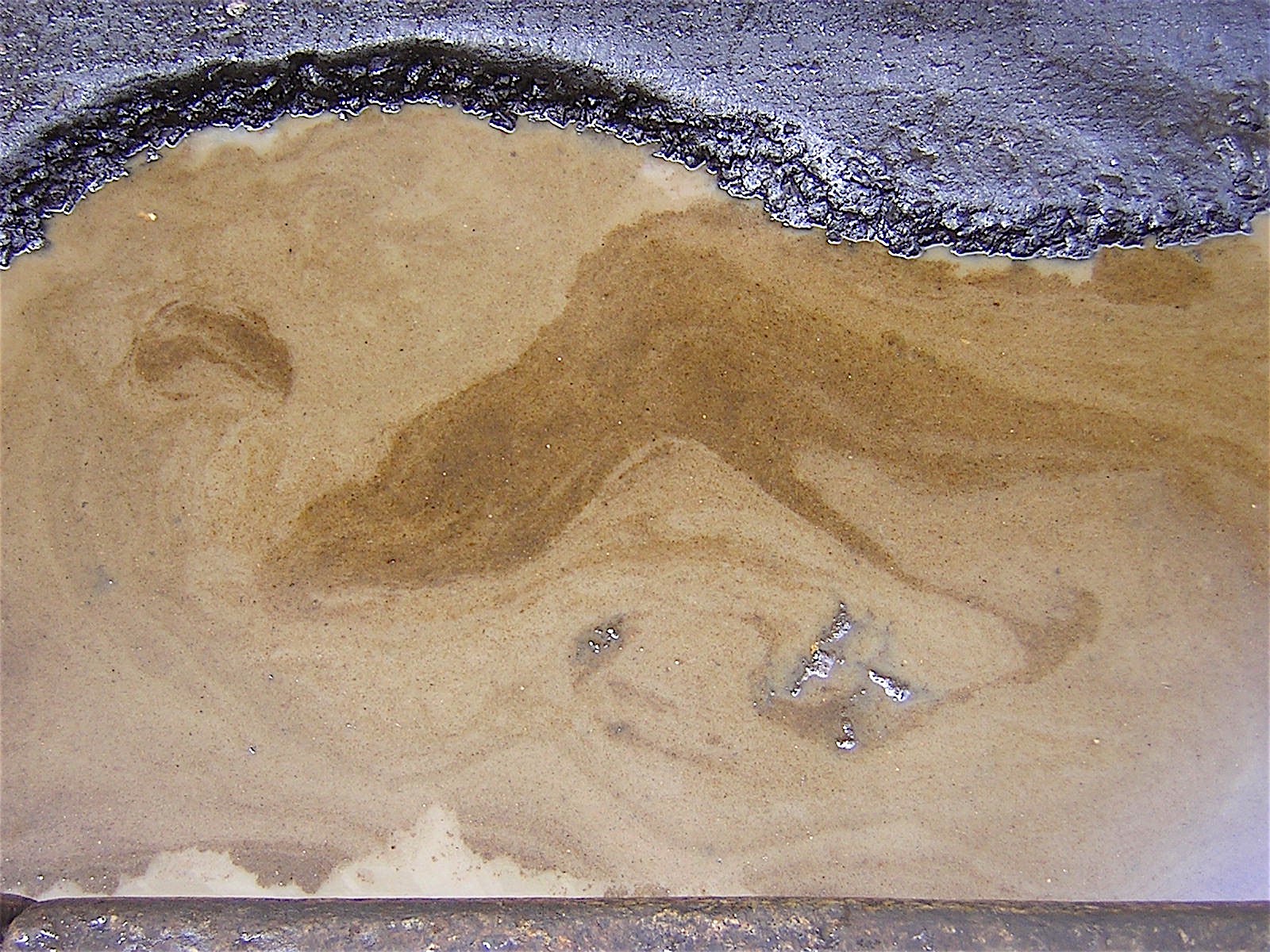
Wednesday, September 8, 2021

Buried Under the Tarmac

Belgian Block, Check. Trolley Tracks, Check.


Trolley track, on its side.


Our block got a new water main this year. I for one found it very educational to watch the job unfold. There were distinct aspects of archaeology as layers of the past were opened to the light of day. 

The rails started coming out of the ground quite early. The Belgian block, on the other hand, was playing hide and seek. Eventually we did start to get some, but it seems clear that much of the old pavement on this bit of street had been carted away during prior reconstructions. The basic profile here is asphalt on top of a layer of concrete on top of dirt. Down in the dirt are the water pipes, so we wound up seeing a lot of dirt as well. 


Another block near us was also getting a new water main, and I visited it occasionally as well. Stretches, at least, had the old road virtually intact under the asphalt. Here's a shot that can give you an idea of what Philadelphia's streets looked like in 1910 or 1890.


Some background: The original streetcars in Philadelphia were drawn by horses, and they first showed up in 1858. Electrification arrived several decades later. Here is an article on Philly's streetcar history, which notes that an electric line went in on Bainbridge and Catharine Streets in 1892.


And then there were a bunch of these things. They are pieces of the old railroad ties (or sleepers, as the English call them). The hexagonal piece of metal you see sticking out of the wood is the head of something called a hex-head screw spike. I had never seen or heard of such a thing before, but apparently they were quite popular in years gone by. 

The advantage over the regular railroad spike is that you don't have to drive the spike with a really big hammer. Instead, you can use a large spanner to screw it into the wood. The little tab is a separate piece, kind of like a washer. I think its purpose is to reach out and hold down the lip on the bottom of the rail. 

I couldn't resist salvaging a few of these screw spikes. 


See also Missing the Point, On a Slow Boat to China, Transit MemoriesScavengers and Scow Trimmers.

Wednesday, August 25, 2021

As the Tide Goes Out

When my wife first started reading the story on her phone to me, I was not prepared to believe what she was saying. A surfer dude from Santa Barbara in California had killed his two children - the elder was two years old, and the little one was ten months old - with a spearfishing gun because his wife possessed serpent DNA and had passed it on to their children. (For stories, click here and here and here.)

The surfer-dude-perp, who at age forty was old enough to know better, had apparently worked all this out by assiduous study of QAnon. He told the FBI that, by murdering his children, he was saving the world.

For a while I've been watching the tide go out on America's latest tsunami of crazy, and I thought I had a good grasp of the creatures left flipping and gasping on the wet sand.

Ron DeSantis. Greg Abbott. Florida. Texas. Arguments that are internally inconsistent, and of course also decoupled from external reality. A seeming wish to visit death and devastating disease on their own followers. Jonestown, anyone?

And how does moving the Covid death toll from 600,000 to 700,000 gain you the keys to the White House?

But spearfishing your own children was something new to me.

I wasn't going to write about it. I've actually been trying to write less about these matters. It's getting harder and harder to summon humor. But in the end I felt a need to mark the event.

See also The 800-Pound Gorilla in the Oval Office, And So the Worm Turned.

Monday, August 2, 2021

A Shortage of Serviceable Ducks

Is the Right Running Out of Decent Canards?

Not a duck.


The word canard means duck in French. It also means a false or misleading story.

In 2013, Alberto Brandolini propounded his Bullshit Asymmetry Principle, which states that the amount of energy needed to refute bullshit is an order of magnitude bigger than to produce it. In this story, I'm going to replace the world bullshit with canard, and also suggest that it may be time for a reconsideration of the overall principle.

I still think refuting a canard is much more work than making one up. I just think the level of asymmetry is declining. I see a number of reasons for this change in America's political discourse. They fall into two categories. First, the democrats are getting better at their game. Second, the fascists seem to be running on empty. 

There is now a cottage industry devoted to shooting down canards, and the reactions are quicker and more forceful. Good heavens, even the New York Times is now willing to use the word lie. 

Aggrieved parties are moving aggressively against the perpetrators of lies. This places the liars on the defensive, a situation they were apparently not expecting, and the outcome can be quite amusing. Sydney Powell, a great propagator of various theories of election fraud, got to watch her lawyers defend her allegations with the argument that "no reasonable person would conclude that the statements were truly statements of fact." (For a story in the Guardian, click here.)

And the media, under pressure, have been tightening their rules and making it much harder for an enterprising canard to truly take flight - or go viral, as they say.

Again, the canardists seem to have been taken by surprise when their access to the microphone started to dwindle. Attempts to shift to new platforms haven't entirely fizzled, but the ability to reach beyond the base and get to a truly large audience seems to be limited at this point.

Finally, canards wear out, and when they do you have to replace them. And guess what? The replacement assembly line doesn't seem to be functioning very well. Many of the canards seem smaller, less credible, and less motivating, and many of them have remarkably short lives. How long did the ridiculous Dr. Seuss canard last? (And no, Minority Leader McCarthy, Democrats did not outlaw Dr. Seuss.)

There definitely seems to be a good bit of fumbling. Take the critical race theory kerfuffle. Many of the canardists don't seem to know much about critical race theory. But then they don't seem to know much about socialism either. I think there's a pattern here. I'm put in mind of the water strider, a bug that can walk across water without breaking the surface tension.

This tomfoolery still works with the base, of course, and many laws are being passed at the state level seeking essentially to prevent the study of history. All this needs to be opposed forcefully, but the perpetrators are acting in a sphere of illusions, and I suspect, if it comes to it, the bubble will be burst by children announcing that the emperor is wearing no clothes. That's essentially what happened in the 1960s.

Species of Canard

I see two main species of canard: distraction and contradiction. 

Distraction is a small, shiny object, preferably moving at great speed while it screams "Look at me, look at me!" Dr. Seuss is a good example. It can own a news cycle or two, distracting from the actual business in front of us.

Contradiction is the equivalent of a frontal assault. I used to have a boss who, when the conversation was going in a direction he didn't like, would simply say no. He didn't have anything to back up the no, but he didn't need anything. He was the boss, and it was a business, not a democracy.

Republicans, on the other hand, tend to respond with bald-faced lies. (Remember, they hate masks.) A classical example is the claim that January 6 was just like "a normal tourist visit" to the Capitol.

I personally think that lying is lazy. A more powerful, and more honorable, way to win an argument is to shift the terms of debate by bringing in new ideas or data. This is what a group of American colonists did when they declared that all men are created equal; monarchy has never recovered from this rhetorical blow.

But instead the right serves up the Big Lie, a contradictional canard if ever there was one. It's not getting much traction beyond the base, possibly because it's so ridiculous even Sydney Powell thinks the people who believe it are demented. (Fact check: Joseph Biden won the election.)

And who are the true believers? Self-identified Republicans are currently about 25% of the population in surveys. Evangelical Christians, a pillar of the right for many years, were 23 percent of the population in 2006; currently they are about 14.5 percent of the population. (For a story, click here.)

These are your dead-enders. We will always have them. There are still monarchists in France. 

One way to control them is to stop exaggerating their power. A recent poll indicates that 56 percent of Republicans believe the Big Lie. Okay, report the survey. Then do the arithmetic: 56% x 25% = 14%. 

Are We at War?

I'm not trying to underestimate the damage that the right has already done, or the damage that it is capable of in the future. Indeed, if things go badly, we could still wind up in a fascist dictatorship.

And facing up to the triumphalist certainty of people like Steve Bannon can get to be demoralizing. Early on he articulated the canardist strategy with the memorable phrase "flood the zone with shit." (For a January 2020 story, when the situation was much more fluid than it is now, see this story in Vox.)

Bannon's idea of flooding the zone is basically a military concept. The idea is to place your opponent in a chaotic and terrifying environment. As Shakespeare put it in Julius Caesar, "Cry 'Havoc!' and let slip the dogs of war" (JC3.1.273).

I suppose we could ask why we would apply such an approach to our political  process, but then Bannon  and his comrades think we are in a war. And I agree. A civil war that has been going on since January 2017. Not a lot of shooting, but plenty of casualties. Just look at the Covid-19 pandemic, where more than 600,000 Americans have lost their lives, basically to satisfy one man's vanity.  

The flood the zone approach may not be pretty, but it does work. However, you need a lot of bullets, and a very large delivery mechanism. My argument is that they briefly had both, and are now losing both.

I say this with some humility, because I've been wrong before. Back in 2013, I wrote a story called Maybe Lying Is Starting to Stop Working. I was, to say the least, premature.

How It Will Unfold

Having said that, I think the tide is running against the right. I think they peaked on June 3, 2020, when Senator Tom Cotton managed to place a piece of fascist propaganda on the op-ed page of the New York Times. In the story, he called for invocation of the Insurrection Act in response to the demonstrations and riots that occurred after the murder of George Floyd. 

I think the right saw that the hinge-point for a successful coup was bringing the professional military in on their side. It didn't happen. 

Since then, power has been slowly slipping out of their hands. In the November election, they lost the White House and the Senate, and on January 6 they failed to achieve their goal of reversing Joe Biden's election.

Now have a look at the voters, and what they want. The Republicans simply don't have much to offer to the great middle, also called independents. These are often people who just want things to calm down. They want to lead a normal life - go to work in the morning, come home in the evening, have dinner with the spouse and possibly kids, vote for representatives who are decent people and try to do the right thing. And of course they're opposed to dictatorship. The right's problem here is that they're in favor of dictatorship, and permanent chaos is their modus operandi. 

And we know our right wing very well. Although January 6 was definitely something new, most of the spaghetti they're throwing at the wall is old and tired and unlikely to stick.

I'm struck by how familiar so much of this stuff is. Look at Senator Susan Collins standing up and saying that states needed to control voter eligibility. States rights. Fourteenth Amendment. She reminds me of George Wallace standing in the schoolhouse door. 

I don't think there are any magic bullets, and I think we're looking at a long timeline, but I do think we have the tools to win this war. And wouldn't it be wonderful if we got all the way to the end without a lot of shooting? 

The right has certainly given us a lot of material to work with. January 6 has proven to be a veritable cornucopia. If you haven't looked at the New York Times video and the earlier New Yorker video, set aside a little time. They substantially deepened my understanding of what happened that day.

You could also watch the hearings of the House select committee investigating the events of January 6.

Fight a war with words and pictures. Fight a war without guns. Use the tools of democracy to defend democracy.

I think the war will be won by altering the shape of the battlefield.

A duck.


Recently a number of prominent anti-vaxxers have done a u-turn and started urging people to get vaccinated. Such an abrupt move to a diametrically opposed position - sometimes called a 180 - is dangerous to the leader who does it. For more see One-Eighties.

See also The Problem with Dystopia, Quagmire, A Home Invasion, After the Riot, Fascism.

Wednesday, July 14, 2021

Slingshot

Freedom from Thinking

Near Uniontown, Pa. Ben Shahn/FSA, Oct. 1935.


Way back in the days of Tom Sawyer and Huck Finn, there was a 12-year-old boy who lived in rural Missouri. His name was JD, and his prize possession was a handmade slingshot. He carried it around in a small canvas bag with long handles that let him hang the bag from his shoulder. Nestled with the slingshot in the bag were a bunch of of small round stones and, usually, a ham sandwich.

Mostly JD shot his stones at squirrels. He'd killed one once, early on, and taken it home. His Pa had cleaned it and thrown the meat in the stew pot and told him to go kill more squirrels. But they'd gotten very cagey. It was almost as if they talked about JD. Whenever he stopped and started to take out his slingshot, the squirrels would go on alert, watch him for a second, and then disappear.

The squirrels were getting boring, and shooting trees wasn't very much fun, even though it was good practice. He'd gotten so he could hit the same mark on a tree three times in a row. 

JD was walking down a dirt road that led into town. He and his Pa lived in a shack on the other side of town. He was walking by a large, well-kept house that he had often passed before. He knew that an old widow lady lived there. He'd even seen her once or twice, sitting in a rocker on the porch.

JD looked at the porch. Back on the house's wall there were two large windows, each with twelve panes of glass. JD wondered if he could hit the bottom left pane on the left window. It would be a little tricky. He'd have to almost graze the top of the railing.

He took out his slingshot, loaded a stone, looked up, aimed carefully, and fired. There was a very satisfying crash of glass as the bottom left pane of the left window shattered, sprinkling shards of glass everywhere. 

JD admired his handiwork for a moment, and then something told him it would be a good idea to leave the area. He was walking away, stuffing his slingshot in the canvas bag, when he heard a voice.

"Young man, where do you think you are going?"

It was a lady's voice. He stopped and turned. It was the widow lady. She was standing on the porch.

"Why did you break my window?" It was a stern voice. He had heard that she had been a schoolteacher.

"I didn't mean to, ma'am. I didn't know it would break."

The widow lady had indeed been a school teacher.

"What did you think would happen?" she asked.

"I don't know, ma'am."

The old lady had been a schoolteacher for a long time . She'd seen a lot of twelve-year-old boys.

"So you weren't thinking about the consequences of your actions?"

The boy thought for a moment and then brightened visibly.

"Yes, ma'am. I wasn't thinking."

The lady thought of what she would teach this boy, given the chance. Some science. How cannons worked, slip in a little ballistics on the side. Maybe Euclid's Elements. If this, then that.

"Do you go to school, boy?"

"No, ma'am. My Pa says the great outdoors is my school." 

"Like Daniel Boone."

The boy looked at her blankly.

"What's your name?"

"JD, ma'am."

The lady thought that perhaps he went to Sunday school.

"Do you know the story of David and Goliath?"

He looked at her blankly. The lady sighed. She had no way into this boy's mind. Her husband had been a doctor. When they first arrived, he had tried to convince his patients not to dig their privy pit directly next to their well. After a few years he gave up, and just treated their symptoms as best he could.

"All right, JD." She walked to the edge of the porch and leaned her arm over the railing.

"Hand me the bag." 

JD complied. She dumped the contents onto a table. She put the ham sandwich back in the bag and handed the bag to JD.

"I'll be keeping your slingshot and your ammunition for a while." She couldn't resist trying to teach him something. Maybe he'd ask his father what "ammunition" meant. She continued.

"Tell your father if he comes today and fixes my window, I will give him the slingshot. You may go now."

Dejected, the boy hung his head and walked away.

Years later, one of her grandchildren visited her from the big city, and told her they were trying to figure out what to do with all the unruly children who kept skipping school. The schools could expel them for truancy, but that just made things worse - they would have every day to get into trouble on the streets. He said he didn't even know what to call them - street urchin seemed unkind, and didn't necessarily imply the petty criminality they were seeing.

They were sitting on her porch, she in her rocker, he in a wicker armchair, lemonade on the table.

The lady looked out, somewhere across the porch's railing. She thought of JD and smiled.

"Have you thought of calling them juvenile delinquents?" she asked.

See also The 800-Pound Gorilla in the Oval Office, Little Karl.

Wednesday, June 23, 2021

Disorder Breeds Bad Law

The Downside of Disruption


Cars broke the Fourth Amendment. That's the thesis of Sarah Seo's 2019 book, Policing the Open Road: How Cars Transformed American Freedom. (For a 2021 interview in The Trace, click here.) 

Back in the sunny days before World War I, chaos and mayhem came to America's streets in the form of the motor vehicle. I have known for some time what cars did to the fabric of our cities (See Cars and Bikes - the Back Story.) What I didn't know was that they also twisted our criminal justice system into a pretzel. 

Professor Seo traces this history from the introduction of the Model T Ford in 1908, noting that the first center line pavement marking - running down the middle of the road to separate traffic going in opposite directions - was painted in Wayne County, Michigan, in 1911. (Seo, p. 49.) 

It was part of a panoply of new devices - stop signs (1914), traffic lights (also 1914), and all kinds of painted lines on road surfaces - all brought forth by the need to control the movement of motor vehicles. (For the origins of the stop sign see James Longhurst, Bike Battles, 2015, p. 91. For an overview of early traffic management efforts, see Peter D. Norton, Fighting Traffic, 2011, chapter 2.) 

Motorists weren't terribly interested in obeying all the new signals on the street, or the many laws that legislatures were busily passing to try to bring some order out of chaos. 

Local governments created licensing requirements, established speed limits, mandated non-glare headlights and rearview mirrors. They established streets where motor vehicles were not allowed to go. They worked out rules for the right-of-way among motor vehicles, pedestrians, horses, and horse-drawn vehicles. A 1905 treatise even had a kind word for bicyclists: "Bicycles, tricycles and automobiles are ordinarily considered vehicles and entitled to the use of that part of the street or highway set aside for them." (Seo, p. 26.) 

All of this came as something of a shock to the citizenry, who were entirely unaccustomed to this level of regulation. As Seo explains, the roads had historically been governed by community standards and tort laws. This system did fall apart under the impact of motor vehicles, and so the gaze of your nosy neighbor, and the civil suit by an offended citizen, gave way to the gaze of the police and criminal prosecution of nonconforming behavior on the road. (Seo, pp. 24-27, 39, 60-61.) 

Why did the country's roads suddenly need all these rules? After all, the main selling point of cars was freedom - freedom of movement, to be sure, but so much else came along with that. By the 1920s there was clearly the element of romance. As with Emma Bovary's memorable carriage ride in Rouen, in the middle of the nineteenth century, it seems undeniable that the appeal of the motor car had an erotic dimension by the Jazz Age, if not before.

So it was perhaps a natural tendency for drivers to ignore rules that got in the way of their freedom.

The problem with this - and the reason for all the traffic control devices and laws - was that there was a downside to the automotive onslaught - two things in particular: endemic congestion and the vast number of crashes. Legislators, police, engineers, and concerned citizens were all trying desperately to deal with these issues. 

In general, the citizenry went with freedom over rules, and upstanding middle-class citizens discovered the joy of crime. Speeding? What's that? Stop sign? Hah! 

Of course, driving was not the only situation during the Roaring Twenties where middle-class people discovered the joy of crime. There was, for instance, something called Prohibition, which people liked about as much as they liked speed limits.  

Private Space, Public Space

It was at the nexus of booze and cars where the Fourth Amendment started to break down. Let's have a look at the text of the Fourth Amendment:

"The right of the people to be secure in their persons, houses, papers, and effects, against unreasonable searches and seizures, shall not be violated, and no Warrants shall issue, but upon probable cause, supported by Oath or affirmation, and particularly describing the place to be searched, and the persons or things to be seized." 

Remember that word "unreasonable." It turns out to be the worm in the heart of the Fourth Amendment.

The framers of the Constitution would have viewed this language through the lens of the English common law, which drew a sharp distinction between the public space and the private space of life. The quintessential private space was the home, often romantically described as a castle, presumably equipped with a moat and a drawbridge and a portcullis.

As Professor Seo puts it, "This way of thinking ordered the world into two spheres, public and private. This division, in turn, determined the scope of legitimate state action vis-a-vis individual rights. Put together, government could regulate the public sphere, but free men (and they were men) enjoyed the right to be left alone and do as they pleased in the private sphere. Applied to the Fourth Amendment, officers could not probe the private sphere without a warrant specifying 'the place to be searched, and the persons or things to be seized.' In contrast, no constitutional requirement hampered law enforcement efforts in the public sphere." (Seo, pp. 124-125.) 

This does not mean that the government could do whatever it wanted in the public sphere. The common law had rules for when police officers could arrest someone in the public sphere, without a warrant. There were different rules depending on the nature of the crime. "One such situation arose when an officer had reasonable grounds to believe that a person had committed a felony. For misdemeanors, the common law required more: the officer had to actually see the offense take place, and in some jurisdictions, the offense also had to amount to a breach of the peace." (Seo, p. 126.)

Note the words "reasonable grounds."

So is a car more like a home, or more like a person walking down the street?  

Carroll v. United States

At the end of 1921, government agents stopped a car on a road in Michigan. They were looking for booze, and they found it. The occupants of the car, George Carroll and John Kiro, were charged and convicted under the National Prohibition Act (also called the Volstead Act), which was the law implementing the Eighteenth Amendment to the Constitution. The Eighteenth Amendment was ratified in 1919, and the Volstead Act took effect in 1920. (For Carroll, see Seo, pp. 113ff.) 

Carroll and Kiro appealed, arguing that the search, which had been conducted without a warrant, was illegal. And so, in due course, Carroll v. United States became the Supreme Court's first car search case. 

The government initially viewed the case as enforcement of the Volstead Act and the Eighteenth Amendment. The defendants argued that the warrantless search violated the Fourth Amendment. 

As "the national debate over alcohol turned into a showdown between two constitutional provisions" (Seo, p. 120), a funny thing happened on the way to the forum. The government switched its argument in the Carroll case from booze to cars.  

Solicitor General James Beck argued the case for the government. Here's Professor Seo on page 124: "With the possibility that Prohibition's unpopularity might jeopardize the convictions, he reframed Carroll as a case not about liquor but about how the automobile had completely transformed American society. In his brief to the Supreme Court, Beck asserted that the fact that 'this is a liquor case is accidental.' The import of the case reached 'far beyond the incidental problem of enforcing the liquor laws' to 'the invention, the rapid development, and the general use of automobiles as a means of transportation.' He described how cars had 'produced a more profound effect upon social conditions than any other invention of modern times.' Although this was a case about the illicit haul of alcohol, the next case could involve a murderer or robber fleeing in a getaway. The revolution in the commission and pursuit of crime, Beck argued, compelled the Court to reconsider 'the well-settled rules of the common law' regarding an officer's authority to search and to seize." 

Beck's arguments carried the day and, as collateral damage, ripped a gaping hole in the law of search and seizure. Chief Justice William Howard Taft (he had previously served as president of the United States) wrote the Court's opinion, which was handed down in 1925. (For the text of the opinion, and Justice McReynolds' dissent, click here.) 

Chief Justice Taft decided not to answer the question: Is a car more like a house or more like a person? Instead he created a new category, the "automobile exception."  Seo remarks, "Carroll v. United States held that a warrantless search and seizure was lawful if the 'officer shall have reasonable or probable cause for believing that the automobile which he stops and seizes has contraband liquor therein which is being illegally transported." (Seo, pp. 137-138.) 

As Seo notes, "allowing officers to seize a car and then search it with reasonable or probable cause for believing that the driver may be violating Prohibition laws, many of which were misdemeanor offenses, went way beyond what existing laws permitted. Under the common law for misdemeanors, warrantless arrests required actual knowledge through personal observation, not cause for believing." (Seo, p. 138.) 

"In short, the Carroll rule constitutionally legitimized police discretion." Chief Justice Taft gave powers to the police that had formerly been reserved for judges: "Carroll delegated the judicial inquiry of probable cause, at least in the first instance, to the police." (Seo, p. 139.)

Seo concludes, "Carroll marked a turning point in criminal procedure." (Seo, p. 141.) 

The Sixties

So how have things worked out? 

Let's skip over the next few decades of car stops (cue flashing lights), high-speed chases (sirens and squealing tires), and many, many crashes (screech, BOOM, tinkle of broken glass). Neither the car industry nor the government got very interested in building safe cars until the 1960s, when Ralph Nader forced them to. His book on the Corvair and related topics, Unsafe at Any Speed: The Designed-In Dangers of the American Automobile (1965), was a turning point. NHTSA, the National Highway Traffic Safety Administration, was founded in 1970. (For a good recent story on Nader and the sixties, click here.) 

And what about the law? Well, also in the 1960s, a Yale Law School professor found himself becoming troubled by the number of times the police were stopping him. He traveled a bit, and it happened in numerous states. When the professor, Charles Reich, asked why he was being stopped, the usual response was "Just checking." When one officer said he "had the right to stop anyone any place any time - and for no reason," Reich decided to write an article, which duly appeared in the Yale Law Journal in 1966, under the title "Police Questioning of Law Abiding Citizens." (Seo, p. 202. To see the article, click here.) 

I'd like to say that Reich's article had the same effect as Ralph Nader's Unsafe at Any Speed. But, instead of things getting better in the world of car stops and searches, they have actually gotten worse. Let's fast-forward again to the 1980s and a writer named Charles Remsberg, who looked at the 1986 Anti-Drug Abuse Act and effectively updated Chief Justice Taft for the modern era. 

The Rise of the Pretextual Stop

Remsberg did this by refining the arbitrary stop that police were already addicted to - "just checking," as they said to Professor Reich - and identifying legally acceptable ways to extend the stop into a criminal investigation that might lead to the discovery of illegal drugs. First, he recommended having an actual violation rather than the more amateurish "just checking." Actual violations are often readily at hand - failure to signal a lane change, for instance. The second step was to assess the situation for signs that could provide a reasonable cause for believing that the car contained contraband. Did the driver seem unduly skittish? Were his eyes glazed over? Strange odors? Furtive movements? And the carefully worked-out list of dos and don'ts goes on from there. (See Seo, pp. 254 ff.) 

And there is no question that this treatment has fallen disproportionately on people of color. A 1996 state case arising from traffic stops on the New Jersey Turnpike settled this issue definitively. In State v. Soto the New Jersey court, reports Seo on pages 264-265, "excluded evidence of drugs against seventeen black motorists based on the equal protection and due process clauses of the Fourteenth Amendment. The defense had compiled data showing disparities in traffic law enforcement 'so wide, so big' that the computer would not even 'spit out a number,' recalled the professor who had conducted the survey. Nearly every driver sped past legal limits, but blacks were stopped at a disproportionate rate - to be precise, between 16.35 and 22.1 standard deviations above the median, depending on the segment of the New Jersey Turnpike. The opinion helpfully explained that statisticians consider standard deviations over 2 to be statistically significant. To put this in layman's terms, it was 'highly unlikely [that] such statistics could have occurred randomly or by chance.' Even more damning, the defense's expert demonstrated that state troopers using radar stopped black drivers in proportion to their motoring population, while troopers not using radar arrested many more blacks. The witness commented, 'As they got more discretion, they stopped more blacks.'" 

It's worth noting that this case was about the Fourteenth Amendment, and not the Fourth Amendment. Perhaps this is a sign of how badly the Fourth Amendment had been broken, way back in the 1920s, basically by a bunch of overeager car salesmen who, careless of the consequences, launched an armada of cars on an unsuspecting country, causing grievous damage to our laws and to the fabric of our cities. 

What to Do?

As Professor Seo notes on page 266, "The problem with pretextual policing is not only that the police treat groups differently; it is, just as importantly, that they have that much discretionary power at all." 

So how do we limit the use of police discretion? There's an old religious maxim: "Avoid the proximate occasion of sin." I think we have a huge opportunity to radically reduce the amount of time that police spend policing motor vehicles. Red-light cameras and speed cameras change our thinking about how to administer the many, many rules of the road. Do we need a uniformed officer with a 9-mm pistol, a Taser, pepper spray, a wooden baton, or perhaps one of those fancy collapsible metal ones - oh, and a badge? Or do we need a civilian technician staring at a computer screen?  

Instead of selective enforcement, this administrative approach can provide 100 percent enforcement, which removes the game aspects of driving - the thrill of transgression, the need for wily stratagems to evade punishment. No more hide and seek, cops and robbers, cowboys and Indians. Just know if you speed, you pay. 

How dull, you say. To which I say, speed kills. I know too much about what happens to a child's body when it's hit by a drag-racing car on Roosevelt Boulevard. 

People often say that the red-light cameras and the speed cameras are just a money grab, and have nothing to do with safety. Well, when speed cameras first went in on Roosevelt Boulevard in Philadelphia, a gargantuan number of tickets were issued. Nine months later, the number of tickets issued had fallen by 93 percent, indicating that people were actually changing their behavior.

Crashes are also way down. There are still way too many crashes, but changes to the design of the road are in the works and should eventually help lower crashes even further.

We could also revisit some of our many, many traffic laws. If the laws are not changing behavior, does it make sense to have them? Take, for instance, the law requiring motorists to signal a lane change. Many people are highly compliant. I try to do it, but occasionally forget. And there are people who will never, ever signal a lane change. Does pulling people over and writing tickets actually change this behavior? 

I could go on about laws that don't do any good, and about how we can redesign our roads so they don't encourage dangerous behavior, but this is a story about the Fourth Amendment, so I think I will end with this thought.

We live in a modern state; it has many rules - perhaps too many. But we do need a lot of rules so that our very complex modern society can function. The idiocracy that seeks to govern us likes to bray about freedom without ever mentioning that we are all answerable for our actions. Freedom always came with responsibility. Those responsibilities are different now, but they do not prevent freedom; they seek to prevent reckless endangerment.

I would like to suggest that our choice is not between freedom and an oblivious bureaucracy. Our choice is between an administrative state and a police state. I'll take the nanny state.


Policing is not imposed from above; it is a service to the community, and the community can take the initiative in seeing that police service is what we want it to be. Legislatively or administratively, it is possible for a community to establish guidelines for police and citizens as well. - Charles Reich, 1966

See also Rugged Individualism, The Supreme Court and ParkingWhat the Greeks Knew.

Monday, June 7, 2021

A Few Deft Touches for Back Streets

And Suddenly People Want to Walk There


So what do you do with a blind brick wall? Paint a few doors and windows, or maybe just rectangles. And call it art. Because it is.

The scene above is on South Hicks Street, the location of my new favorite coffee shop, called Suprema (actually the entrance to Suprema is on Pine). Somewhere behind that wall are two small theaters, tucked into the old ballroom of the Drake apartment building, which fronts on Spruce and runs quite a distance down South Hicks. (I found this information online.)

So if you're thinking that the facade treatment above looks like a stage set, I'm thinking you wouldn't be wrong.

Not too hard to do, really. Once you have the idea. 


I've been writing about Philadelphia's alleys and small streets for a number of years, and I'm pleased to say that more and more people seem to be getting ideas. They don't have to be big ideas. Here's a provisional reworking of a small passageway on 16th Street, between Spruce and Locust, last summer.


The decor went away in the winter, but the passageway seems to be making a comeback now that the warm weather is here again.

And here's a temporary installation, also on 16th just north of Spruce. Call it eye candy, but it works. The alley is no longer invisible. It is a place.


I think one of our little streets with the greatest potential is Moravian, just north of Walnut. One of the reasons I like Moravian is that its current situation varies block by block, from depressing to catastrophic. Here's a shot at 17th Street.


This is a little unfair, because of the digging in the road, but I've taken too many pictures of long rows of greasy dumpsters, and I need something to motivate me to take a picture. So forgive me.

The upshot of upgrading is that you make the space more useful. Here's an alley behind the Atlantic building, in the 1400 block of Spruce. This space was a mess that you may not remember, because it was usually closed off with a sagging chain-link gate backed by some opaque plastic tarpaulins. 


Now, as you can see, it's open, it looks nice, and there are some parking spots and an entrance to the building that can be used by residents as well as staff.

Look at this side entrance to the Bellevue. Somebody decided to care. And it shows.


The easiest little streets to spruce up are the residential blocks. These streets provide access to the homes, but generally have very little through traffic. Other blocks are everybody's rear door. They're basically places to stow cars and stash trash, and they look it.

And many of them are a lot cleaner than they used to be. But still they tend to be colorless, and lacking in a sense of cohesion.

I wish someone would care a bit more about the 1400 block of Moravian. It's just west of Broad; on the north side lies the Union League, and on the south side are a number of very nice older buildings, including Drexel and Company on 15th and, in the mid-block, one of the former homes of the Philadelphia Stock Exchange. (I've written about this block before; to see the story, click here.)

This block used to be a filthy mess. It's now much cleaner and neater than it used to be, but I think the people looking after things here should not rest on their laurels. Take this street to the next level. Put the dumpsters inside, and move the sheriff's-office parking to one of the many, many large garages in the area. A few of the facades on the south side of the street need some restoration. And then you can go for a pedestrian-priority street with outdoor dining.

Here's a taste of the payoff. This slice of the Union League is tucked away in the mid-block, waiting for its audience to show up and have a cappuccino.


See also Small Streets Are Like Diamonds, Streets Without Joy, City Beautiful Sprouts on Cypress Street, What We Lost, Do We Secretly Want Ugly Cities and Dangerous Streets?

Thursday, May 20, 2021

What Does a Clean Street Look Like?

And How About a Metric for Trash Collection?

Leaving a rally a few weeks after the Parkland massacre, Society Hill, 2018.

I've been doing some thinking about trash. It's actually a pretty boring subject. Almost as boring as parking, and the subject lacks a Donald Shoup, the man who revolutionized thinking about parking. Not that there haven't been important innovations in the past few decades - recycling, and designing products for their full life cycle come to mind. The concept of minimizing the amount of trash from inception through final disposal is very useful. There's even a mantra for these ideas - reduce, reuse, recycle.

In addition to the 3 Rs, deep thinkers have come up with the 7 Rs - Rethink, Refuse, Reduce, Reuse, Repurpose, Recycle, and Rot. This last being a nod to composting. The only problem with the 7 Rs, from my point of view, is that I am never able to remember them all. 

But I'm looking at a slightly different problem - how we collect and remove trash in a way that gives us clean streets. 

Normally, when I think of street trash, I see two things: First, household and commercial trash that is placed out for collection, a portion of which always seems to wind up on the street and not in the truck. Second is trash dropped by street users - dog walkers, cigarette smokers, people who are eating a candy bar, someone who has finished reading the newspaper, a motorist discarding a banana peel - who decide not to use a trash can.

I'd like to expand that definition of trash to a definition that includes fallen leaves and what I call road schmutz. So, street trash, leaves, and road schmutz.

Three Issues

Let's start with leaves. I clearly remember a brisk autumn day, decades ago, when my young daughter and I were returning home. As we turned the corner onto our block we saw, stretching into the distance, a series of large, neat piles of fallen leaves. They had undoubtedly been made by the street sweeper, a City of Philadelphia employee who appeared on the block from time to time, with a broom and a barrel on wheels, and swept the sidewalk. As we approached the first pile, Alicia couldn't resist, and she jumped into it feet first. Just then I saw the street sweeper, who had been standing back by a stoop. The look on his face turned from shock to benign amusement when he figured out that my daughter was too small to scatter the pile of leaves very much. 

Yes, the City used to sweep sidewalks, and even pick up leaves. One day I noticed that our guy hadn't been around for a while, and later on I figured out he wasn't coming back. I was helped along on this path by attending a meeting where Rina Cutler, who was in charge of streets and other things at the time, told us that the street sweepers had gone away and weren't coming back.

And so now it's up to us, the residents, to sweep the leaves each fall and bag them appropriately and set them out at the right time for collection.

Second, let's do road schmutz. This is the grimy particulate matter that quietly darkens your sidewalk. It also shows up on your window sills, and happily gathers in abundance in the gutter, nestling up to the curbstone. My understanding is that this material is mostly hydrocarbon particulates coming out of the tailpipes of passing motor vehicles. 

We all seem to be remarkably accepting of it, but it definitely alters the appearance of our streets, much as the smoke from a fireplace can alter the appearance of a Rembrandt painting that hangs above the mantle. Hues are darkened and subdued, and images lose their original clarity.

I haven't hosed down the sidewalk in front of our house for quite a while, but I know that if I did that, the sidewalk would be a much lighter, brighter color. 

Are the effects of grime a big deal? Well, people who restore old Frank Furness buildings seem to think so. Cleaning the facade of the Furness Library out at Penn revealed a building that is a startling, vivid shade of red. Who knew?

Finally, to the stuff we all think of as trash. I confess I live in a charmed world, just a few blocks from Rittenhouse Square. The local civic group, the Center City Residents' Association, partners with the Center City District, which primarily looks after the central business district, to have its street cleaners come along on trash day, after the City trash collection trucks have been through, and pick up the stuff that didn't quite make it into the truck. This makes a huge difference in the amount of trash hanging around on my block and many others. 

Other neighborhoods are not so fortunate. The City publishes a litter index, which color codes neighborhoods on a map, using red for very trashy, followed by the progressively less dire colors of orange, yellow, and green. Most of Center City is green, with a few areas of light yellow. Large parts of the city are red, particularly in the north, south, and west. The far northeast and northwest look very green. 

How Clean Is Clean? And, Do We Care?

Cleanliness is actually a controversial topic in Philadelphia. There are competing priorities. 

There is, for instance, strong resistance to bringing back alternate side of the street parking, which requires parked cars to clear one side of a street to allow for street sweeping to clear the gutter. Many people just hate this idea, and they have effectively blocked it for years. Before the pandemic hit, there were some actual signs of movement. We'll see what happens. (For a pre-pandemic story, click here.)

What lies under the parked cars. Wash West, 2021.


And then there's the Italian Market, where two recent efforts to organize a business improvement district have created almost a textbook case of misgovernment. Certain people don't want things to change, and they have the power to enforce their will. It's quite similar to what is going on in the U.S. Senate today. (I'm not going to get into the weeds here, but if you'd like to see some stories, click here and here and here and here and here.)

Finally I suppose there are some who may question whether a focus on cleaning streets is essentially a distraction from more important issues, like saving the planet. Well, I think substituting electric cars for cars that burn gasoline would be good for the planet; it would also reduce pediatric asthma; and it would result in visibly cleaner streets. So maybe spending time on clean streets adds a new battalion to the army fighting against global warming and poisonous air.

Two Strategies

It seems to me that the City is pursuing two basic strategies as it seeks to grapple with the issue of clean streets. The first strategy is to increase capital invested per worker; the second strategy is to push work onto the customer.

1. The idea that capital spending can increase worker productivity is an old one. After all, a carpenter can surely do more work with power tools than with hand tools. This isn't the only way to increase productivity, but it has been reliably effective.

2. An early example of pushing work onto the customer came when grocers decided they were tired of pulling cans of beans off the shelf, and told the customers to do the picking themselves. And of course self-service could be sold as empowering the consumer. I personally think this is a weak argument, but it has been remarkably effective over the years, allowing grocers to sell more beans with fewer workers.

At the Streets Department, both of these strategies appear to assume that the basic issue is a manpower shortage caused by budget constraints. As I started working on this story, I was inclined to agree with this analysis. After all, I've been watching the workers disappear for decades. And of course I read the newspaper stories about the City's budget difficulties.

Looking for a Metric

But can we prove that the problem is not enough workers? This thought led me down a rabbit hole. I had a look at the City's 2021 budget. (I looked at the 2019 actuals, to steer clear of the pandemic. When the 2022 budget came out, I checked, and the numbers are consistent, when you allow for the pandemic.) 

In the budget there's a metric for total tonnage hauled, but that number by itself doesn't tell you very much. You need to know how many workers are hauling those tons. I looked for the workers who actually throw the trash and drive the trucks and found some numbers. I think I got them all, but I'm not sure.

Then I went looking for another city to benchmark against. A lot of cities are very close-mouthed about how many people work in their sanitation departments. New York, of course, loves to talk about numbers, and so I used it as my test case. 

Just for fun I started by looking at workers per square mile; then I compared workers to the city's total population. And I looked at workers per street mile. 

-The number of square miles in New York City is only about twice the number in Philadelphia, so it's not surprising that, with its larger workforce, it has about five times as many sanitation workers per square mile.   

-When it comes to total population NYC has about twice as many sanitation workers per thousand residents as Philly does.

-On the other hand, NYC has about three times the number of miles of streets that Philly has, so it's not surprising that Philly has more than twice the sanitation workers per mile of street.

When I got to comparing tonnage hauled per worker, Philly actually did substantially better than NYC.

But I could hear some alarm bells ringing quietly in my ear. New York has more workers per square mile, and more workers per thousand residents, but Philly has more workers per mile of street. I think this means that Philly's collection network is much denser than New York's, which would help explain its better performance on tons of trash hauled. But I was very uncertain. This problem is more complicated than I had expected it to be.

So I sat and I thought.

Moravian Street, 2017.


A Few More Variables

While I was thinking I reached out to a convenience sample of well-informed New Yorkers and asked them how often their trash got picked up. 

My daughter lives in a small apartment building in Brooklyn. She has three trash pickups per week. Plus a separate pickup for recycling once a week. There used to be another pickup - for composting - but that went away during the pandemic.

My brother lives in a large apartment building in Manhattan, and he reports two trash pickups and one recycling pickup per week.

This brings up an interesting point. New York City collects trash from large apartment buildings. Philadelphia does not - it requires these buildings to hire private trash haulers. 

Commercial Buildings

Both cities require commercial buildings to hire private trash haulers, but New York is in the process of establishing Commercial Waste Zones to rationalize the current helter-skelter system of private collection. As the NYC Sanitation Department's website puts it, "more than 90 different private carters crisscross the city each night to service the city’s 100,000 commercial businesses, driving long, overlapping and unsafe routes.

"The CWZ program will divide the city into 20 zones, each served by up to three carters selected through a competitive process. Five citywide contracts will also be awarded for the collection of containerized waste and compactors. This approach will reduce truck traffic associated with commercial waste collection by 50 percent, eliminating millions of heavy-duty truck miles from NYC streets every year, while strengthening service standards and allowing for customer choice." (For more on NYC's Commercial Waste Zones, click here.)

Next to the Union League, 2017.


Tonnage per Truck

Back to the large residential buildings. The fact that NYC picks up - and Philadelphia doesn't - strikes me as a big deal. It means that these two cities are conducting very different operations. One might even say non-comparable, but I have further thoughts on that. 

One more complicating factor. My casual observation also suggests to me that the size of the crew serving a truck is variable, at least in Philadelphia. There may be good reasons for this -  some routes may work better with more people; others with less. The amount of trash put out may vary over the course of the year. And so on.

So, what metric might allow us to compare the efficiency of trash collection in Philadelphia with the performance of other cities? There are so many variables that need to be filtered out. After a while I came to tonnage per truck. 

And I looked for the number of trash trucks in Philadelphia's fleet, and I couldn't find it. 

A man's got to know his limitations. I gave some thought to filing a Right to Know request, but I frankly think assembling and analyzing all this information is a job that is beyond me. Remember, our most appropriate peer cities aren't necessarily more communicative about their trash operations than we are.

Tonnage per truck should allow us to filter out frequency of pickups, size of truck crew, and differences in the types of buildings where the public sanitation service picks up trash. Will it filter out variations in network density? I'm not sure. But I think that's a rabbit hole within a rabbit hole, and this story is already too long. 

If tonnage per truck does filter out all - or at least most of - the noise in the system, we should be able to use this metric to compare the efficiency of trash collection in Philadelphia with the performance of other cities. 

Perhaps this comparison would tell us that we simply need to hire more people. After all, when you compare Philly and NYC staffing by square mile or total population, you're tempted to say Philly is understaffed. 

But what if tons per truck doesn't tell us we're understaffed? Then perhaps we should look more closely at peer cities that perform well, and see if they're doing things that we might want to bring to Philly.

Of course, it's possible that Philly's Streets Department has a tonnage per truck metric, along with other internal metrics that might prove useful to outsiders trying to analyze the Sanitation Division's operations. But if such internal metrics are not there, somebody is going to have to roll up her sleeves and build them from the base data. Time for our city's controller, Rebecca Rhynhart, to do another one of her famous performance audits.

In Sum

Here we are at the end. So what I have I learned? 

I think we're stuck with the Streets Department's two main strategies - push work to the customer, and increase investment per worker. What this means is that richer neighborhoods are going to be a lot cleaner than poorer neighborhoods. I personally think that is a suboptimal outcome. And even the richer neighborhoods are going to be dirty. The rotting leaves in the gutter can be hard to get to (parked cars), and many homeowners are content to stop their cleaning at the curb. And the road schmutz will continue to make the fabric of our built environment darker and murkier than I would like.

I think progress is possible, but many powerful constituencies are defending their perceived interests in ways that will make progress difficult.

Years ago, a friend of mine had moved to a nice block in Fairmount that was extremely short of street trees. She decided to organize a petition requesting that trees be planted, and she started going door to door asking for signatures. She remembers one older lady answering her door and listening patiently to the spiel. Then the old lady said this: "You want trees? Trees are dirty. If you want trees, move to the country!"

Don't assume that other people see the world the way you do.

Personally, I prefer Gordon Cullen's approach. Years ago, he wrote this: "... today the tree is more usually accepted in its own right as a living organism which is pleased to dwell among us."

Is it too much to ask for both trees and clean streets?

Recycling bins, Prague, 2013. Sklo means glass in Czech.


See also
Barnacles at the Curb, Scavengers and Scow Trimmers, Gordon Cullen and the Outdoor Floor, Measuring the Health of a Parking System.